Home
Class 12
CHEMISTRY
Names of organic compounds are under the...

Names of organic compounds are under the latest guide line of IUPAC. IUPAC means international union of pure and applied chemistry. The main rules are longest chain rule, lowest number rule etc. We have to include the rules for naming the substituetns, multiple bonds and even functional groups.
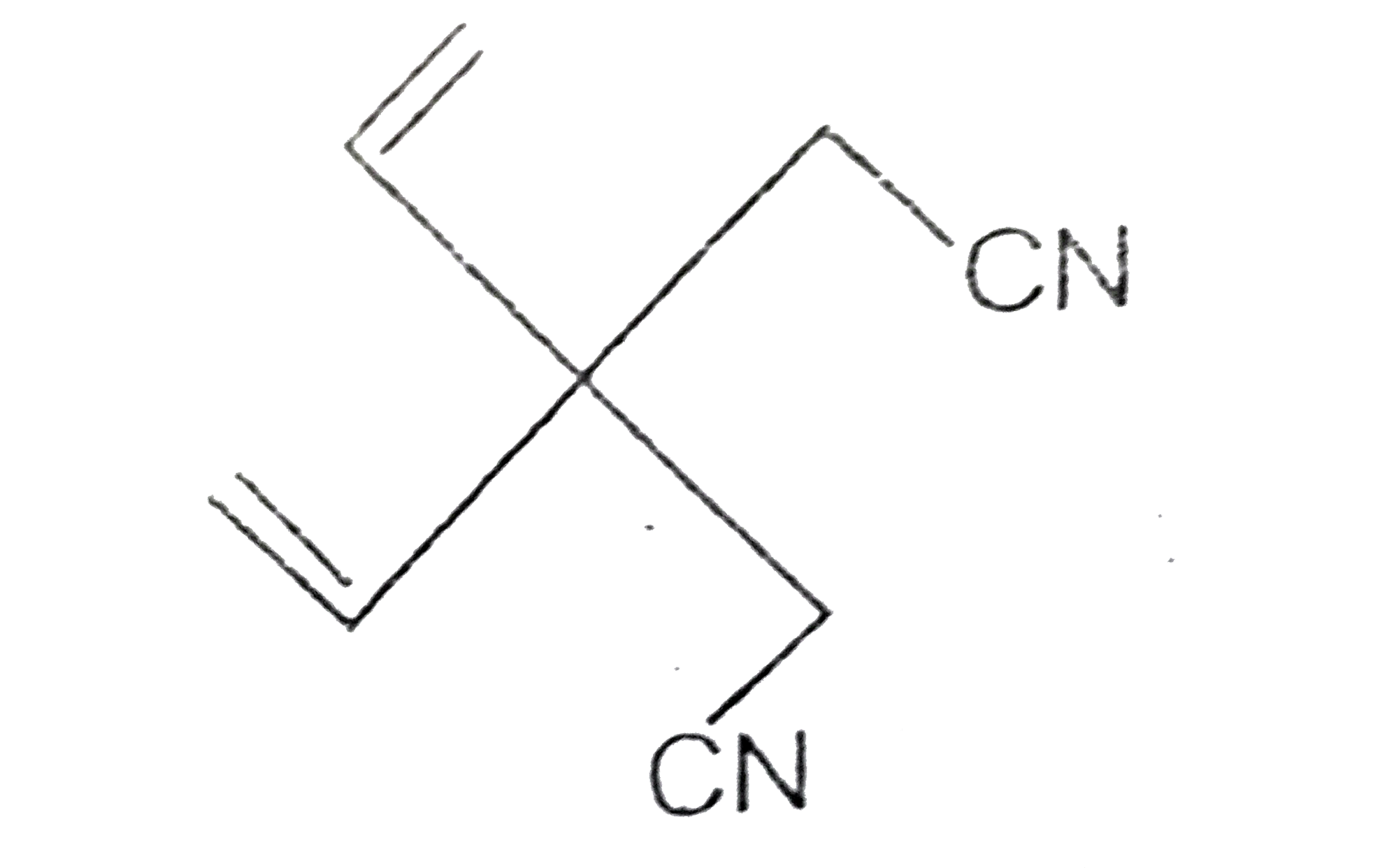
Write the IUPAC name of the following compound

A

3,3-Diethenyl pentane 1,5-dinitrile

B

3, ethyenyl,3-ethyl pentane 1,5-dinirile

C

3,3-diethenyl pentane 1,5-dicyanide

D

None of these

Text Solution

Verified by Experts

The correct Answer is:

A
Promotional Banner

Topper's Solved these Questions

  • ORGANIC CHEMISTRY: SOME BASIC PRINCIPLE AND TECHNIQUES

    AAKASH INSTITUTE ENGLISH|Exercise SECTION-E ASSERTION-REASON TYPE QUESTIONS|14 Videos
  • ORGANIC CHEMISTRY: SOME BASIC PRINCIPLE AND TECHNIQUES

    AAKASH INSTITUTE ENGLISH|Exercise SECTION-F MATRIX-MATCH TYPE QUESTIONS|4 Videos
  • ORGANIC CHEMISTRY: SOME BASIC PRINCIPLE AND TECHNIQUES

    AAKASH INSTITUTE ENGLISH|Exercise SECTION-C OBJECTIVE TYPE QUESTION (MORE THAN ONE OPTIONS ARE CORRECT)|18 Videos
  • ORGANIC CHEMISTRY : SOME BASIC PRINCIPLES AND TECHNIQUES

    AAKASH INSTITUTE ENGLISH|Exercise Assignment(Section-D)(Assertion - Reason Type Questions)|15 Videos
  • POLYMERS

    AAKASH INSTITUTE ENGLISH|Exercise ASSIGNMENT (SECTION-D)|13 Videos

Similar Questions

Explore conceptually related problems

Assertion : IUPAC name of compound CH_(3)CH=CH-CHO is but-2-enal. Reason : Functional group gets preference over multiple bond in the IUPAC name of a compound.

Explain the term - Nomenclature'. State its need with reference to organic compounds. State the basic rules of Nomenclature by the trivial system - with suitable examples. Explain the longest chain rule and the smallest number for functional groups rule of Nomenclature by the IUPAC system-with suitable examples.

Write the IUPAC name and condensed formula of the following compounds whose bond line structures are given as folllows: (a)

The IUPAC name of [Co(H_2NCH_2CH_2NH_2)_2 (NO_2)NO_5 is bis(enthane-1,2-diamine) dinitrito-N-cobalt(III) nitrate.It follows the following rules that. (a)Cation is named first followed by anion. (b) Ligands are named in an alphabetical order before the name of the central atom/ion. ( c)Name of anionic ligands end in "o" (ex.chlorido) those of neutral (and if cation) ligands are the same except aqua for H_2O , ammine for NH_3 etc. (d)Prefixes mono,di,tri,etc.are used to indicate the number of individual ligand.When the name of the ligands include a numerical prefix, then terms bis, tris, tetrakis are used. (e)Oxidation state of the metal is indicated by Roman numeral in parenthesis. (f) For cationic and neutral complexes, the metal is named same as the element and for anionic complex, the name of metal ends with suffix-ate.For some metals, the Latin names are used in the complex anions , e.g., ferrate for Fe, argentate for silver etc. The correct IUPAC name of the coordination compound [Pt(NH_3)_2Cl(NH_2CH_3)] is :

For the C_3H_4 (one triple bond) compound, write structural formulae and IUPAC names for all possible isomers having the number of double or triple bond as indicated:

The IUPAC name of [Co(H_2NCH_2CH_2NH_2)_2 (NO_2)NO_5 is bis(enthane-1,2-diamine) dinitrito-N-cobalt(III) nitrate.It follows the following rules that. (a)Cation is named first followed by anion. (b) Ligands are named in an alphabetical order before the name of the central atom/ion. ( c)Name of anionic ligands end in "o" (ex.chlorido) those of neutral (and if cation) ligands are the same except aqua for H_2O , ammine for NH_3 etc. (d)Prefixes mono,di,tri,etc.are used to indicate the number of individual ligand.When the name of the ligands include a numerical prefix, then terms bis, tris, tetrakis are used. (e)Oxidation state of the metal is indicated by Roman numeral in parenthesis. (f) For cationic and neutral complexes, the metal is named same as the element and for anionic complex, the name of metal ends with suffix-ate.For some metals, the Latin names are used in the complex anions , e.g., ferrate for Fe, argentate for silver etc. The IUPAC name of Fe_4[Fe(CN)_6]_3 is :

Read the given passage and answer the questions number 1 to 5 that follow: The substitution reaction of alkyl halide mainly occurs by S_N 1 and S_N 2 mechanism. Whatever mechanism alkyl halides follow for the substitution reaction to occur, the polarity of the carbon halogen bond is responsible for these substitution reactions. The rate of S_N 1 reactions are governed by the stability of carbocation whereas for S_N 2 reactions steric factor is the deciding factor. If the starting material is a chiral compound, we may end up with an inverted product or racemic mixture depending upon the type of mechanism followed by alkyl halide. Cleavage of ethers with HI also governed by steric factor and stability of carbocation, which indicates that in organic chemistry, these two major factors help us in deciding the kind of product formed 1. Predict the stereochemistry of the product formed if an optically active alkyl halide undergoes substitution reaction by S_N 1 mechanism. 2. Name the instrument used for measuring the angle by which the plane polarised light is rotated. 3. Predict the major product formed when 2-Bromopentane reacts with alcoholic KOH. 4. Give one use of CHI_3 5. Write the structures of the products formed when anisole is treated with HI.

For the following compounds, write structural formulas and IUPAC names for all possible isomers having the number of double or triple bond as indicated: (a) C_(4)H_(8) (one double bond) (b) C_(5)H_(8) (one triple bond)

(a) Write the IUPAC name of the compound (A) whose bond line structre is (b) Write the condensed formula of the compound (A). (c) Define and identify all the primary (1^(@)) , secondary (2^(@)) , tertiary (3^(@)) , and quaternary (4^(@)) carbon atoms. (d) Identify all the 1^(@), 2^(@) , and 3^(@) H atoms. (e) Given the number of H atoms bonded to 1^(@), 2^(@), 3^(@) , and 4^(@) C atom in an alkane. (f) Given the number of C atoms bonded to 1^(@), 2^(@), 3^(@) , and 4^(@) C atoms bonded to 1^(@), 2^(@), 3^(@) , and 4^(@) C atom in an alkane.
