Home
Class 12
CHEMISTRY
S(N)1 is observed in...

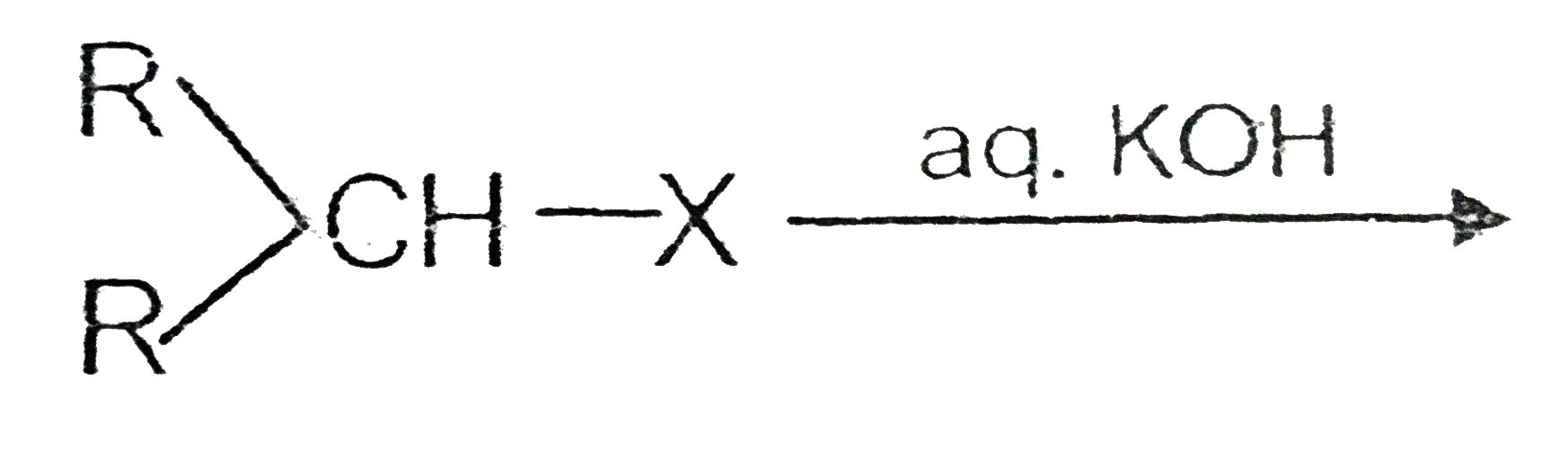
`S_(N)1` is observed in

A

B

`R- OH+ SOCl_(2) to `

C

`R - X overset(alc . KOH)(to)`

D

`ROH + HX to `

Text Solution

Verified by Experts

The correct Answer is:

A

NA
Promotional Banner

Similar Questions

Explore conceptually related problems

As shown in the figure two sources producing sound Sr and Sn (velocity of sound 360 m/sec) each producing sound of frequency 200 Hz. S_(1) is rotating anti clock wise where as S_n is approaching observer O each with a speed 10 m/sec. (neglect radius of circular path of S_1 ), then calculate If wind is blowing from right to left with a speed 10 m/sec and observer is at rest find the number of beats received by observer when S_(1) is at A. (nearly)

Consider a source of sound S , and an observer P . The source emits sound of frequency N_(0) . The frequency observed by P is found to be N_(1) if P approaches S at a speed v and S is stationary; N_(2) if S approaches P at a speed v and P is stationary and N_(3) if each of P and S has speed v/2 towards one another ​

Two different sound sources s_(1) and s_(2) have frequencies ratio 1:2. Source s, is approaching towards an observer and s_(2) is receding from the same observer. Speeds of both s_(1) and s_(2) are the same and equal to v. speed of sound in air in 300 m/s. If no beats are heard by the observer the value of V is 1

A vehicle , with a horn of frequency n is moving with a velocity of 30 m//s in a direction prependicular to the straight line joining the observer and the vehicle . The observer perceives the sound to have a grequency (n + n_(1)) . If the sound velocity in air is 330 m//s , then

A vehicle, with a horn of frequency n is moving with a velocity of 30 m/s in a direction perpendicular to the straight line joining the observer and the vehicle. The observer perceives the sound to have a frequency n + n_(1) . Then (if the sound velocity in air is 300 m/s)

What is an S_(N^1) mechanism ? Give an example of a reaction following an S_(N^1) mechanism and explain why the mechanism is considered to be S_(N^1) .

In a series of 2n observations, half of them equal a end remaining half equal -a. If the S.D. of the observationsis 2, then |a| equals (1) 1/n (2) sqrt2 (3) 2 (4) sqrt2/n

Let S_(1),S_(2),S_(3) , …. Are squares such that for each nge1, The length of the side of S_(n) is equal to length of diagonal of S_(n+1) . If the length of the side S_(1) is 10 cm then for what value of n, the area of S_(n) is less than 1 sq.cm.
