Home
Class 12
PHYSICS
A particle starting from rest moves alon...

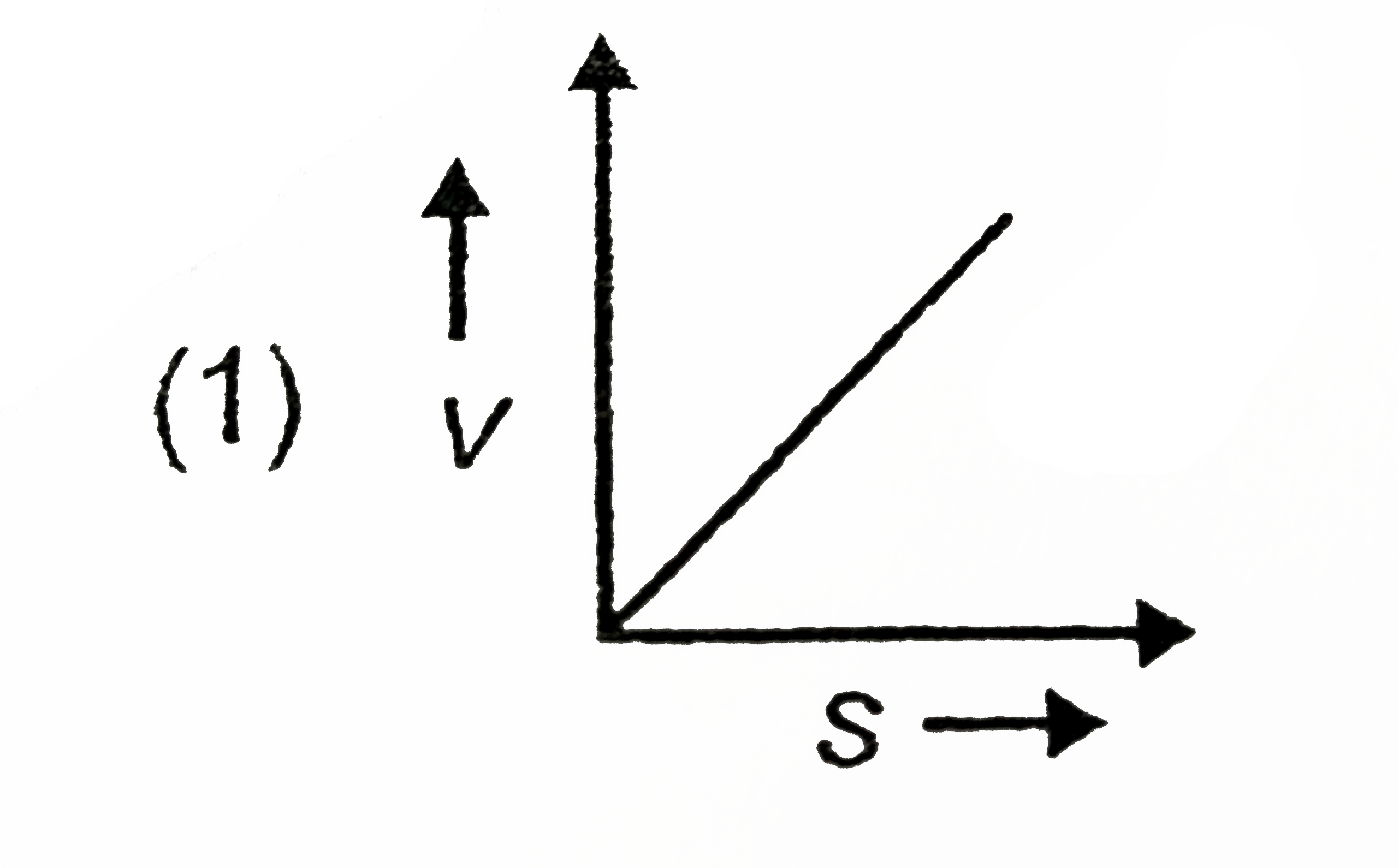
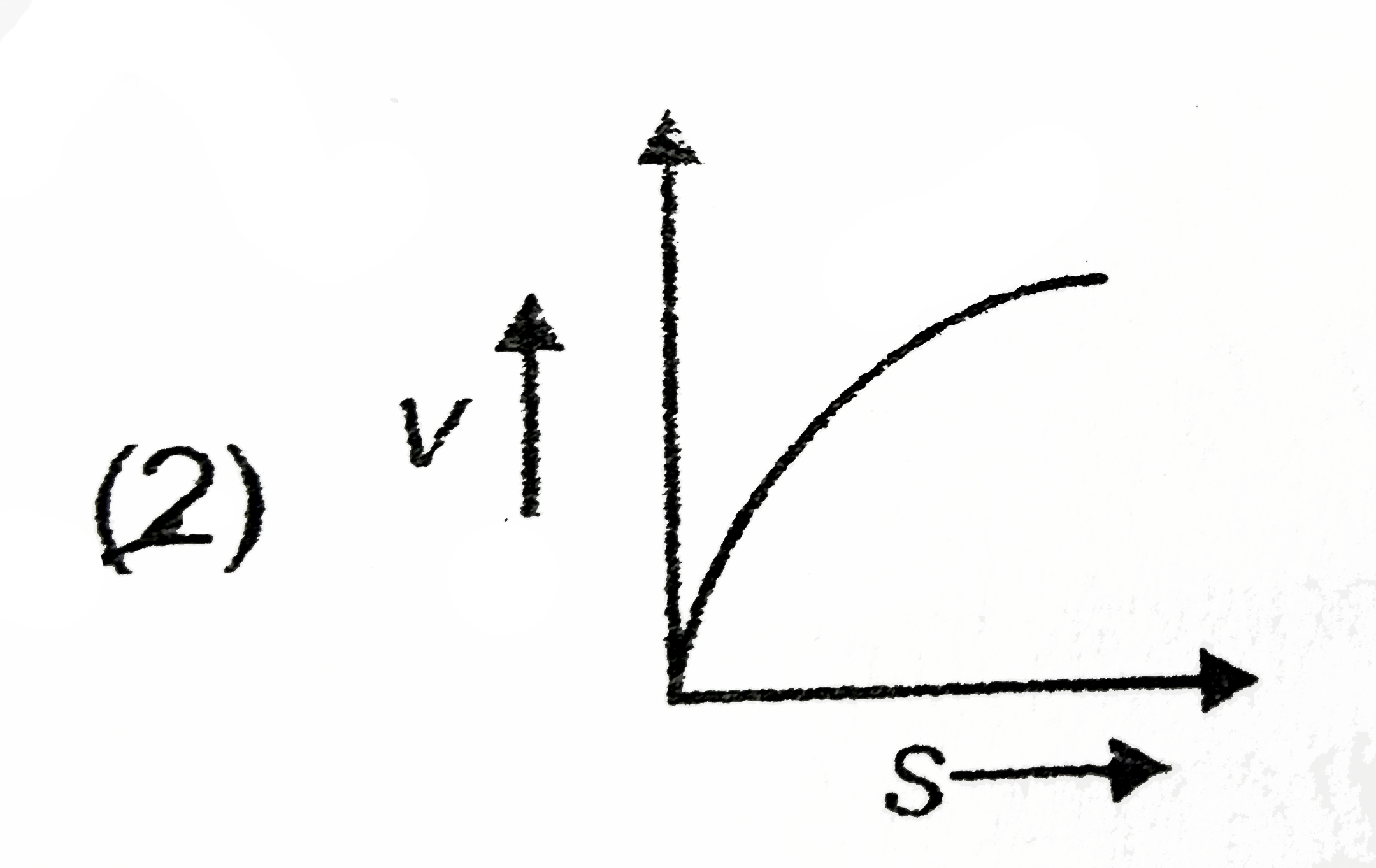
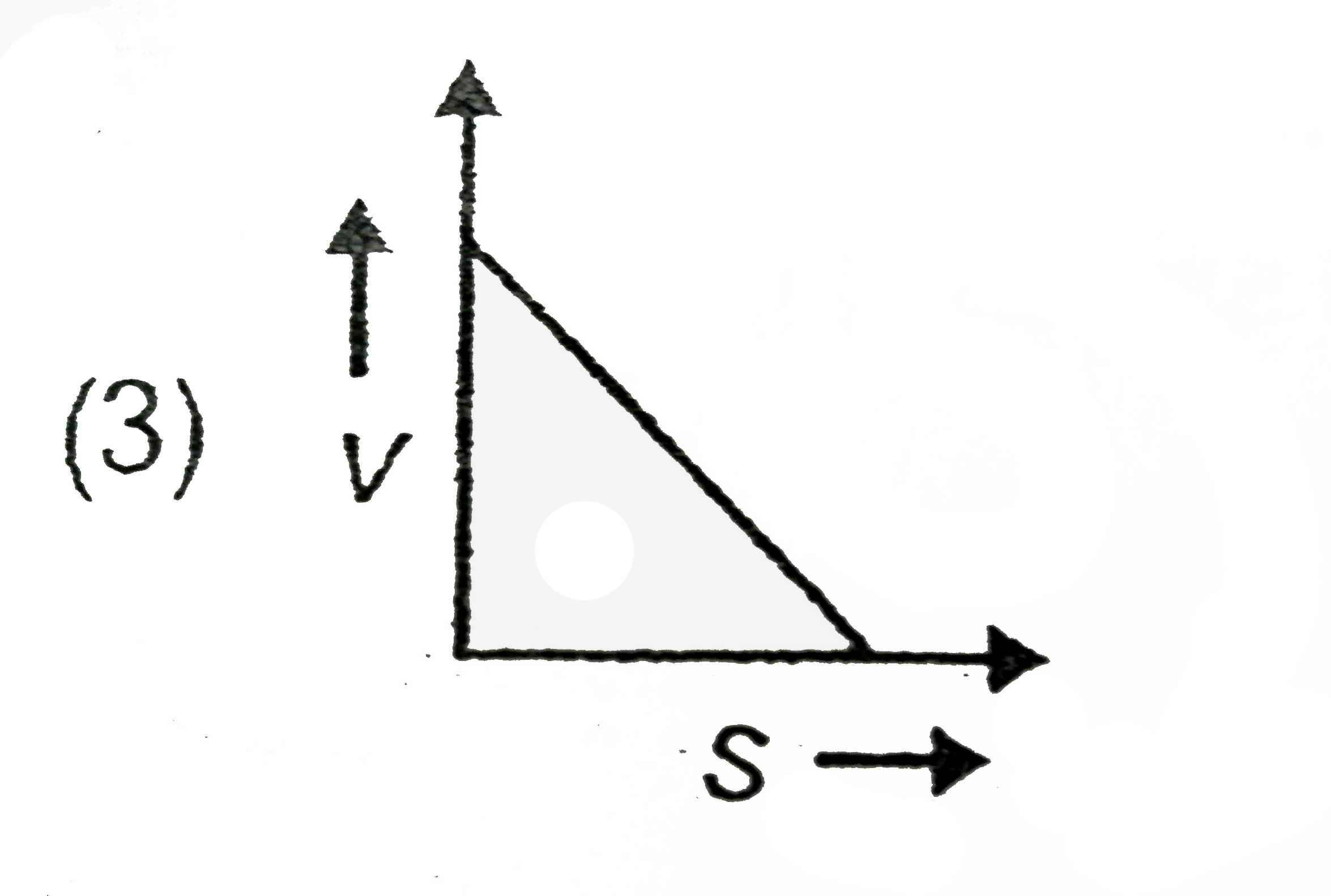
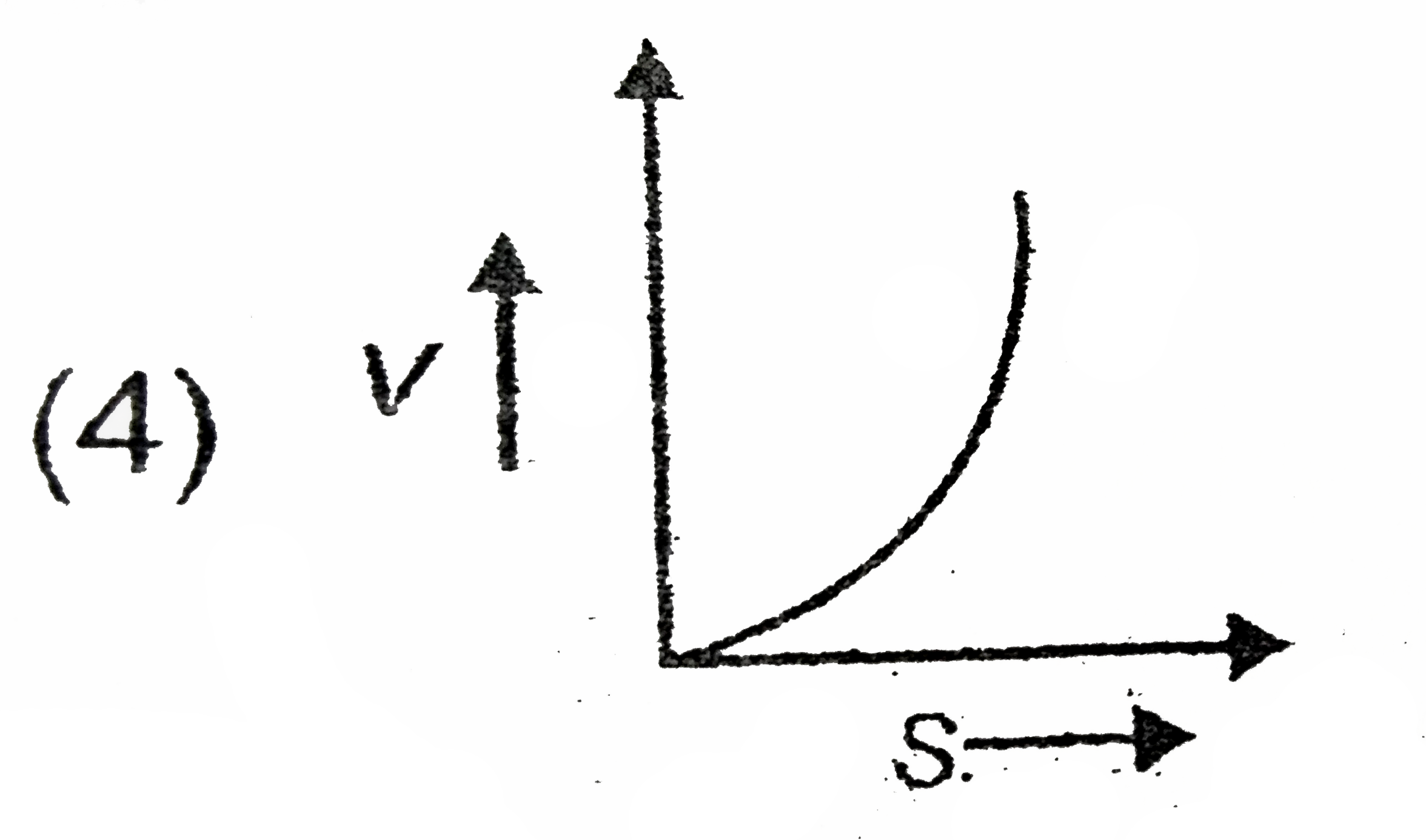
A particle starting from rest moves along a straight line with constant acceleration for this velocity displacement graph will have the form-

A

B

C

D

Text Solution

AI Generated Solution

The correct Answer is:

To solve the problem of determining the form of the velocity-displacement graph for a particle starting from rest and moving with constant acceleration, we can follow these steps: ### Step 1: Understand the given conditions The particle starts from rest, which means its initial velocity (u) is 0. It moves with constant acceleration (a). **Hint:** Remember that "starting from rest" means the initial velocity is zero. ### Step 2: Use the kinematic equation For a particle moving with constant acceleration, we can use the kinematic equation that relates velocity (v), initial velocity (u), acceleration (a), and displacement (s): \[ v^2 = u^2 + 2as \] Since the initial velocity \( u = 0 \), the equation simplifies to: \[ v^2 = 2as \] **Hint:** Identify the variables in the equation: \( v \) is the final velocity, \( a \) is acceleration, and \( s \) is displacement. ### Step 3: Rearranging the equation From the equation \( v^2 = 2as \), we can express \( s \) in terms of \( v \): \[ s = \frac{v^2}{2a} \] This shows that displacement \( s \) is proportional to the square of the velocity \( v^2 \). **Hint:** Look for the relationship between \( s \) and \( v \) to determine the shape of the graph. ### Step 4: Identify the type of graph The equation \( s = \frac{1}{2a} v^2 \) indicates that \( s \) is proportional to \( v^2 \). This means that if we plot \( v^2 \) on the y-axis against \( s \) on the x-axis, we will get a straight line. However, if we plot \( v \) against \( s \), the graph will be parabolic because \( s \) is proportional to \( v^2 \). **Hint:** Consider how the graph would look if you plotted \( v \) against \( s \) based on the relationship derived. ### Step 5: Conclusion Since the velocity \( v \) is related to the displacement \( s \) by a quadratic relationship, the velocity-displacement graph will be parabolic. Thus, the correct answer is that the velocity-displacement graph will have the form of a **parabola**. **Final Answer:** The velocity-displacement graph will be parabolic. ---
Promotional Banner

Topper's Solved these Questions

  • MOTION IN STRAIGHT LINE

    AAKASH INSTITUTE ENGLISH|Exercise Assignment (SECTION - B)|19 Videos
  • MOTION IN STRAIGHT LINE

    AAKASH INSTITUTE ENGLISH|Exercise Assignment (SECTION - C)|7 Videos
  • MOTION IN STRAIGHT LINE

    AAKASH INSTITUTE ENGLISH|Exercise Try Yourself|40 Videos
  • MOTION IN A STRAIGHT LINE

    AAKASH INSTITUTE ENGLISH|Exercise ASSIGNMENT (SECTION - D)|15 Videos
  • MOVING CHARGE AND MAGNESIUM

    AAKASH INSTITUTE ENGLISH|Exercise SECTION D|16 Videos

Similar Questions

Explore conceptually related problems

A body starting from rest moves along a straight line with a constant acceleration. The variation of speed (v) with distance (s) is represented by the graph:

A particle starts from rest and moves with constant acceleration. Then velocity displacement curve is:

A particle starting from rest moves in a straight line with acceleration as shown in the a-t graph. Find the distance (in m) travelled by the particle in the first four seconds from start of its motion. Q

A particle starts from origin and moves on a straight line path with an acceleration proportional to square of its displacement.Kinetic energy during displacement x will be

A particle starts from rest at t=0 and moves in a straight line with an acceleration as shown below. The velocity of the particle at t=3 s is

A particle starts motion from rest and moves along a straight line. Its acceleration-time graph is shown. Find out speed of particle at t=2s and at t=3s.

A particle is moving along a straight line with constant acceleration. At the end of tenth second its velocity becomes 20 m//s and tenth second it travels a distance od 10 m . Then the acceleration of the particle will be.

The velocity - displacement graph of a particle moving along a straight line is shown The most suitable acceleration - displacement graph will be

Figure shows acceleration versus time graph of a particle starting from rest and moving along a straight line. Which of the following staement (s) is/are correct ?

A particle starts from point A moves along a straight line path with an acceleration given by a = p - qx where p, q are connected and x is distance from point A . The particle stops at point B. The maximum velocity of the particle is

AAKASH INSTITUTE ENGLISH-MOTION IN STRAIGHT LINE-Assignment (SECTION - A)
  1. The displacement of a body is given by s=(1)/(2)g t^(2) where g is acc...

    Text Solution

    |

  2. A particle moves along with X-axis. The position x of particle with re...

    Text Solution

    |

  3. A ball of mass is thrown vertically upwards by applying a force by h...

    Text Solution

    |

  4. Which of the following x-t graphs represents the distance-time variati...

    Text Solution

    |

  5. A particle starting from rest moves along a straight line with constan...

    Text Solution

    |

  6. A ball falls freely from rest. The ratio of the distance travelled in ...

    Text Solution

    |

  7. A ball is thrown vertically upward attains a maximum height of 45 m. T...

    Text Solution

    |

  8. A car travelling with a velocity of 80 km/h slowed down to 44 km/h in ...

    Text Solution

    |

  9. The distance covered by a moving body is directly proportional to the ...

    Text Solution

    |

  10. A person driving a car with a speed 72 km/h suddenly sees a boy crossi...

    Text Solution

    |

  11. Which of the following is correct expression for the stopping distance...

    Text Solution

    |

  12. Which of the following shows the correct expression of height d time t...

    Text Solution

    |

  13. A stone dropped from the top of a tower reaches the ground in 3 s. The...

    Text Solution

    |

  14. Two cars are moving is one a same line dimension in opposite direction...

    Text Solution

    |

  15. Two objects A and B are moving in opposite directions with velocities ...

    Text Solution

    |

  16. Two objects A and B are moving with velocities v(A) and v(B) respectiv...

    Text Solution

    |

  17. The relative velocity of two objects A and B is 10 m/s. If the velocit...

    Text Solution

    |

  18. Two train are moving in a straight line in the same direction with a s...

    Text Solution

    |

  19. Which one of the following represents displacement-time graph of two o...

    Text Solution

    |

  20. Two objects A and B are moving with velocities v(A) and v(B) respectiv...

    Text Solution

    |
