Text Solution
Verified by Experts



Topper's Solved these Questions
WORK, ENERGY AND POWER
AAKASH INSTITUTE ENGLISH|Exercise EXERCISE|37 VideosWORK, ENERGY AND POWER
AAKASH INSTITUTE ENGLISH|Exercise Assignment (SECTION - A)|64 VideosWORK, ENERGY AND POWER
AAKASH INSTITUTE ENGLISH|Exercise SECTION-I (SUBJECTIVE TYPE QUESTIONS)|6 VideosWAVES
AAKASH INSTITUTE ENGLISH|Exercise ASSIGNMENT ( SECTION-D ( Assertion - Reason Type Questions ))|12 Videos
Similar Questions
Explore conceptually related problems
AAKASH INSTITUTE ENGLISH-WORK, ENERGY AND POWER-SECTION-J (AAKASH CHALLENGERS QUESTIONS)
- Rain drops each of mass m falling from rest in air experience an upwar...
Text Solution
|
- A particle is moved foom the orgin A, back to the origin, along the pa...
Text Solution
|
- Three particeles each of mass m are converted by three identical spein...
Text Solution
|
- In a simple pendulum, the breaking strength of the string is double th...
Text Solution
|
- A smooth ring of mass m1 connected with a hanging block of mass m2, by...
Text Solution
|
- A block is projected with a speed v(0) strikes the point pf projection...
Text Solution
|
- A block of mass m is released from rest onto a spring. A having stiffn...
Text Solution
|
- Two beads of masses m(1) and m(2) connected by an inextensible string ...
Text Solution
|
- A partical of mass m attached with a massless spring of natural length...
Text Solution
|
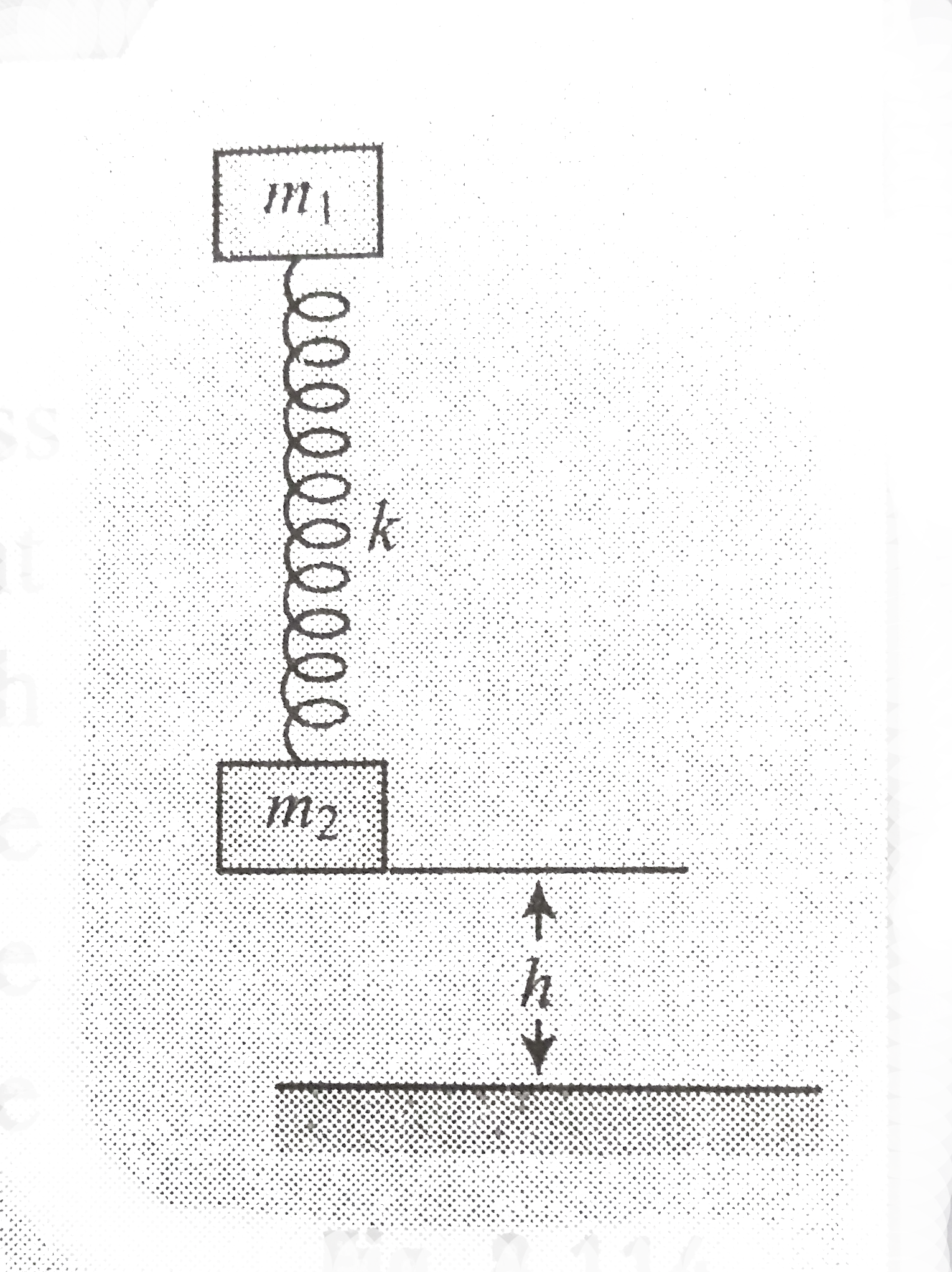
- A spring-mass system ( m1 + massless spring + m2) fall freely from a h...
Text Solution
|
- A smooth sledge is moving with constant velocity v(0) toward left. A b...
Text Solution
|
- A prismatic block of mass m is lifted through a distanced along the sl...
Text Solution
|
- Discuss the stability of an atom in a molecule possessing Lennard-jone...
Text Solution
|
- A pendulum bob swing from the point P when the ideal string of length ...
Text Solution
|