Home
Class 12
PHYSICS
An arrangement of two blocks placed one ...

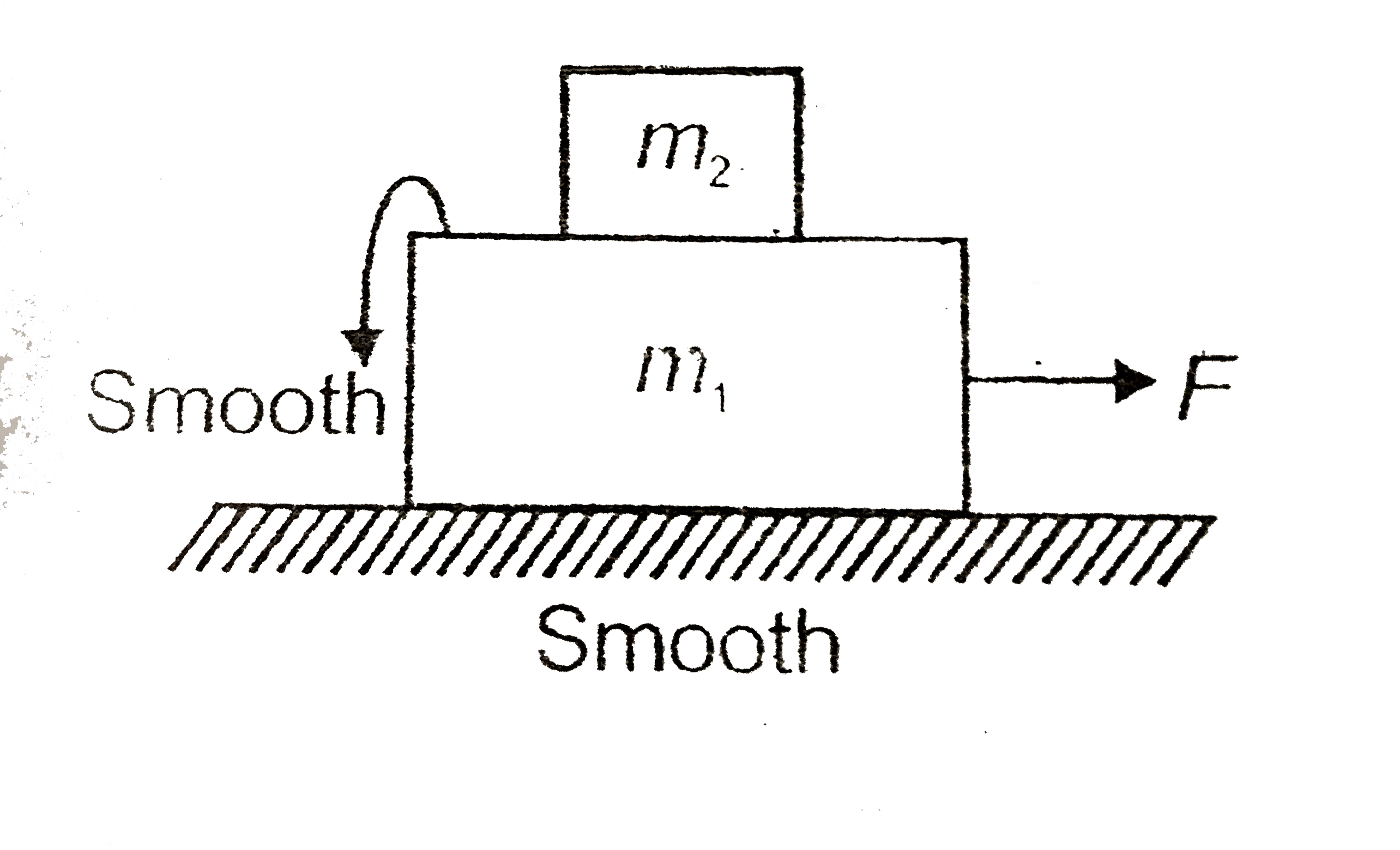
An arrangement of two blocks placed one above the other is shown. There is no fricition any where. A horizontal force `F` acts on one of the blocks as shown. It is required to calculate the acceleration of centre of mass.

Text Solution

Verified by Experts
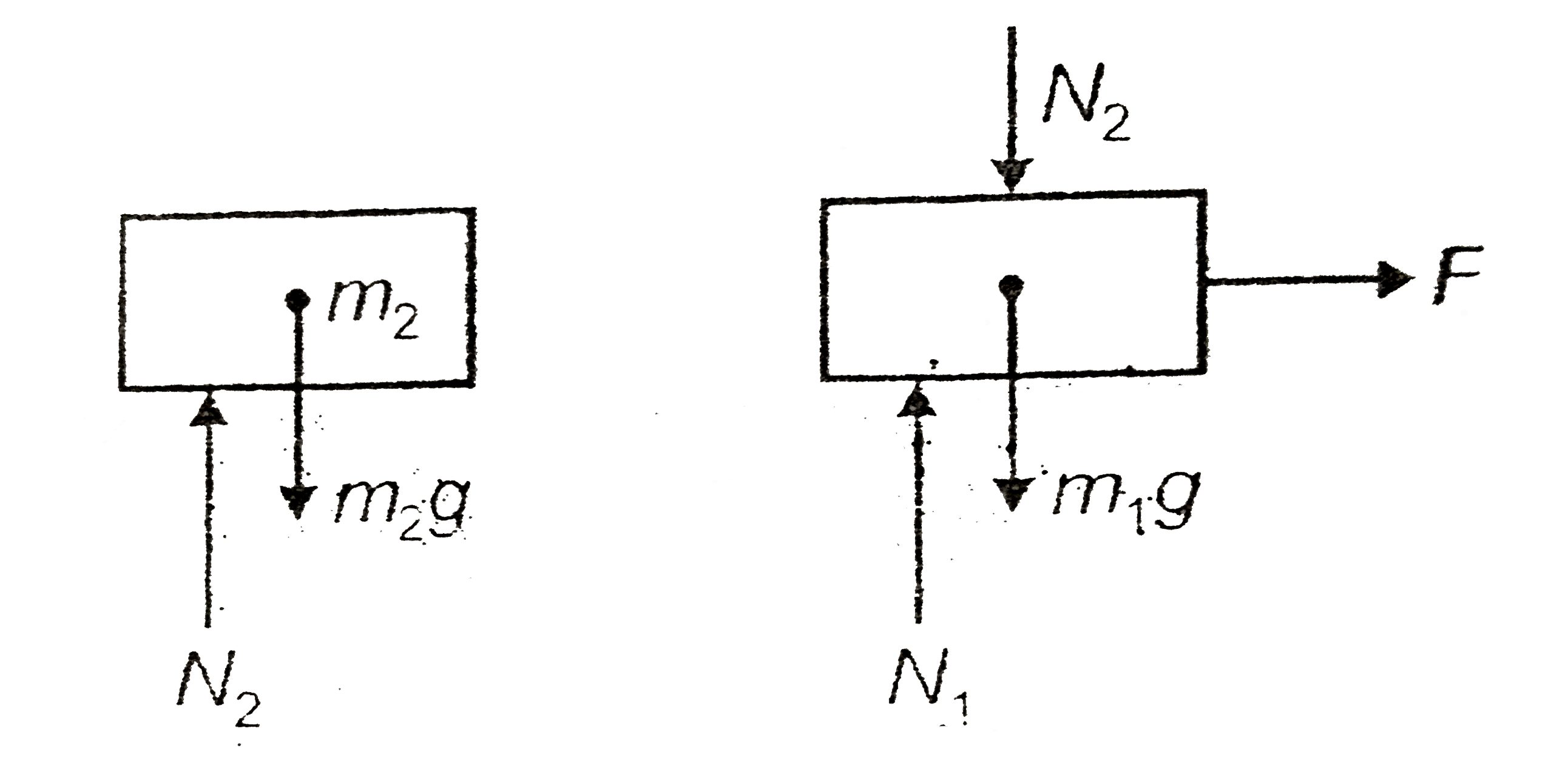
Method-1 : The FBDs of two blocks in ground's frame are shown.

For `m_(2)`, `a_(2)=0`, `N_(2)=m_(2)g`
For `m_(1)`, `a_(1)=(F)/(m_(1))`, `N_(2)+m_(1)g=N_(1)`
`impliesN_(1)=(m_(1)+m_(2))g`
Now, `a_(CM)=(m_(1)a_(1)+m_(2)a_(2))/(m_(1)+m_(2))=(m_(1)xx(F)/(m_(1))+0)/(m_(1)+m_(2))`
`=(F)/(m_(1)+m_(2))`
Method-2 :
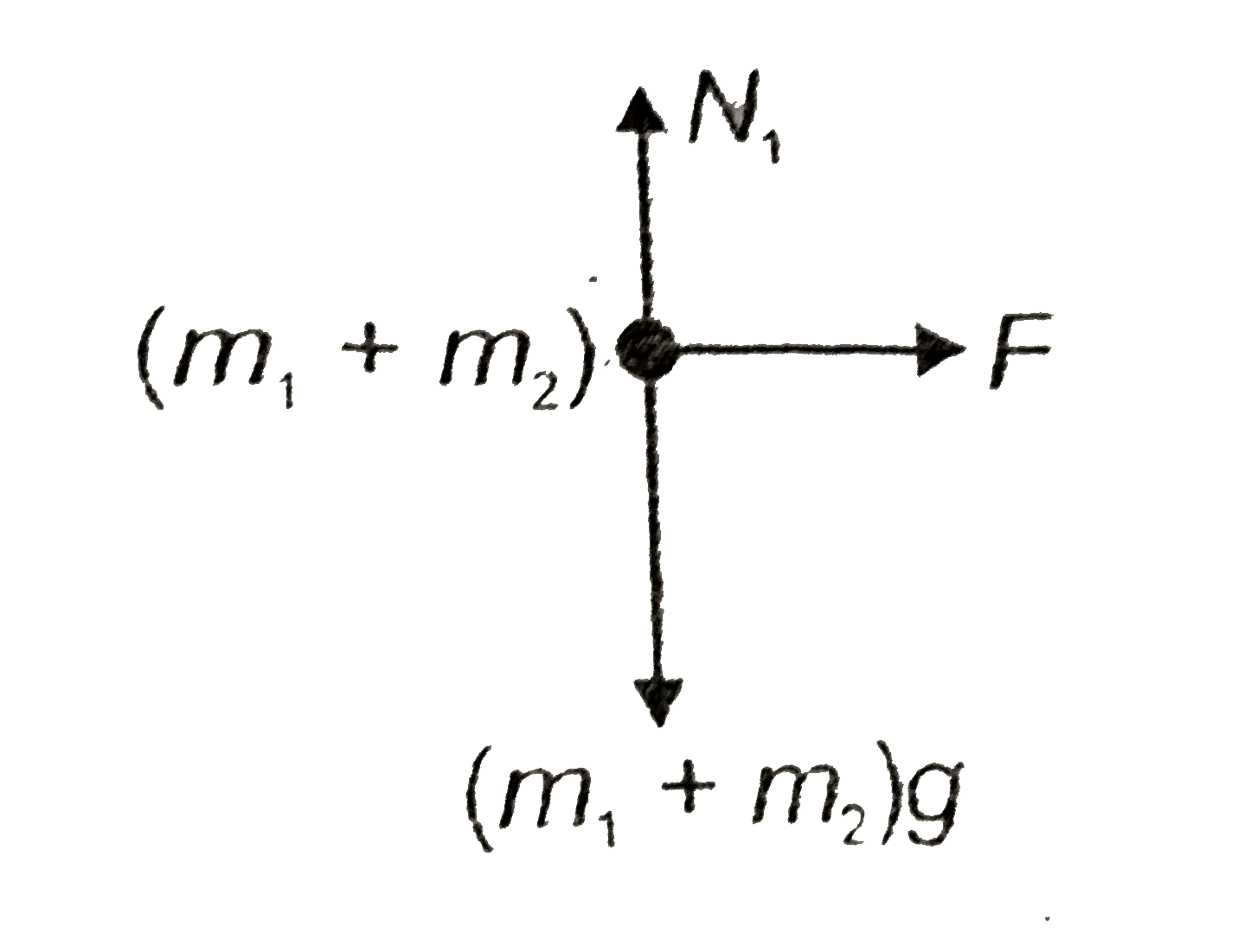
By definition of centre of mass, the total mass of the system `m_(1)+m_(2)` is situated at a point and the external forces are acting on it. The FBD of centre of mass is shown. Net force in vertical direction is zero.

`impliesN_(1)=(m_(1)+m_(2))g`
and `a_(CM)=(F)/(m_(1)+m_(2))`
Promotional Banner

Topper's Solved these Questions

  • SYSTEM OF PARTICLES AND ROTATIONAL MOTION

    AAKASH INSTITUTE ENGLISH|Exercise Illustration|4 Videos
  • SYSTEM OF PARTICLES AND ROTATIONAL MOTION

    AAKASH INSTITUTE ENGLISH|Exercise Assignment (Section - A) Objective Type Questions (One option is correct)|62 Videos
  • SEMICONDUCTOR ELECTRONICS: MATERIALS, DEVICES AND SIMPLE CIRCUITS

    AAKASH INSTITUTE ENGLISH|Exercise Assignment (Section-D (Assertion and reason))|5 Videos
  • TEST 1

    AAKASH INSTITUTE ENGLISH|Exercise EXERCISE|21 Videos

Similar Questions

Explore conceptually related problems

Minimum horizontal force (F) required to move the block shown in diagram is__

Two blocks of masses m_(1) and m_(2) are connected by an ideal sprit, of force constant k . The blocks are placed on smooth horizontal surface. A horizontal force F acts on the block m_(1) . Initially spring is relaxed, both the blocks are at rest. What is acceleration of centre of mass of system at the instant of maximum elongation of spring

Two blocks A and B of masses 2kg and 4kg are placed one over the other as shown in figure. A time varying horizontal force F =2t is applied on the upper block as shown in figure. Here t is in second and F is in newton. Drow a graph showing acceleration of A and B on y-axis and time on x-axis.Coefficient of friction between A and B is mu =(1)/(2) and the horizontal surface over which B is placed smooth. (g =10m//s^(2))

A small block B of mass m_2 is placed on another block A of mass m_1 A constant horizontal force F is applied to the block A. All the surfaces are assumed to be frictionless. Find the acceleration of center of mass of the system

A block is placed on a rough horizontal plane. Three horizontalforces are applied on the block as shown in the figure. If the block is in equilibrium, find the friction force acting on the block.

A block is placed on a smooth inclined plane as shown . For what value of horizontal force F, the block will remain at rest ?

Blocks are in contact on a frictionless table. A horizontal force F=3N is applied to one block as shown. The force exerted by the smaller block m_(2) on block m_(1) is :

Four block are arranged on a smooth horizontal surface as shown in figure .The masses of the blocks are given (see the fig ) The coefficient of static friction between the top and the bottom blocks is mu_(s) What is the maximum value of the horizontal force F applied to one of the bottom blocks as shown that makes all four block with the same acceleration ?

A block of mass m is placed in contact with one end of a smooth tube of mass M. A horizontal force F acts on the tube in each case (i) and (ii). Then,

Two blocks of mass m and 2m are arranged on a wedge that is fixedd on a horizontal surface. Friction coefficient between the block and wedge are shown . Find the magnitude of acceleration of two blocks.

AAKASH INSTITUTE ENGLISH-SYSTEM OF PARTICLES AND ROTATIONAL MOTION-Try Yourself
  1. An arrangement of two blocks placed one above the other is shown. Ther...

    Text Solution

    |

  2. Two bodies of masses 1kg and 3kg are lying in xy plane at (0,0) and (2...

    Text Solution

    |

  3. Three point masses of 1kg, 2kg and 3kg lie at (0,0), (1,2), (3,-1) res...

    Text Solution

    |

  4. Three particles of masses m,m and 4kg are kept at a verticals of trian...

    Text Solution

    |

  5. Three particles having their masses in the ratio 1 : 3 : 5 are kept at...

    Text Solution

    |

  6. Centre of mass of the system lies inside disc or square plate and why ...

    Text Solution

    |

  7. Two particles of equal mass are moving along the same line with the sa...

    Text Solution

    |

  8. Two particles of equal mass are moving along the same straight line wi...

    Text Solution

    |

  9. A shell following a parabolic path explodes somewhere in its flight. T...

    Text Solution

    |

  10. All the particles are situated at a distance R from the origin. The di...

    Text Solution

    |

  11. Will the velocity and acceleration of centre of mass change if particl...

    Text Solution

    |

  12. vecA=(3hati+2hatj-6hatk) and vecB=(hati-2hatj+hatk), find the scalar p...

    Text Solution

    |

  13. vecA=(hati-2hatj+6hatk) and vecB=(hati-2hatj+hatk), find the cross pro...

    Text Solution

    |

  14. Find a unit vector in the direction of vector vecA=(hati-2hatj+hatk)

    Text Solution

    |

  15. Find a vector perpendicular to vector vecA=(hati+2hatj-3hatk) as well ...

    Text Solution

    |

  16. The angular displacement of a particle is 24 rad in 10 seconds. Calcul...

    Text Solution

    |

  17. The angular velocity of a rigid body is 24 rad s^(-1), Calculate the t...

    Text Solution

    |

  18. The angular velocity of circular disc of radius 2cm is 20 rad s^(-1). ...

    Text Solution

    |

  19. What is the angular velocity of a particle lying on the axis of rotati...

    Text Solution

    |

  20. What is the angular acceleration of a particle moving with constant an...

    Text Solution

    |

  21. A wheel is rotating with an angular velocity of 3 rad s^(-1). If the a...

    Text Solution

    |