Home
Class 12
PHYSICS
A disc shaped pulley of mass 'm'=4 kg an...

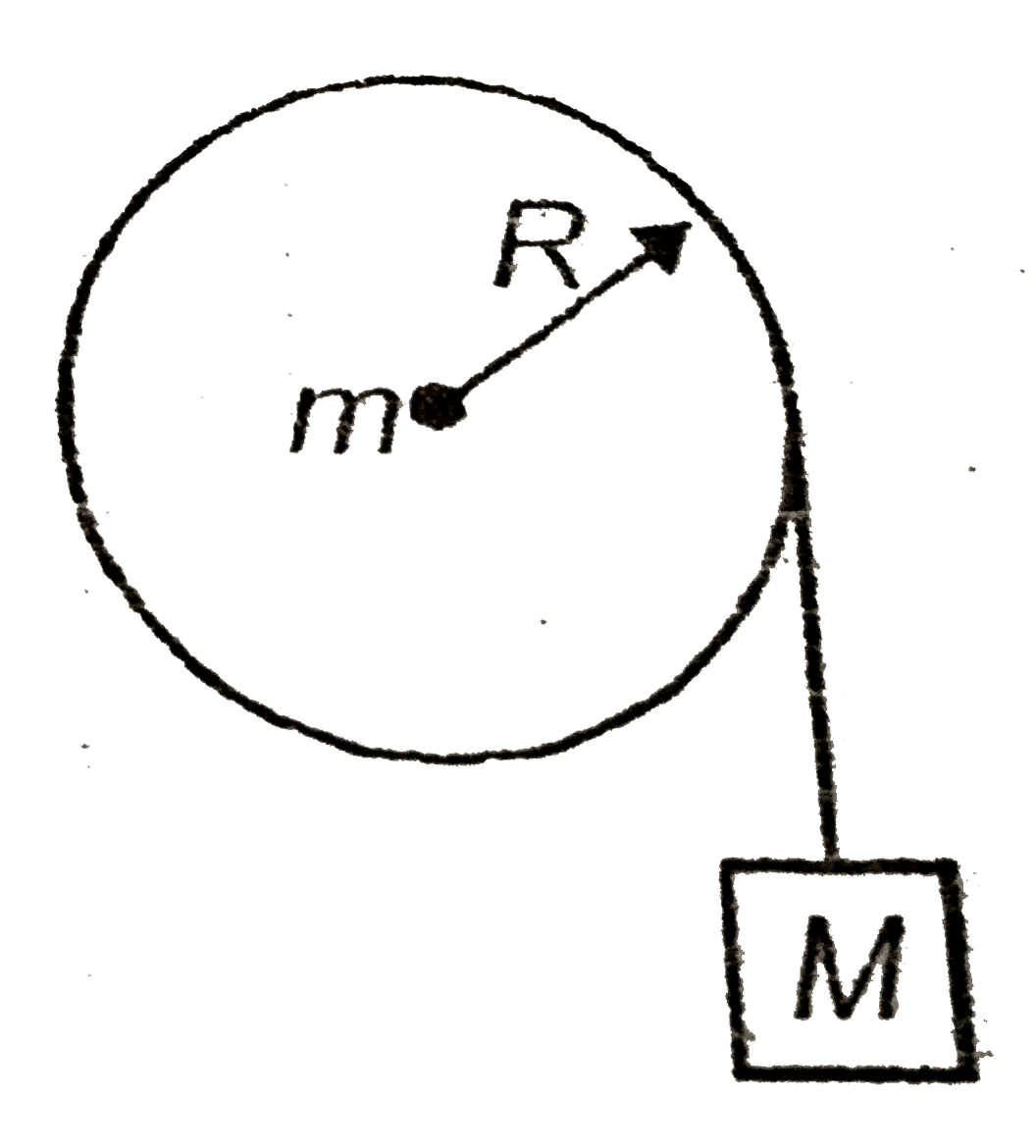
A disc shaped pulley of mass `'m'=4 kg` and radius `R=0.5m` can rotate freely about its center. A block of mass `M=2kg` hangs from the pulley through is massless string that is tightly wrapped around the pulley. When the system is released, there is no slipping between pulley and string.

`(a)` Calculate the angular accelerating of the pulley
`(b)` Calculate the tension in the string

Text Solution

Verified by Experts
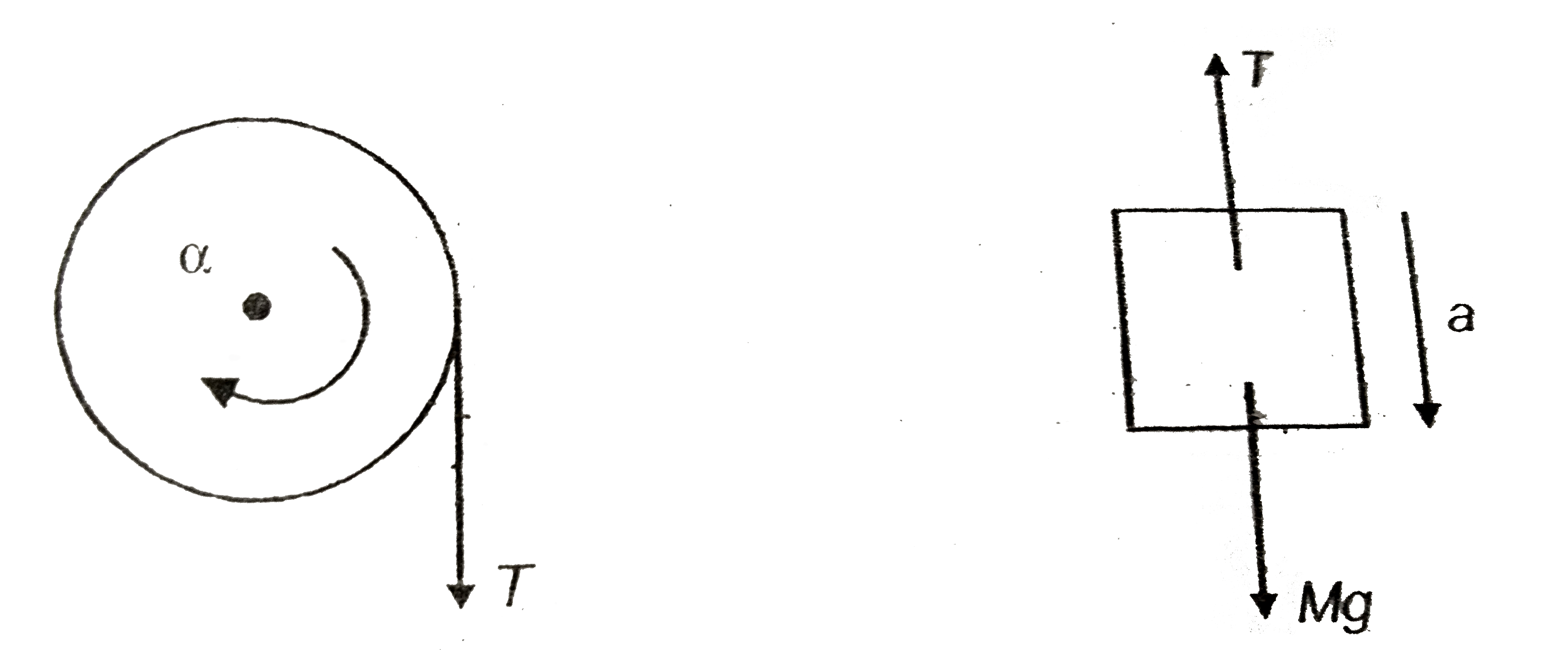
we choose the puley and mass as two separate systems and draw free body diagrams as shown.

Applying Newton's Second Law in translational form,
`Mg-T=Ma`……..`(1)` [For the block]
Applying Newton's Second Law in Rotational form,
`sumT_(cm)=l_(cm)*alphaimpliesTR=(mR^(2))/(2)alpha`........`(2)` [For the disc]
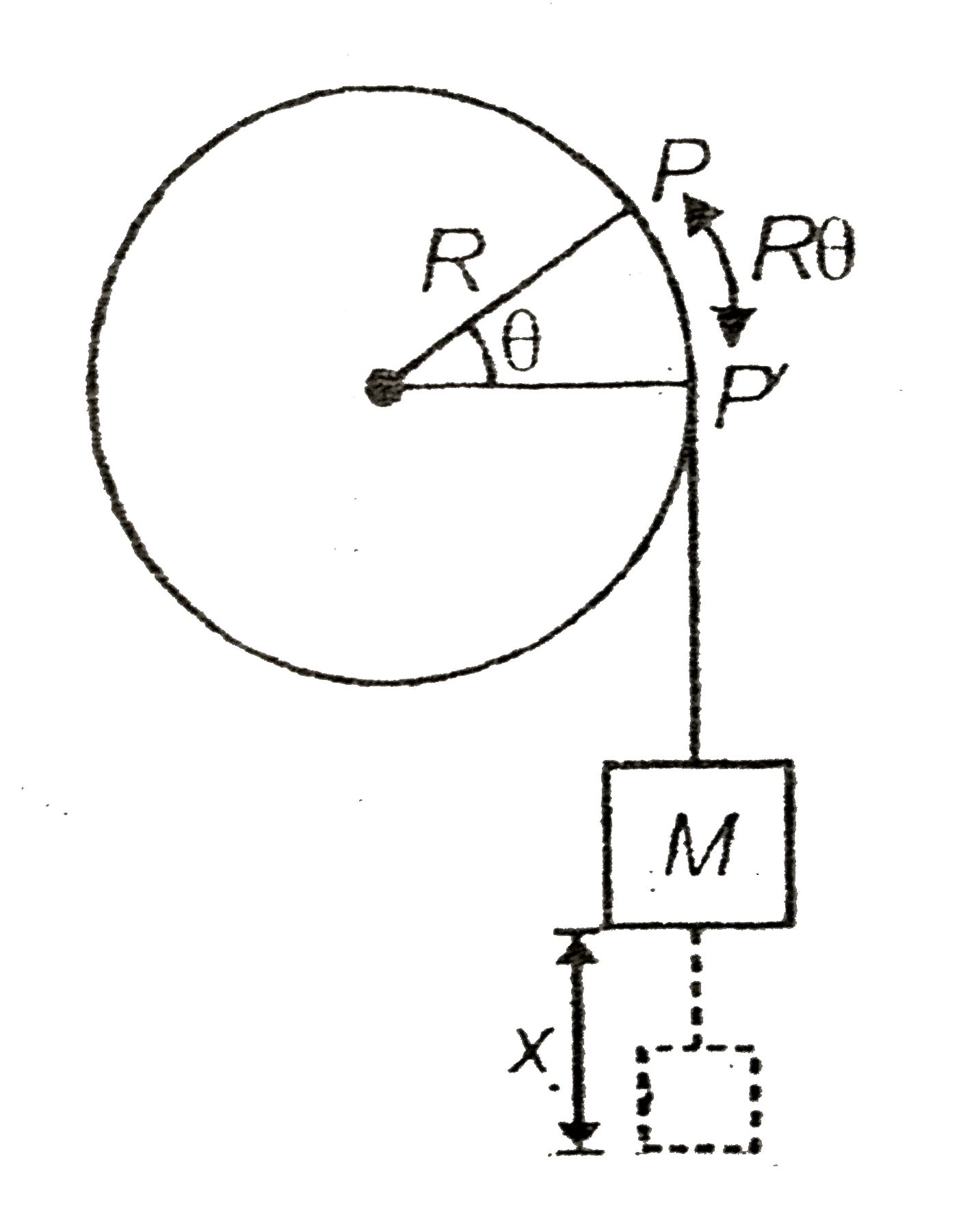
If point `P` on the pulley rotates by any angle `theta`, the block of mass `M` moves down by a distance `X`, such that `x=Rtheta`
Differentiating this equation twice we get
`(d^(2)x)/(dt^(2))=(Rd^(2))/(dt^(2))`
`a=R alpha`.........`(3)`
Using equations `(1)`, `(2)` and `(3)`, we get
`Mg-T=Ma`
and `T=(ma)/(2)`........`(4)`
Adding the two equations
`a=(Mg)/((M+(m)/(2)))`
`impliesa=(20)/(2+2)=5m//s^(2)`
`impliesalpha=(a)/(R )=(5)/(0.5)=10rad//s^(2)`
Tension `T=(ma)/(2)=5N` [from equation `(4)`]
Promotional Banner

Topper's Solved these Questions

  • SYSTEM OF PARTICLES AND ROTATIONAL MOTION

    AAKASH INSTITUTE ENGLISH|Exercise Illustration|4 Videos
  • SYSTEM OF PARTICLES AND ROTATIONAL MOTION

    AAKASH INSTITUTE ENGLISH|Exercise Assignment (Section - A) Objective Type Questions (One option is correct)|62 Videos
  • SEMICONDUCTOR ELECTRONICS: MATERIALS, DEVICES AND SIMPLE CIRCUITS

    AAKASH INSTITUTE ENGLISH|Exercise Assignment (Section-D (Assertion and reason))|5 Videos
  • TEST 1

    AAKASH INSTITUTE ENGLISH|Exercise EXERCISE|21 Videos

Similar Questions

Explore conceptually related problems

A uniform disc of mass M and radius R is mounted on a fixed horizontal axis. A block of mass m hangs from a massless string that is wrapped around the rim of the disc. The magnitude of the acceleration of the falling block (m) is

Two blocks of masses 6 kg and 4 kg are attached to the two ends of a massless string passing over a smooth fixed pulley. if the system is released, the acceleration of the centre of mass of the system will be

Two masses m_(1) and m_(2) are joined with the help of massless string passing over a pulley of Radius R and mass M . Assume that string doesn't slip over the pulley. Take m_(1)=10kg , m_(2)=5kg , M=10 kg , R=1m . (a) Calculate the acceleration of each book. (b) Calculate the tensions in the thread.

The time period of block of mass m is (Assume pulleys and string are massless) .

If the string & all the pulleys are ideal, acceleration of mass m is :-

Two bodies of masses 4 kg and 6 kg are tied to the ends of a massless string. The string passes over a frictionless pulley. The acceleration of the system is :

A pulley fixed to the ceiling carries a string with blocks of mass m and 3m attached to its ends. The masses of string and pulley are negligible .When the system is released, its center of mass moves with what acceleration

A thread is wound around two discs on either sides. The pulley and the two discs have the same mass and radius. There is no slipping at the pulley and no friction at the hinge. Find out the acceleration of the two discs and the angular acceleration of the pulley.

Two masses 5 kg and 3 kg are suspended from the ends of an unstretchable light string passing over a frictionless pulley. When the masses are released, the thrust on the pulley is (g = 10 ms^(-2) )

In the arrangement shown, the pulleys and strings are massless. The acceleration of block B is :

AAKASH INSTITUTE ENGLISH-SYSTEM OF PARTICLES AND ROTATIONAL MOTION-Try Yourself
  1. A disc shaped pulley of mass 'm'=4 kg and radius R=0.5m can rotate fre...

    Text Solution

    |

  2. Two bodies of masses 1kg and 3kg are lying in xy plane at (0,0) and (2...

    Text Solution

    |

  3. Three point masses of 1kg, 2kg and 3kg lie at (0,0), (1,2), (3,-1) res...

    Text Solution

    |

  4. Three particles of masses m,m and 4kg are kept at a verticals of trian...

    Text Solution

    |

  5. Three particles having their masses in the ratio 1 : 3 : 5 are kept at...

    Text Solution

    |

  6. Centre of mass of the system lies inside disc or square plate and why ...

    Text Solution

    |

  7. Two particles of equal mass are moving along the same line with the sa...

    Text Solution

    |

  8. Two particles of equal mass are moving along the same straight line wi...

    Text Solution

    |

  9. A shell following a parabolic path explodes somewhere in its flight. T...

    Text Solution

    |

  10. All the particles are situated at a distance R from the origin. The di...

    Text Solution

    |

  11. Will the velocity and acceleration of centre of mass change if particl...

    Text Solution

    |

  12. vecA=(3hati+2hatj-6hatk) and vecB=(hati-2hatj+hatk), find the scalar p...

    Text Solution

    |

  13. vecA=(hati-2hatj+6hatk) and vecB=(hati-2hatj+hatk), find the cross pro...

    Text Solution

    |

  14. Find a unit vector in the direction of vector vecA=(hati-2hatj+hatk)

    Text Solution

    |

  15. Find a vector perpendicular to vector vecA=(hati+2hatj-3hatk) as well ...

    Text Solution

    |

  16. The angular displacement of a particle is 24 rad in 10 seconds. Calcul...

    Text Solution

    |

  17. The angular velocity of a rigid body is 24 rad s^(-1), Calculate the t...

    Text Solution

    |

  18. The angular velocity of circular disc of radius 2cm is 20 rad s^(-1). ...

    Text Solution

    |

  19. What is the angular velocity of a particle lying on the axis of rotati...

    Text Solution

    |

  20. What is the angular acceleration of a particle moving with constant an...

    Text Solution

    |

  21. A wheel is rotating with an angular velocity of 3 rad s^(-1). If the a...

    Text Solution

    |