Home
Class 12
PHYSICS
A rod AB of mass M and length L is lying...

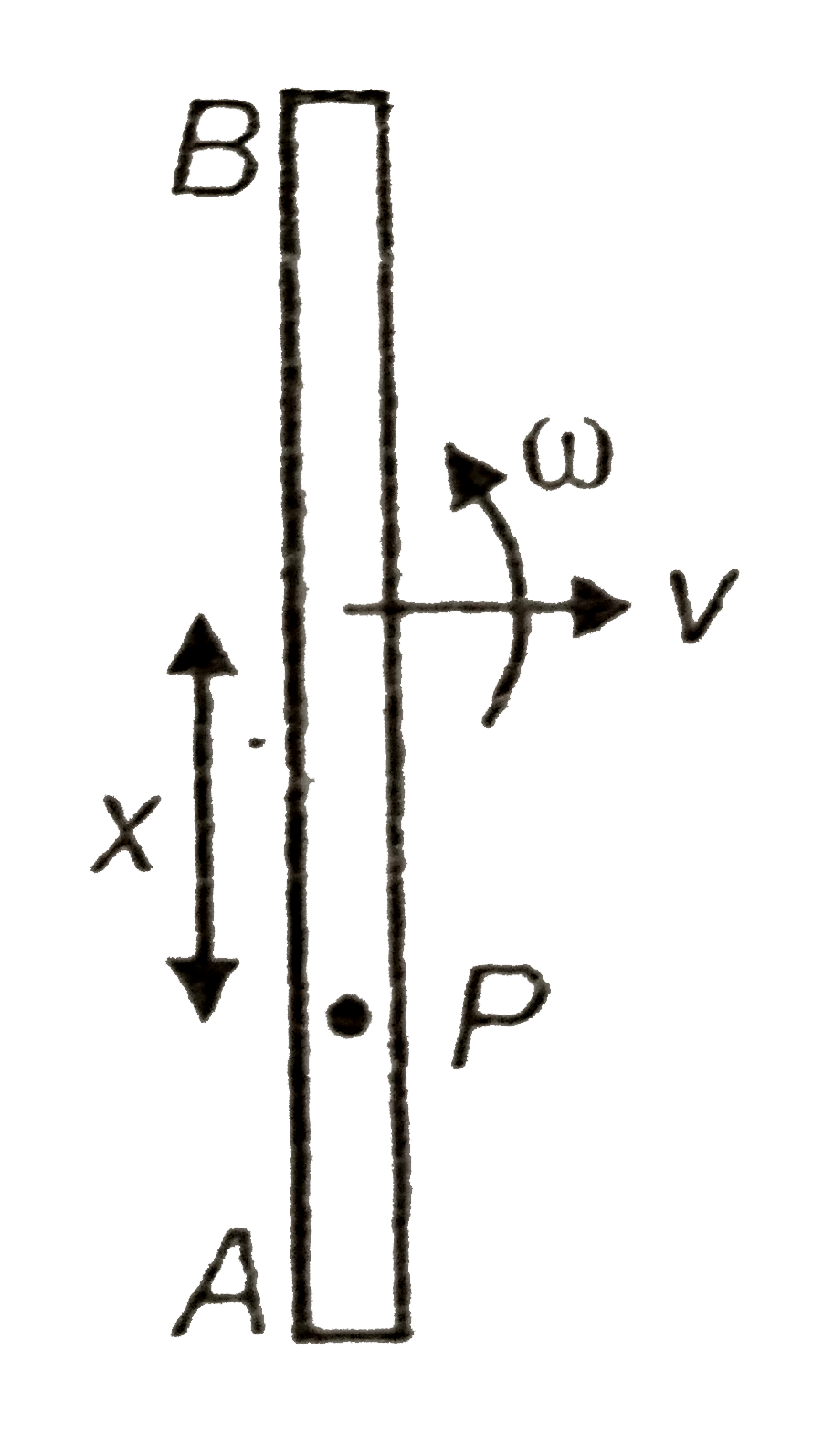
A rod AB of mass `M` and length L is lying on a horizontal frictionless surface. A particle of mass `m` travelling along the surface hits the end A of the rod with a velocity `v_(0)` in a direction perpendicular to AB. The collision in elastic. After the collision the particle comes to rest
(a). Find the ratio `m//M`
(b). A point P on the rod is at rest immediately after collision find the distance AP.
(c). Find the linear speed of the point P a time `piL//3v_(0)` after the collision.

Text Solution

Verified by Experts
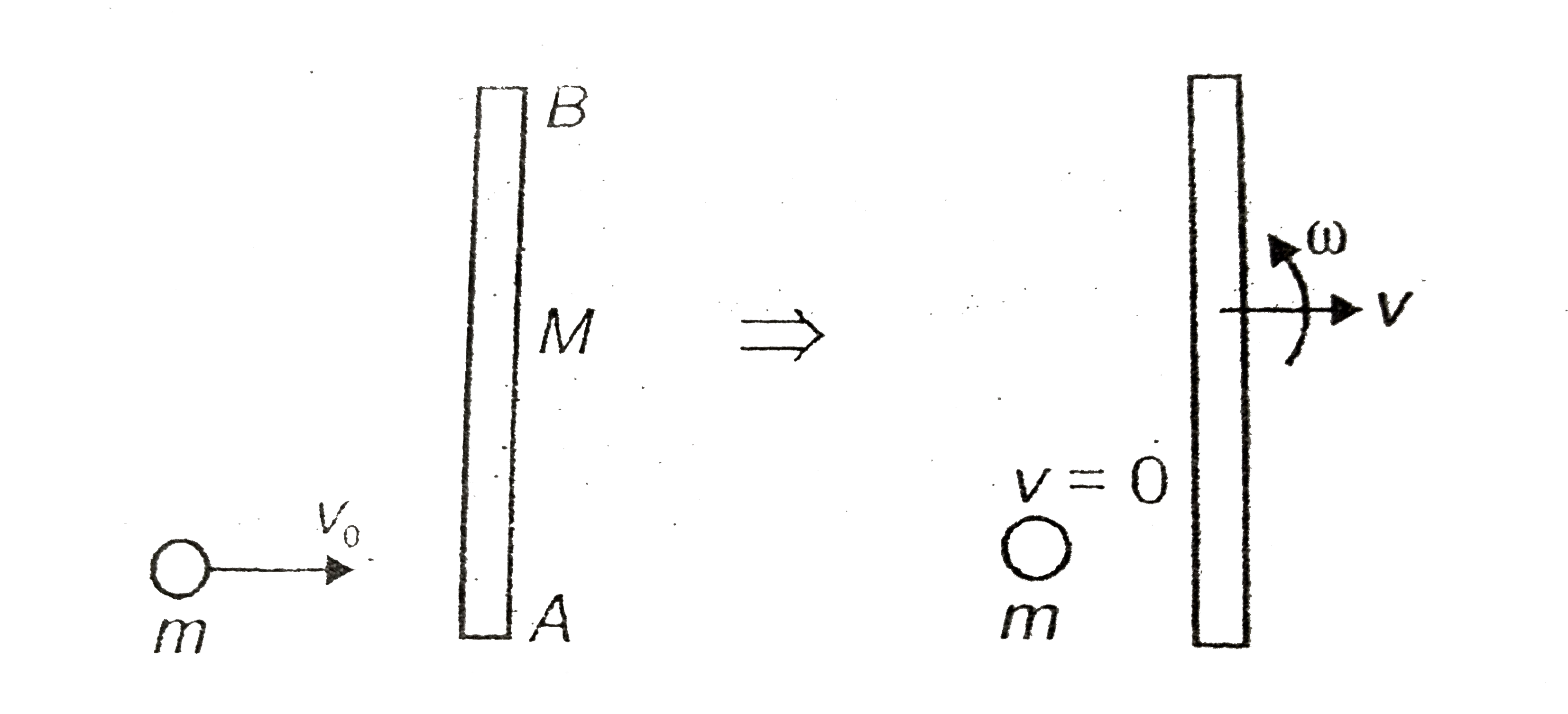
Let us assume that speed of centre of mass of rod be `v_(0)` and angular speed about centre of mass be `omega` immediately after collision.

Taking the ball and rod to be part of a combined system, so for our system `sumF_("ext")=0`. So momentum can be conserved.
`(a) :. mv_(0)=MVimpliesv=(m)/(M)v_(0)`..........`(1)`
`sumtau=0` about centre of rod. So conserving angular momentum
`mv_(0)*(L)/(2)=I_(CM)*omegaimpliesmv_(0)(L)/(2)=(ML^(2))/(12)omega`
`:.omega=(6m)/(M)(v_(0))/(L)`..........`(2)`
Since the collision is perfectly elastic, K.E. of system will remain conserved.
`(1)/(2)mv_(0)^(2)=(1)/(2)MV^(2)+(1)/(2)I_(C.M.*omega^(2)` [Replacing the values of `v` and `omega` from equation `(1)` and `(2)` ]
`implies(1)/(2)mv_(0)^(2)=(1)/(2)M((m)/(M)v_(0))^(2)+(1)/(2)*(ML^(2))/(12)xx(36m^(2))/(M^(2))(v_(0)^(2))/(L^(2))`
or `1=(m)/(M)+(3m)/(M)=(4m)/(M)`
`(m)/(M)=(1)/(4)`
`(b)` For velocity of any point `P` to be zero immediately after the collision, the net velocity of point `P` is
`v+omegax=0`
`:.x=-(v)/(omega)`
`=-(mv_(0))/((M*6mv_(0))/(ML))`
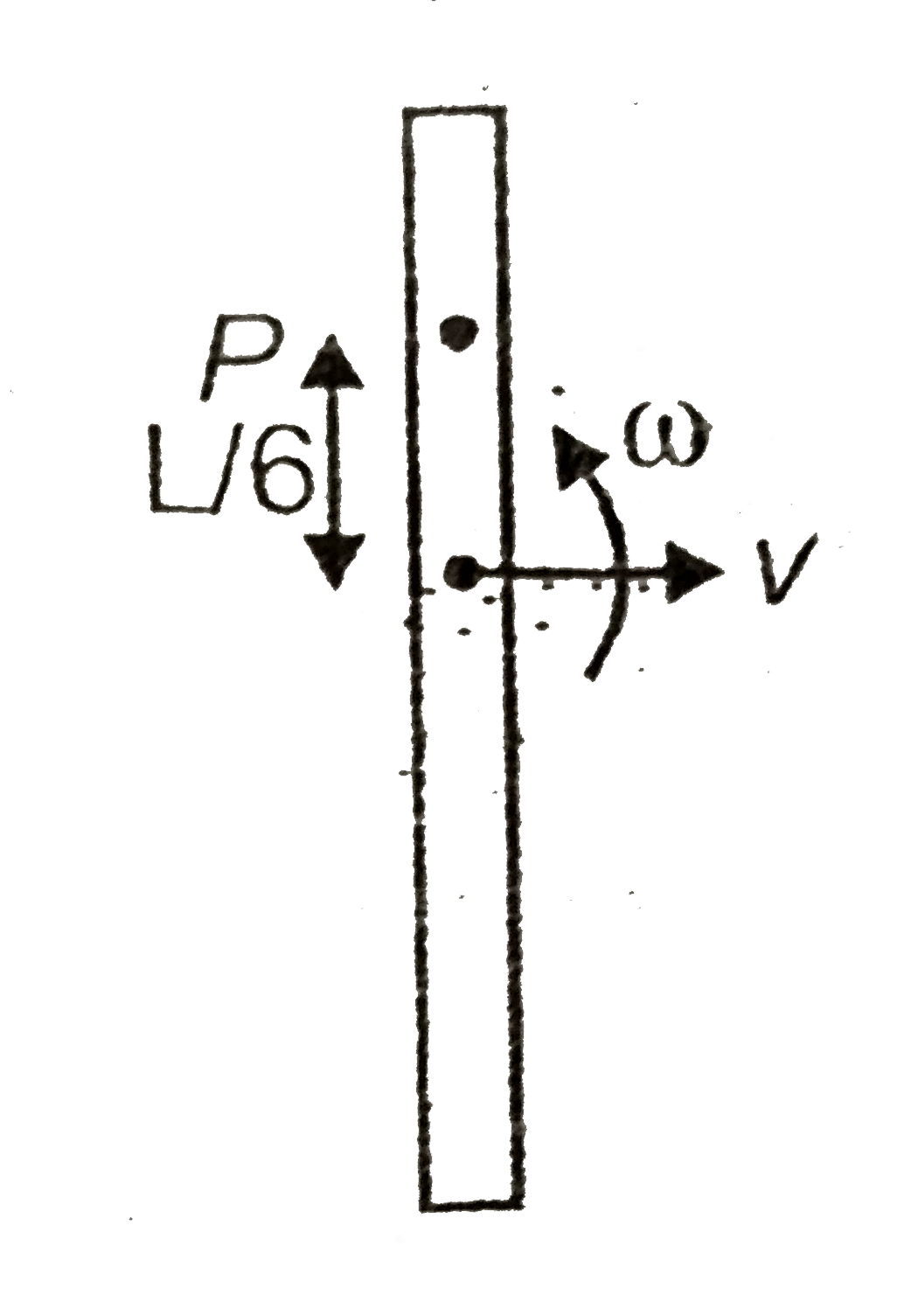
`:.=-(L)/(6)`

(-ve sign shows that the point will be on opposite side of what we have taken and is quite-logical too)

So, `AP=(L)/(2)+(L)/(6)=(4L)/(6)=(2L)/(3)`
`(c )` Just after collision,
`v=(m)/(M)v_(0)=(v_(0))/(4)`
`omega=(6mv_(0))/(ML)=(3v_(0))/(2L)`
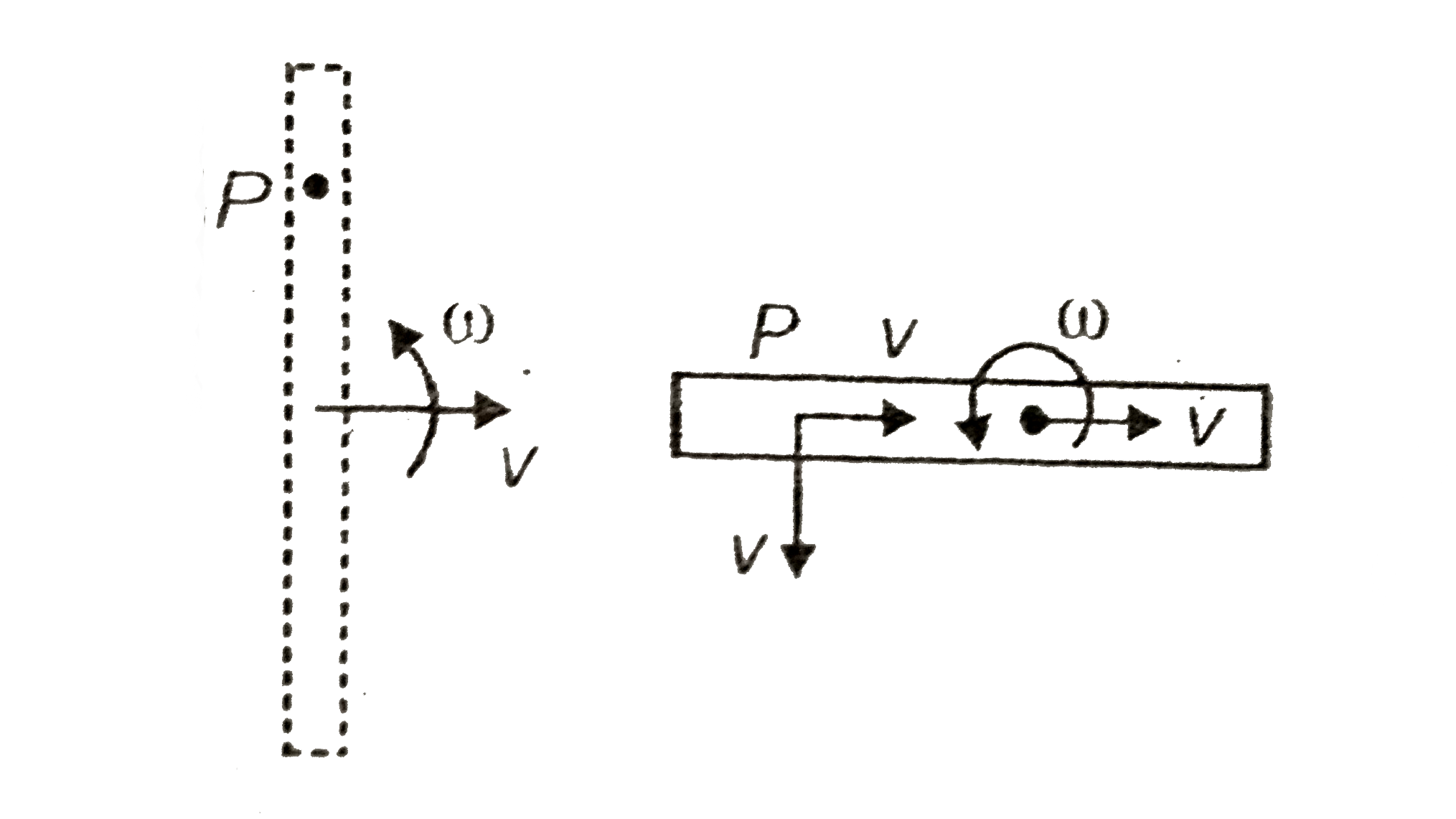
Since `v=(omegaL)/(6)`, both the translational speed as well as speed due to rotation will be equal to `v=(v_(0))/(4)` at any time after collision.
After time `t=(piL)/(3v_(0))`

`theta=omega t=(3v_(0))/(2L)xx(piL)/(3v_(0))=(pi)/(2)`
So rad has turned by an angle `(pi)/(2)`, till that time after collision.
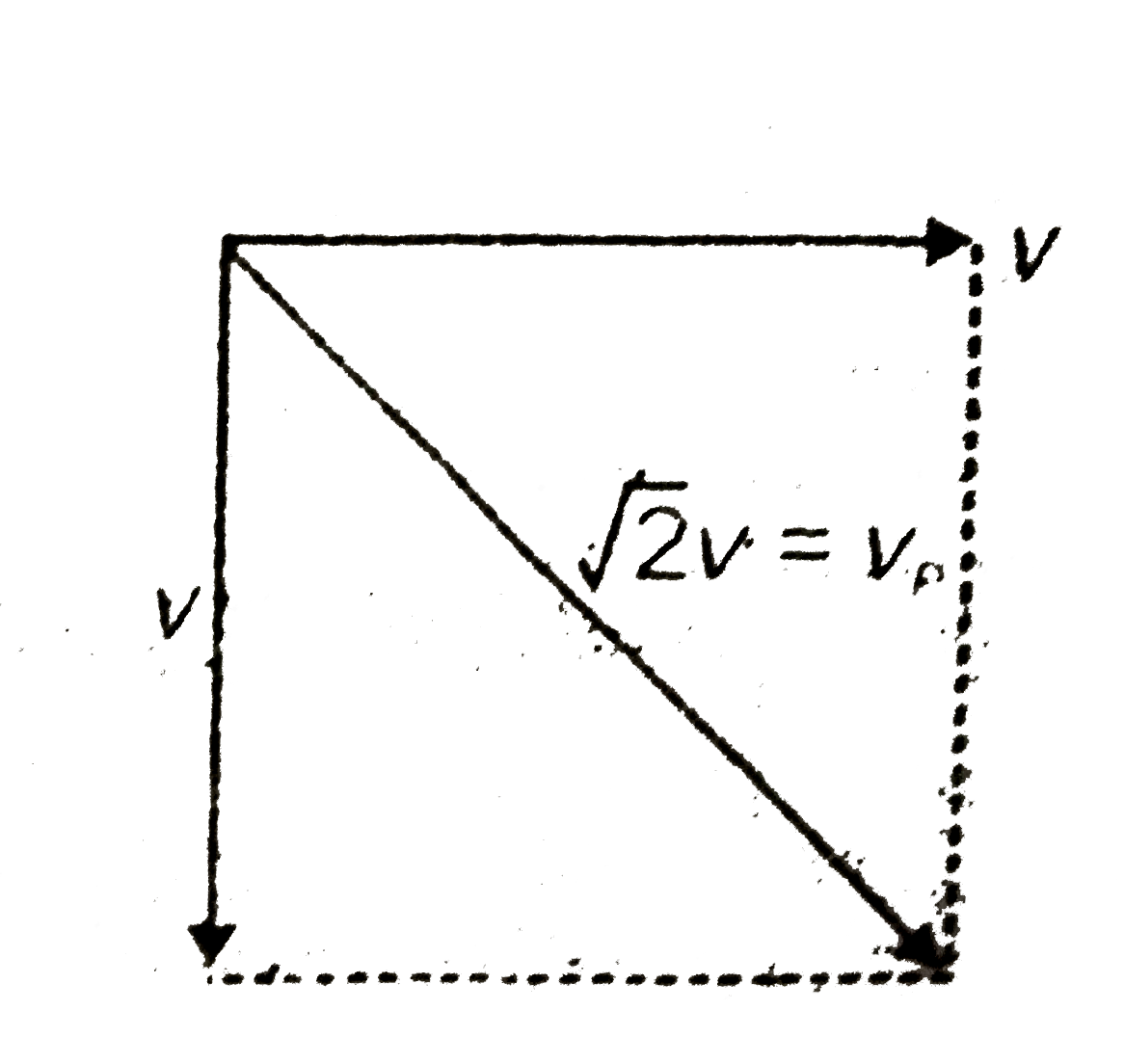
The point `P` has two velocities one in the direction of motion of cenre of rod and another perpendicular to the rod.

Resultant speed `=sqrt(v^(2)+v^(2))=vsqrt(2)=(v_(0))/(4)sqrt(2)`
Promotional Banner

Topper's Solved these Questions

  • SYSTEM OF PARTICLES AND ROTATIONAL MOTION

    AAKASH INSTITUTE ENGLISH|Exercise Illustration|4 Videos
  • SYSTEM OF PARTICLES AND ROTATIONAL MOTION

    AAKASH INSTITUTE ENGLISH|Exercise Assignment (Section - A) Objective Type Questions (One option is correct)|62 Videos
  • SEMICONDUCTOR ELECTRONICS: MATERIALS, DEVICES AND SIMPLE CIRCUITS

    AAKASH INSTITUTE ENGLISH|Exercise Assignment (Section-D (Assertion and reason))|5 Videos
  • TEST 1

    AAKASH INSTITUTE ENGLISH|Exercise EXERCISE|21 Videos

Similar Questions

Explore conceptually related problems

A rod AB of length 2L and mass m is lying on a horizontal frictionless surface. A particle of same mass m travelling along the surface hits the rod at distance (L)/(2) from COM with a velocity v_(0) in a direction perpendicular to rod and sticks to it. Angular velocity of rod just after collision is

A rod AB of length 2L and mass m is lying on a horizontal frictionless surface. A particle of same mass m travelling along the surface hits the rod at distance (L)/(2) from COM with a velocity v_(0) in a direction perpendicular to rod and sticks to it. Angular velocity of rod just after collision is

A rod AC of length l and mass m is kept on a horizontal smooth plane. It is free to rotate and move. A particle of same mass m moving on the plane with velocity v strikes the rod at point B making angle 37^@ with the rod. The collision is elastic. After collision,

A uniform rod of mass M and length L lies flat on a frictionless horizantal surface. Two forces F and 2F are applied along the length of the rod as shown. The tension in the rod at point P is

A slender rod of mass M and length L rests on a horizontal frictionless surface. The rod is pivoted about one of ends. The impulse of the force exerted on the rod by the pivot when the rod is struck by a blow of impulse J perpendicular to the rod at other end is

A straight rod AB of mass M and length L is placed on a frictionless horizontal surface. A force having constant magnitude F and a fixed direction start acting at the end A. The rod is initially perpendicular to the force. The initial acceleration of end B is

A uniform rod of mass M and length l is placed on a smooth- horizontal surface with its one end pivoted to the surface. A small ball of mass m moving along the surface with a velocity v_(0) , perpendicular to the rod, collides elastically with the free end of the rod. Find: a. the angular velocity of the rod after collision. b. the impulse applied by the pivot on the rod during collision. (Take M//m = 2 )

A uniform rod of mass m and length L is at rest on a smooth horizontal surface. A ball of mass m, moving with velocity v_0 , hits the rod perpendicularly at its one end and sticks to it. The angular velocity of rod after collision is

A rod of mass m and length l in placed on a smooth table. An another particle of same mass m strikes the rod with velocity v_(0) in a direction perpendicular to the rod at distance x( lt l//2) from its centre . Particle sticks to the end. Let omega be the angular speed of system after collision , then As x is increased from 0 to l/2 , the angular speed omega .

A uniform rod of mass M and length a lies on a smooth horizontal plane. A particle of mass m moving at a speed v perpendicular to the length of the rod strikes it at a distance a/4 from the centre and stops after the collision. Find a. the velocity of the cente of the rod and b. the angular velocity of the rod abut its centre just after the collision.

AAKASH INSTITUTE ENGLISH-SYSTEM OF PARTICLES AND ROTATIONAL MOTION-Try Yourself
  1. A rod AB of mass M and length L is lying on a horizontal frictionless ...

    Text Solution

    |

  2. Two bodies of masses 1kg and 3kg are lying in xy plane at (0,0) and (2...

    Text Solution

    |

  3. Three point masses of 1kg, 2kg and 3kg lie at (0,0), (1,2), (3,-1) res...

    Text Solution

    |

  4. Three particles of masses m,m and 4kg are kept at a verticals of trian...

    Text Solution

    |

  5. Three particles having their masses in the ratio 1 : 3 : 5 are kept at...

    Text Solution

    |

  6. Centre of mass of the system lies inside disc or square plate and why ...

    Text Solution

    |

  7. Two particles of equal mass are moving along the same line with the sa...

    Text Solution

    |

  8. Two particles of equal mass are moving along the same straight line wi...

    Text Solution

    |

  9. A shell following a parabolic path explodes somewhere in its flight. T...

    Text Solution

    |

  10. All the particles are situated at a distance R from the origin. The di...

    Text Solution

    |

  11. Will the velocity and acceleration of centre of mass change if particl...

    Text Solution

    |

  12. vecA=(3hati+2hatj-6hatk) and vecB=(hati-2hatj+hatk), find the scalar p...

    Text Solution

    |

  13. vecA=(hati-2hatj+6hatk) and vecB=(hati-2hatj+hatk), find the cross pro...

    Text Solution

    |

  14. Find a unit vector in the direction of vector vecA=(hati-2hatj+hatk)

    Text Solution

    |

  15. Find a vector perpendicular to vector vecA=(hati+2hatj-3hatk) as well ...

    Text Solution

    |

  16. The angular displacement of a particle is 24 rad in 10 seconds. Calcul...

    Text Solution

    |

  17. The angular velocity of a rigid body is 24 rad s^(-1), Calculate the t...

    Text Solution

    |

  18. The angular velocity of circular disc of radius 2cm is 20 rad s^(-1). ...

    Text Solution

    |

  19. What is the angular velocity of a particle lying on the axis of rotati...

    Text Solution

    |

  20. What is the angular acceleration of a particle moving with constant an...

    Text Solution

    |

  21. A wheel is rotating with an angular velocity of 3 rad s^(-1). If the a...

    Text Solution

    |