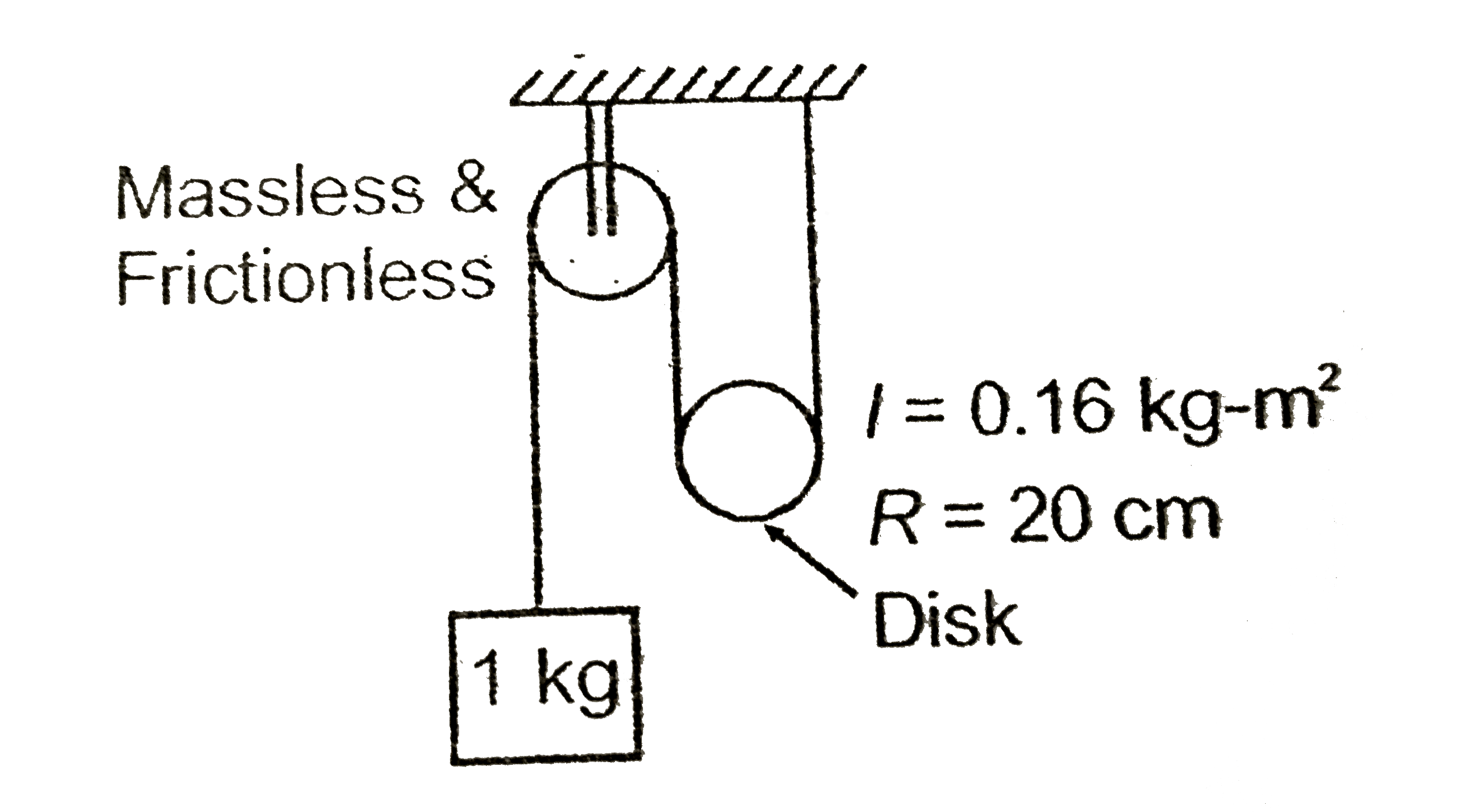



Topper's Solved these Questions
SYSTEM OF PARTICLES AND ROTATIONAL MOTION
AAKASH INSTITUTE ENGLISH|Exercise Assignment (Section - H) Multiple True-False Type Questions|4 VideosSYSTEM OF PARTICLES AND ROTATIONAL MOTION
AAKASH INSTITUTE ENGLISH|Exercise Assignment (Section - I) Subjective Type Questions|8 VideosSYSTEM OF PARTICLES AND ROTATIONAL MOTION
AAKASH INSTITUTE ENGLISH|Exercise Assignment (Section - F) Matrix-Match Type Questions|8 VideosSEMICONDUCTOR ELECTRONICS: MATERIALS, DEVICES AND SIMPLE CIRCUITS
AAKASH INSTITUTE ENGLISH|Exercise Assignment (Section-D (Assertion and reason))|5 VideosTEST 1
AAKASH INSTITUTE ENGLISH|Exercise EXERCISE|21 Videos
Similar Questions
Explore conceptually related problems
AAKASH INSTITUTE ENGLISH-SYSTEM OF PARTICLES AND ROTATIONAL MOTION-Assignment (Section - G) Integar Type Questions
- In an atwood machine the two blocks have massess 1kg and 3kg. The pull...
Text Solution
|
- A body projected with a speed u at an angle of 60^(@) with the horizon...
Text Solution
|
- A cubical tanker completely filled with water is moving with a constan...
Text Solution
|
- Two blocks A and B of mass 16kg and 64kg are placed on a smooth horizo...
Text Solution
|
- A body of mass 5//6kg kept at rest in horizontal plane is acted upon b...
Text Solution
|
- The moment of inertia of a uniform semicircular wire of mass M and rad...
Text Solution
|
- In the arrangement shown the fixed pulley is massless and frictionless...
Text Solution
|
- A solid sphere of radius 2.45m is rotating with an angular speed of 10...
Text Solution
|
- A body is projected with a speed u at an angle of 30^(@) with the hori...
Text Solution
|
- In the given arrangement the block is released from the position where...
Text Solution
|