

Home
Class 12
PHYSICS
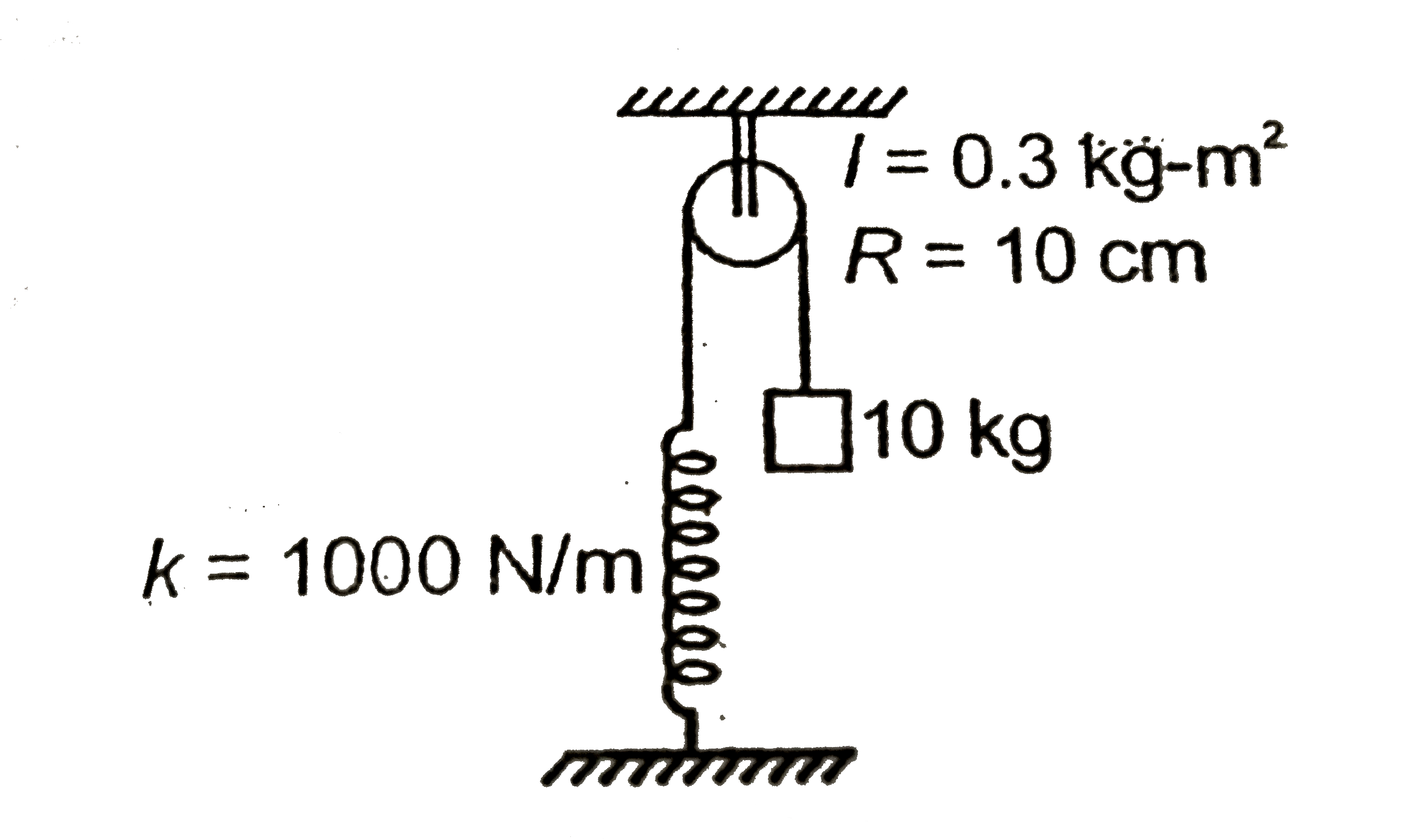
In the given arrangement the block is re...

In the given arrangement the block is released from the position where the spring is unstretched. The speed of the block when it has descended through `2cm` is `(x)/(10)`. Find the value of `x`.

Promotional Banner

Topper's Solved these Questions

  • SYSTEM OF PARTICLES AND ROTATIONAL MOTION

    AAKASH INSTITUTE ENGLISH|Exercise Assignment (Section - H) Multiple True-False Type Questions|4 Videos
  • SYSTEM OF PARTICLES AND ROTATIONAL MOTION

    AAKASH INSTITUTE ENGLISH|Exercise Assignment (Section - I) Subjective Type Questions|8 Videos
  • SYSTEM OF PARTICLES AND ROTATIONAL MOTION

    AAKASH INSTITUTE ENGLISH|Exercise Assignment (Section - F) Matrix-Match Type Questions|8 Videos
  • SEMICONDUCTOR ELECTRONICS: MATERIALS, DEVICES AND SIMPLE CIRCUITS

    AAKASH INSTITUTE ENGLISH|Exercise Assignment (Section-D (Assertion and reason))|5 Videos
  • TEST 1

    AAKASH INSTITUTE ENGLISH|Exercise EXERCISE|21 Videos

Similar Questions

Explore conceptually related problems

A block suspended from a spring is released when the spring is unstretched. Then choose the correct options.

The pulley shown in figure has a radius of 20 cm and moment of inertial 0.2 kg-m^2. The string going over it is attached at one end to a vertical sprign of spring constant 50 N/m fixed from below and supports a 1 kg mas at other end. The system is released from rest with the spring at its natural length. Find the speed of the block when it has desceds through 10 cm. Take g=10 m/s^2 .

A 2 kg block is connected with two springs of force constants k_(1)=100 N//m and k_(2)=300 N//m as shown in figure. The block is released from rest with the springs unstretched. The acceleration of the block in its lowest postion is (g=10 m//s^(2))

The block is allowed to fall, slowly from the position where spring is in its natural length. Find, maximum extension in the string.

In the figure shown co-efficient of friction between the block B and C is 0.4. There is no friction between the block C and hte surface on which it is placed. The system of blocks is released from rest in the shown situation. Find the distance moved by the block C when block A descends through a distance 2m. Given masses of the blocks are m_(A)=3 kg, m_(B)=5 kg and m_(C)=10 kg .

A 1kg block situated on a rough incline is connected to a spring of spring constant 100Nm^(-1) as shown in figure,. The block is released from rest with the spring in the unstretched position. The block moves 10cm down the incline before coming to rest. Find the coefficient of friction between the block and the incline. Assume that the spring has negligible mass and the pulley is frictionless.

Blocks A and B shown in the figure are having equal masses m. The system is released from rest with the spring unstretched. The string between A and ground is cut, when there is maximum extension in the spring. The acceleration of centre of mass of the two blocks at this instant is

A block of mass m lies on a horizontal frictionless surface and is attached to one end of a horizontal spring (with spring constant k ) whose other end is fixed . The block is intinally at rest at the position where the spring is unstretched (x=0) . When a constant horizontal force vec(F) in the positive direction of the x- axis is applied to it, a plot of the resulting kinetic energy of the block versus its position x is shown in figure. What is the magnitude of vec(F) ?

A 4.00 kg block carrying a charge Q = 50.0muC is connected to a spring for which k = 100 N/ m. The block lies on a frictionless horizontal track, and the system is immersed in a uniform electric field of magnitude E = 5.00 xx 10^5 V/m , directed as shown in figure. If the block is released from rest when the spring is unstretched (at x = 0). (a) By what maximum amount does the spring expand? (b) What is the equilibrium position of the block? (c) Show that the block's motion is simple harmonic and determine its period. (d) Repeat part (a) if the coefficient of kinetic friction between block and surface is 0.2.