

Home
Class 12
PHYSICS
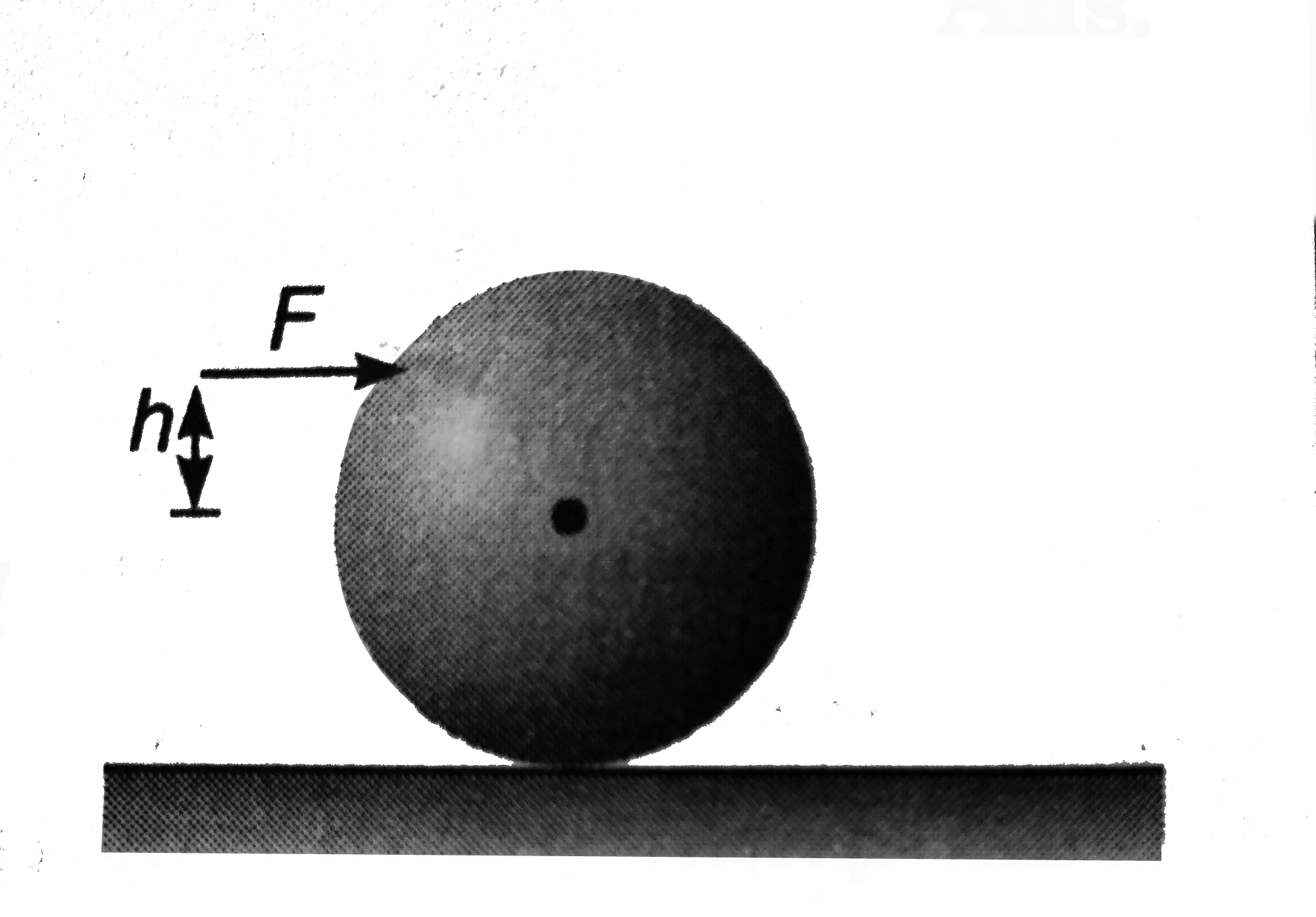
A billiard ball, initially at rest, is g...


A billiard ball, initially at rest, is given a sharp impulse by a cue. The cue is held horizontally a distance `h` above the centre line as shown in figure. The ball leaves the cue with a speed `v_(0)` and because of its backward slipping eventually acquires a final
speed `(9)/(7)v_(0)` show that `h=(4)/(5)R`
Where `R` is the radius of the ball.

Promotional Banner

Topper's Solved these Questions

  • SYSTEM OF PARTICLES AND ROTATIONAL MOTION

    AAKASH INSTITUTE ENGLISH|Exercise Assignment (Section - J) Aakash Challengers Questions|13 Videos
  • SYSTEM OF PARTICLES AND ROTATIONAL MOTION

    AAKASH INSTITUTE ENGLISH|Exercise Try Yourself|63 Videos
  • SYSTEM OF PARTICLES AND ROTATIONAL MOTION

    AAKASH INSTITUTE ENGLISH|Exercise Assignment (Section - H) Multiple True-False Type Questions|4 Videos
  • SEMICONDUCTOR ELECTRONICS: MATERIALS, DEVICES AND SIMPLE CIRCUITS

    AAKASH INSTITUTE ENGLISH|Exercise Assignment (Section-D (Assertion and reason))|5 Videos
  • TEST 1

    AAKASH INSTITUTE ENGLISH|Exercise EXERCISE|21 Videos

Similar Questions

Explore conceptually related problems

A billiard ball, initially at rest, is given a sharp impulse by a cue. The cue is held horizontally a distance h above the centre line as shown in figure. The ball leaves the cue with a speed v_(0) and because of its forward english (backward slipping) eventually acquires a final speed (9)/(7)v_(0) show that h=(4)/(5)R Where R is the radius of the ball.

The cue stick hits a cue ball horizontally a distance x above the centre of the ball. Find the value of x for which the cue ball will instantaneously roll without slipping. Calculate the answer in terms of the radius R of the ball.

A billiard ball of mass m and radius r, when hit in a horizontal direction by a cue at a height h above its centre, acquired a linear velocity v_(0). The angular velocity omega_(0) acquired by the ball is

A syringe containing water is held horizontally with its nozzle at a height h above the ground as shown in fig the cross sectional areas of the piston and the nozzle are A and a respectively the piston is pushed with a constant speed v. Find the horizontal range R of the stream of water on the ground.

A uniform disc of radius R is in pure rolling on a fixed horizontal surface with constant speed v_0 as shown in the figure. For what value of theta , speed of point P will be v_0/2√(5+2√3) ? (OP= R/2 and O is the centre of disc)

Five balls are placed one after the other along a straight line as shown in the figure. Initially, all the balls are at rest. Then the second ball has been projected with speed v_(0) towards the third ball. Mark the correct statements, (Assume all collisions to be head-on and elastic.)

A solid spherical ball of radius R collides with a rough horizontal surface as shown in figure. At the time of collision its velocity is v_(0) at an angle theta to the horizontal and angular velocity omega_(0) as shown . After collision, the angular velocity of ball may

AB is a horizontal diameter of a ball of mass m=0.4 kg and radius R=0.10m . At time t=0 , a sharp impulse is applied at B at angle of 45^@ with the horizontal as shown in figure so that the ball immediately starts to move with velocity v_(0)=10ms^(-1) a. Calculate the impulse and angular velcity of ball just after impulse provided. If coefficient of kinetic friction between the floor and th ball is mu=0.1 . Calculate. The b. velocity of ball when it stops sliding, c. time t at that instant d. horizontal distance travelled by the ball up to that instant. e. angular displacement of the ball about horizontal diameter perpendicular to AB , up to that instant, and f. energy lost due to friction ( g=10ms^(-2))

(a) With what velocity (v_0) should a ball be projected horizontally from the top of a tower so that the horizontal distance on the ground is eta H , where H is the height of the tower ? (b) Also determine the speed of the ball when it reaches the ground. .

A horizontal circular platform of radius 0.5 m and mass axis. Two massless spring toy-guns, each carrying a steel ball of mass 0.05 kg are attached to the platform at a distance 0.25m from the centre on its either sides along its diameter (see figure). Each gun simultaneously fires the balls horizontally and perpendicular to the diameter in opposite directions. After leaving the platform, the balls have horizontal speed of 9ms^(-1) with respect to the ground. The rotational speed of the platform in rad s^(-1) after the balls leace the platform is