Home
Class 12
PHYSICS
Consider an infinite distribution of poi...

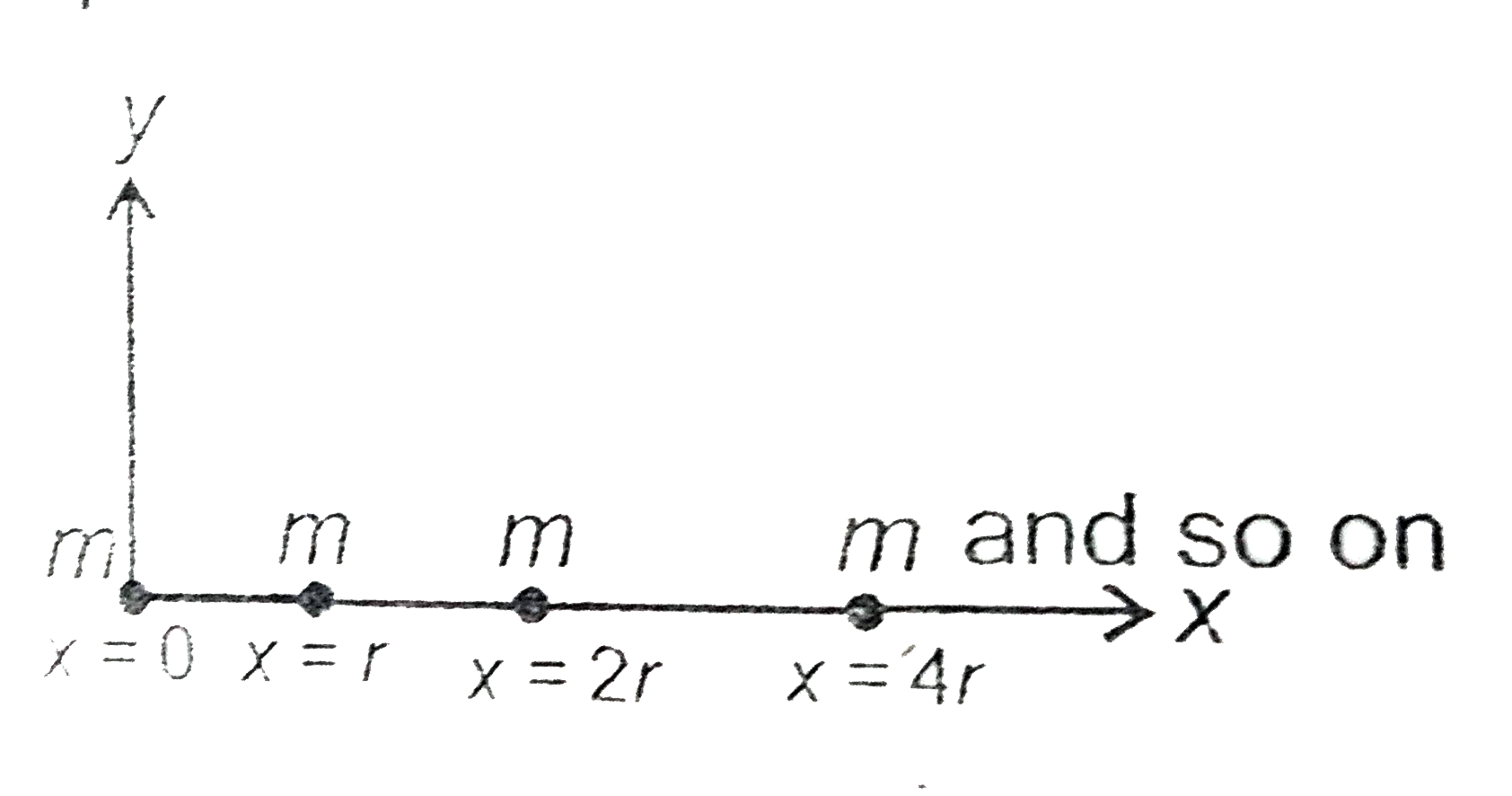
Consider an infinite distribution of point masses (each of mass m) placed on x-axis as shown in the diagram. What is the gravitational force acting on the point mass placed at the origin ?

A

`(4Gm^(2))/(3r^(2))`

B

`(Gm^(2))/(3r^(2))`

C

`(4Gm^(2))/(r^(2))`

D

`(Gm^(2))/(r^(2))`

Text Solution

Verified by Experts

The correct Answer is:

A
Promotional Banner

Topper's Solved these Questions

  • GRAVITATION

    AAKASH INSTITUTE ENGLISH|Exercise ASSIGNMENT SECTION -C (Objective Type Questions (More than one option are correct))|12 Videos
  • GRAVITATION

    AAKASH INSTITUTE ENGLISH|Exercise ASSIGNMENT SECTION -D (Linked Comprehension Type Questions)|13 Videos
  • GRAVITATION

    AAKASH INSTITUTE ENGLISH|Exercise ASSIGNMENT SECTION -A (Objective Type Questions (one option is correct))|50 Videos
  • ELECTROSTATIC POTENTIAL AND CAPACITANCE

    AAKASH INSTITUTE ENGLISH|Exercise ASSIGNMENT SECTION - D|9 Videos
  • KINETIC THEORY

    AAKASH INSTITUTE ENGLISH|Exercise EXERCISE (ASSIGNMENT) SECTION - D Assertion - Reason Type Questions|10 Videos

Similar Questions

Explore conceptually related problems

Three identical point mass each of mass 1kg lie in the x-y plane at point (0,0), (0,0.2m) and (0.2m, 0). The net gravitational force on the mass at the origin is

Three identical point mass each of mass 1kg lie in the x-y plane at point (0,0), (0,0.2m) and (0.2m, 0). The net gravitational force on the mass at the origin is

A mass m is placed inside a hollow sphere of mass M as shown in figure. The gravitaional force on mass m is

Four point masses each of mass 'm' are placed on the corner of square of side 'a' Calculate magnitude of gravitational force experienced each particle .

Four particles having masses, m, 2m, 3m, and 4m are placed at the four corners of a square of edge a. Find the gravitational force acting on a particle of mass m placed at the center.

Four particles having masses, m, 2m, 3m, and 4m are placed at the four corners of a square of edge a. Find the gravitational force acting on a particle of mass m placed at the centre.

Four particles having masses, m, 2m, 3m, and 4m are placed at the four corners of a square of edge a. Find the gravitational force acting on a particle of mass m placed at the centre.

Three point masses m,m and 2m are placed on the vertex of an equilateral triangle of side 'a' Another point mass 'm' is placed at the centroid of the triangle as shown in the figure. If the magnitude of net force on the point mass placed at centroid is (KGm^2)/(a^2) then find the value of K (G= universal gravitational constant )

We know that when two equal masses are placed on a line then, gravitational force on a third mass is zero due to these two masses when the third is placed at the centre of line joining the two masses. But if third mass is placed anywhere else on the x-axis, the gravitational force acts on that mass due to these two masses. Consider a system shown in figure. In this system two point masses of mass M each are placed at y-axis at a distance a from origin and these masses are fixed. If a third point mass of mass m is released at a distance x from origin on x-axis, then answer the following questions. Which of the following graphs best represents the variation of force on mass m with distance x ?

We know that when two equal masses are placed on a line then, gravitational force on a third mass is zero due to these two masses when the third is placed at the centre of line joining the two masses. But if third mass is placed anywhere else on the x-axis, the gravitational force acts on that mass due to these two masses. Consider a system shown in figure. In this system two point masses of mass M each are placed at y-axis at a distance a from origin and these masses are fixed. If a third point mass of mass m is released at a distance x from origin on x-axis, then answer the following questions. The distance between positions of maximum force on mass m is

AAKASH INSTITUTE ENGLISH-GRAVITATION -ASSIGNMENT SECTION -B (Objective Type Questions (one option is correct))
  1. Consider an infinite distribution of point masses (each of mass m) pla...

    Text Solution

    |

  2. The gravitational field in a region is given by vec(g)=(2hat(i)+3hat(j...

    Text Solution

    |

  3. Consider a ring of mass m and radius r. Maximum gravitational intensit...

    Text Solution

    |

  4. The weight of an object on the surface of the Earth is 40 N. Its weigh...

    Text Solution

    |

  5. A solid sphere of uniform density and radius 4 units is located with i...

    Text Solution

    |

  6. Potential (V) at a point in space is given by v=x^(2)+y^(2)+z^(2). Gra...

    Text Solution

    |

  7. Three particle of mass m each are placed at the three corners of an eq...

    Text Solution

    |

  8. A body at rest starts from a point at a distance r (gtR) from the cent...

    Text Solution

    |

  9. Imagine a light planet revolving around a massive star in a circular o...

    Text Solution

    |

  10. The value of g at depth h is two third the value that on the earth's ...

    Text Solution

    |

  11. Given that the gravitation potential on Earth surface is V(0). The pot...

    Text Solution

    |

  12. E, U and K represent total mechanical energy potential energy and kine...

    Text Solution

    |

  13. If v(0) be the orbital velocity of an articial satellite orbital veloc...

    Text Solution

    |

  14. The period of revolution of a satellite orbiting Earth at a height 4R ...

    Text Solution

    |

  15. A particle is projected vertically upward with with velocity sqrt((2)/...

    Text Solution

    |

  16. A tunnel is dug across the diameter of earth. A ball is released from ...

    Text Solution

    |

  17. Identify the incorrect statement about a planet revolving around Sun

    Text Solution

    |

  18. A large solid sphere of diameter d attracts a small particle with a fo...

    Text Solution

    |

  19. The value of acceleration due to gravity will be 1% of its value at th...

    Text Solution

    |

  20. If the radius of earth shrinks to kR (k lt 1), where R is the radius o...

    Text Solution

    |
