Home
Class 12
PHYSICS
Figure depicts two circular motions. The...


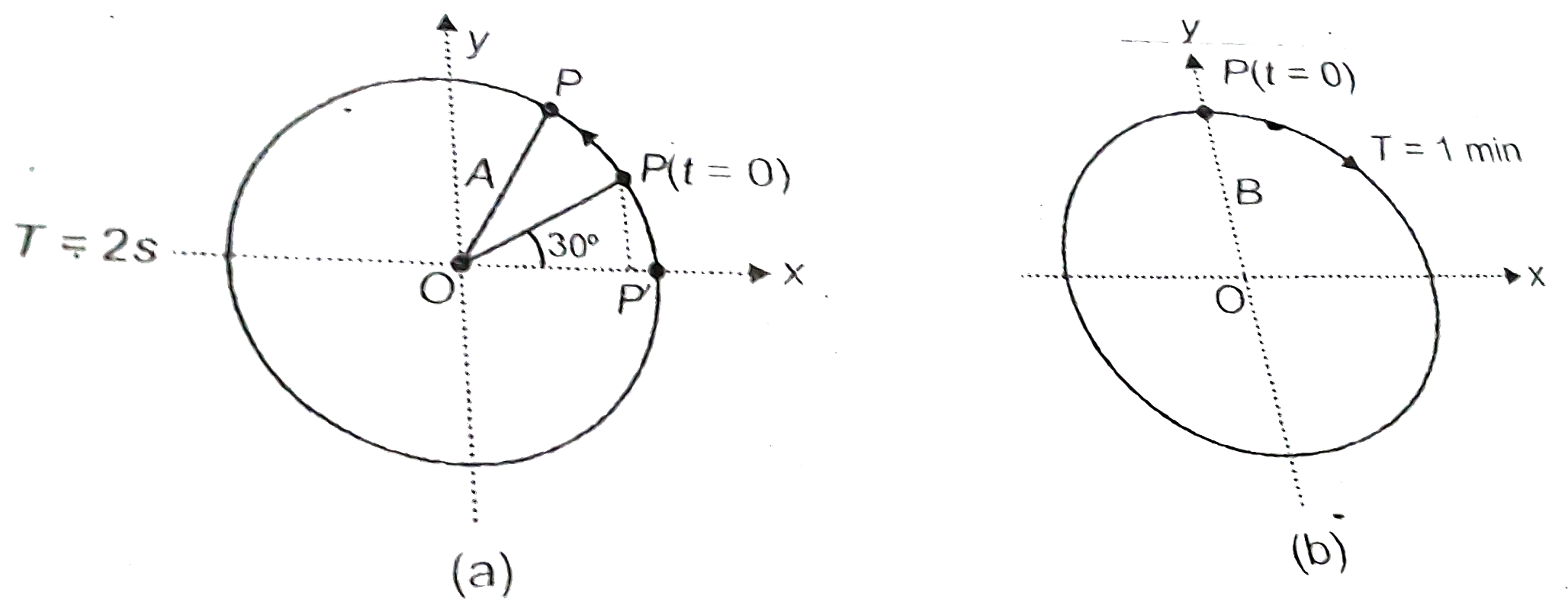
Figure depicts two circular motions. The radius of the circle, the period of revolution, the initial position and the sense of revolution are indicated on the figure. Obtain the SHMs of the x-projection of the radius vector of the rotating particle P in each case.

Text Solution

Verified by Experts

(a) At `t=0` , OP makes anangleof `30^(@) = (pi)/( 6)` rad with the positive direction of x-axid. After time t, it covers an angle `( 2pi)/(T)t` in anticlockwise direction, and makes an angle of `(2pi)/(T)t+(pi)/(6) ` with the x-axis.
The projection of OP on the x-axis at time t is given by `x(g) = A cos ((2pi)/(T)t+ (pi)/(6))`
For`t=2s`
`x(g) = Acos((2pi)/(2)t + (pi)/(6))`
Which is an SHM of amplitude A, period 2s, and an initial phase `= (pi)/(6)`
(b) At `t=0`, OP makes an angle of `90^(@) = (pi)/(2)` with the x-axis . After time t, it covers anangle of `(2pi)/(T)t`, in the clockwise direction and makes an angle of `((pi)/(2) - (2pi)/(T)t)` with the x-axis . The projection of OP on x-axis at time t, is given by
`x(t) = B cos ((pi)/(2) - (2pi)/(T) t)`
`= B sin ((2pi)/(T)t)`
For`T= 1 min = 60s`
`x(t) = B sin((pi)/(30)t)`
Writing this as `x(t) = Bcos ((pi)/(30t)-(pi)/(2))` ( as ` cos ( - theta) = cos theta` and `cos ( 90^(@)- theta) = sintheta )` and comparing it with equation (ii),`x(t) = A cos ( omegat + phit)`, we find that this represents SHM of amplitude B, period 60s , and initial phase of `(-(pi)/(2))`
Promotional Banner

Topper's Solved these Questions

  • OSCILLATIONS

    AAKASH INSTITUTE ENGLISH|Exercise Try Yourself|86 Videos
  • OSCILLATIONS

    AAKASH INSTITUTE ENGLISH|Exercise ASSIGNMENT ( SECTION -A)|58 Videos
  • NUCLEI

    AAKASH INSTITUTE ENGLISH|Exercise ASSIGNMENT (SECTION-D)|10 Videos
  • PHYSICAL WORLD

    AAKASH INSTITUTE ENGLISH|Exercise ASSIGNMENT (Section-B)|4 Videos

Similar Questions

Explore conceptually related problems

The following figure depicts two circular motions. The radius of the circle, the period of revolutin the initial position and the sense of revolution are indicated on the figure. Obtain the simple harmoic motion of the x-projection of the radius vector of the rotating particle P in each case.

The radius of cirlcue, the period of revolution, initial position and sense of revolution are indicated in the figure. y-projection of the radius vector of rotating particle P is :

Figure shows the circular motion of a particle. The radius of the circle, the period, same of revolution and the initial position are indicated on the figure. The simple harmonic motion of the x-projection of the radius vector the rotating particle P is

Figure shows the circular motion of a particle. The radius of the circle, the period, same of revolution and the initial position are indicated on the figure. The simple harmonic motion of the x-projection of the radius vector the rotating particle P is

Figure shows the circular motion of a particle. The radius of the circle, the period, sense of revolution and the initial positionn are indicated in the figure. The simple harmonic motion off the x-projection of the radius vector of the rotating particle P is

Initial velocity and acceleration of a particles are as shown in the figure. Acceleration vector of particle remain constant. Then radius of curvature of path of particle :

A particle moves in a circle of radius R. In half the period of revolution its displacement is ………… and distance covered is ………. .

Read each statement below carefully and state, with reasons, if it is true or false : (a) The net acceleration of a particle in circular motion is always along the radius of the circle towards the center. (b) The velocity vector of a particle at a point is always along the tangent to the path of the particle at that point. (c) The acceleration vector of a particle in uniform circular motion averaged over one cycle is a null vector.

(Figure 3.139) shows three circular arcs, each of radius R and total charge as indicated. The net electric potential at the center of curvature. .

A particle of mass m , initial speed u and angle of projection theta is projected as shown in the figure. Average torque on the projectile between initial and final positions P and Q about the point of projection is
