Home
Class 12
PHYSICS
In the figure, dots and arrows show the ...

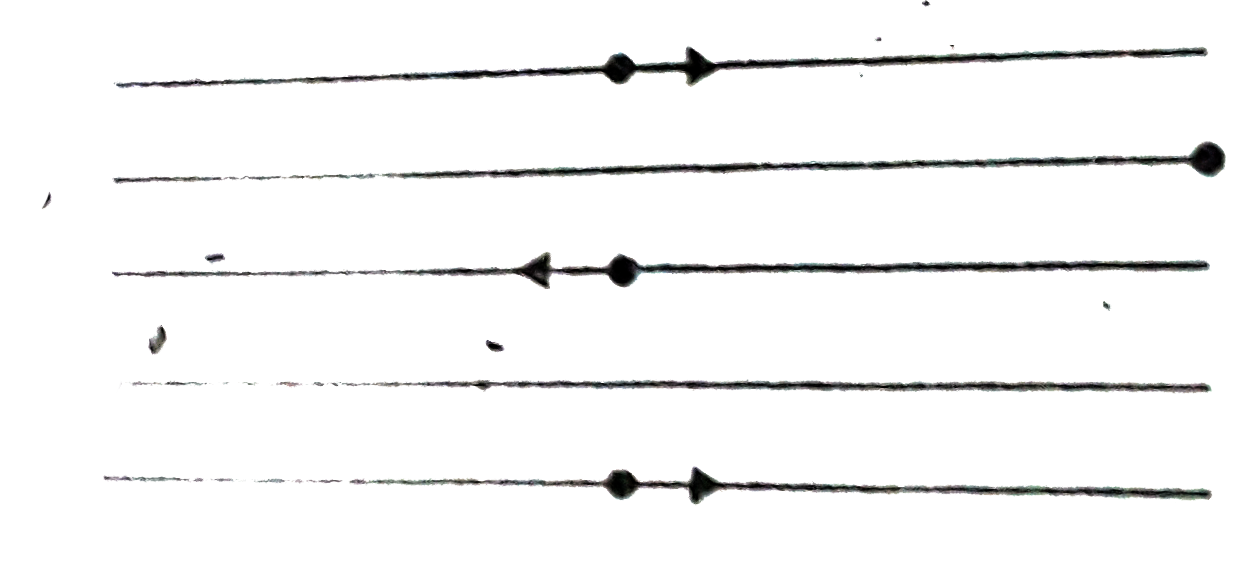
In the figure, dots and arrows show the position and the velocity of a paritcle executing SHM. What are the phases at the five indicated instants when the position at time t is given by
`x = Asin (omega t + phi)`

Text Solution

Verified by Experts

When `x = A sin ( omega t + phi)`
then`v = A omega cos ( omega t + phi)`
(i) `x=0` , so `sin ( omega t + phi) = 0`, hence `cos ( omega t + phi)= +-1`
`:. V = +- A omega`
Since the arrow is directed towards right, `v= + A omega`
So,` cos ( omega t + phi ) = +1 implies delta = omega t + phi =2 n pi`
`sin ( omega t + phi) = 0 implies delta = npi`
Hence both will be satisfies when `delta =2n pi`
when` n =0, +-1, +-2, +-3....."`
(ii) ` x= +A implies sin ( omega t + phi) = 1 implies dleta = omega t = phi =2n pi +(pi)/(2)`
`v=0 implies cos ( omegat + phi) = 0 implies delta = 2n pi +- (pi)/(2)`
combining these two two, we get ` delta =2npi+ (pi)/(2)`
(iii) `x=0 implies sin ( omega t + pi) = 0 implies delta = omega t + pi = n pi`
`v = -A omega implies cos ( omega t + phi) -1 implies delta = omegat + phi =2 n pi + pi`
Combining these two general values of `delta` , we get
`delta = ( 2n + 1) pi = 2 n pi-pi`
(iv) ` x= - A implies sin ( omega t + phi) = -1 implies delta = 2 n pi + ( 3pi)/(2)`
`v= 0 implies cos ( omega t + phi) = 0 implies delta = 2 n pi + (pi)/(2) ` or ` 2 n pi + (3pi)/(2)`
` :. delta = 2n pi + ( 3pi)/(2)`
(v)` x=0 , v= +A omega implies delta = omega t + phi = 2 n pi + 2pi`
Note `:` `delta_((ii)) - delta_((i))= delta_((iii) )-delta_((ii))= delta_((iv))-delta_((iii))= delta_((v))-delta_((iv))= (pi)/(2)`
If `delta_((i))=0,delta_((ii))=(pi)/(2),delta_((iii))=pi,delta_((iv))= (3pi)/(2), delta_((v))= 2pi`
Promotional Banner

Topper's Solved these Questions

  • OSCILLATIONS

    AAKASH INSTITUTE ENGLISH|Exercise Try Yourself|86 Videos
  • OSCILLATIONS

    AAKASH INSTITUTE ENGLISH|Exercise ASSIGNMENT ( SECTION -A)|58 Videos
  • NUCLEI

    AAKASH INSTITUTE ENGLISH|Exercise ASSIGNMENT (SECTION-D)|10 Videos
  • PHYSICAL WORLD

    AAKASH INSTITUTE ENGLISH|Exercise ASSIGNMENT (Section-B)|4 Videos

Similar Questions

Explore conceptually related problems

The time period of a particle executing SHM is T . After a time T//6 after it passes its mean position, then at t = 0 its :

The figure shows the positions and velocity of two particle. If the paritcle move under the mutual attraction of each other, then the position of centre of mass at t = 1 s is :-

Variation of velocity v versus time t in SHM is ( Given x = Asinomegat)

A particle executes simple harmonic motion of amplitude A along the x - axis. At t = 0 , the position of the particle is x = (A)/(2) and it moves along the positive x - direction. Find the phase constant delta , if of the equation is written as x = Asin (omega t + delta) .

A particle is executing SHM with time period T Starting from mean position, time taken by it to complete (5)/(8) oscillations is,

A particle executes simple harmonic motion of amplitude A along the X-axis. At t=0 the position of the particle is x=A/2 and it moves along the positive x-direction. Find the phase constant delta if the equation is written as x=Asin(omegat+delta)

For a particle executing SHM, x = displacement from mean position, v = velocity and a = acceleration at any instant, then

Time period of a particle executing SHM is 16s.At time t = 2s , it crosses the mean position . Its amplitude of motion is ( 32sqrt(2))/(pi) m . Its velocity at t = 4s is

The initial position and velocity of a body moving in SHM with period T = 0.25s are x = 5.0cm and v = 218cm//s . What are the amplitude and phase constant of the motion ?

Position-time relationship of a particle executing simple harmonic motion is given by equation x=2sin(50pit+(2pi)/(3)) where x is in meters and time t is in seconds. What is the position of particle at t=0 ?
