Home
Class 12
PHYSICS
Two identical springs of spring constant...

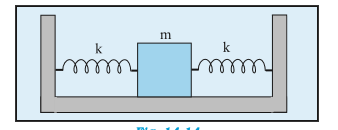
Two identical springs of spring constant k are attached to a block of mass m and to fixed supports as shown in Fig. 14.14. Show that when the mass is displaced from its equilibrium position on either side, it executes a simple harmonic motion. Find the period of oscillations.

Text Solution

Verified by Experts


Let the mass be displaced by a small distance x to the right of the equilibrium position as shown in figure. Under this situation, the spring on the left gets elongated by a length equal tox and that on the right gets compressed by the same length. The forces acting on the mass are then.
`F_(1) = kx` ( force exerted by the spring on the left is, tryping to pull the mass towards the mean position)
`F_(2) = - kx` ( force exerted by the spring on the right is, tryping to push the mass towards the means position) .
The net force, F acting on teh mass is then given by `F= - 2 kx`.
Hence,the force acting on the mass is proportional to the displacement and is directed towards the mean position, therefore , the motion executed by the mass is SHM. The time period of oscialltions is ,
`T= 2pisqrt((m)/(2k))`
Promotional Banner

Topper's Solved these Questions

  • OSCILLATIONS

    AAKASH INSTITUTE ENGLISH|Exercise Try Yourself|86 Videos
  • OSCILLATIONS

    AAKASH INSTITUTE ENGLISH|Exercise ASSIGNMENT ( SECTION -A)|58 Videos
  • NUCLEI

    AAKASH INSTITUTE ENGLISH|Exercise ASSIGNMENT (SECTION-D)|10 Videos
  • PHYSICAL WORLD

    AAKASH INSTITUTE ENGLISH|Exercise ASSIGNMENT (Section-B)|4 Videos

Similar Questions

Explore conceptually related problems

Two identical springs of spring constant k are attached to a block of mass m and to fixed supports as shown in figure . Show that when the mass is displaced from its equilibrium position on either side, it executes a simple harmonic motion. Find the period of oscillation.

Two identical springs of spring constant k are attached to a block of mass m and to fixed supports as shown in the figure. The time period of oscillation is

Tow identical springs of spring constant k are attached to a block of mass m and to fixed supports as shown in figure. When the mass is displaced from equilibrum position by a distance x towards right, find the restoring force.

A block of mass m hangs from a vertical spring of spring constant k. If it is displaced from its equilibrium position, find the time period of oscillations.

A mass of 1.5 kg is connected to two identical springs each of force constant 300 Nm^(-1) as shown in the figure. If the mass is displaced from its equilibrium position by 10cm, then the period of oscillation is

Two blocks each of mass m are connected with springs each of force constant K as shown in fig. The mass A is displaced to the left & B to the right by the same amount and released then the time period of oscillation is -

A body of mass m is suspended from three springs as shown in figure. If mass m is displaced slightly then time period of oscillation is

Two springs, each of spring constant k , are attached to a block of mass m as shown in the figure. The block can slide smoothly alongs a horizontal platform clamped to the oppsite walls of the trolley of mass M . If the block is displaced by x cm and released, the period of oscillaion is :

A 100 g block is connected to a horizontal massless spring of force constant 25.6(N)/(m) As shown in Fig. the block is free to oscillate on a horizontal frictionless surface. The block is displaced 3 cm from the equilibrium position and , at t=0 , it is released from rest at x=0 It executes simple harmonic motion with the postive x-direction indecated in Fig. The position time (x-t) graph of motion of the block is as shown in Fig. Q. When the block is at position B on the graph its.

A tray of mass M=10kg is supported on two identical springs, each of spring constant k, as shown in figure, when the tray is depressed a little and released, it executes simple harmonic motion of period 1.5 s. when a block of mass m is placed on the tray, the speed of oscillation becomes 3 s. the value of m is

