Home
Class 12
PHYSICS
The following figure depicts two circula...

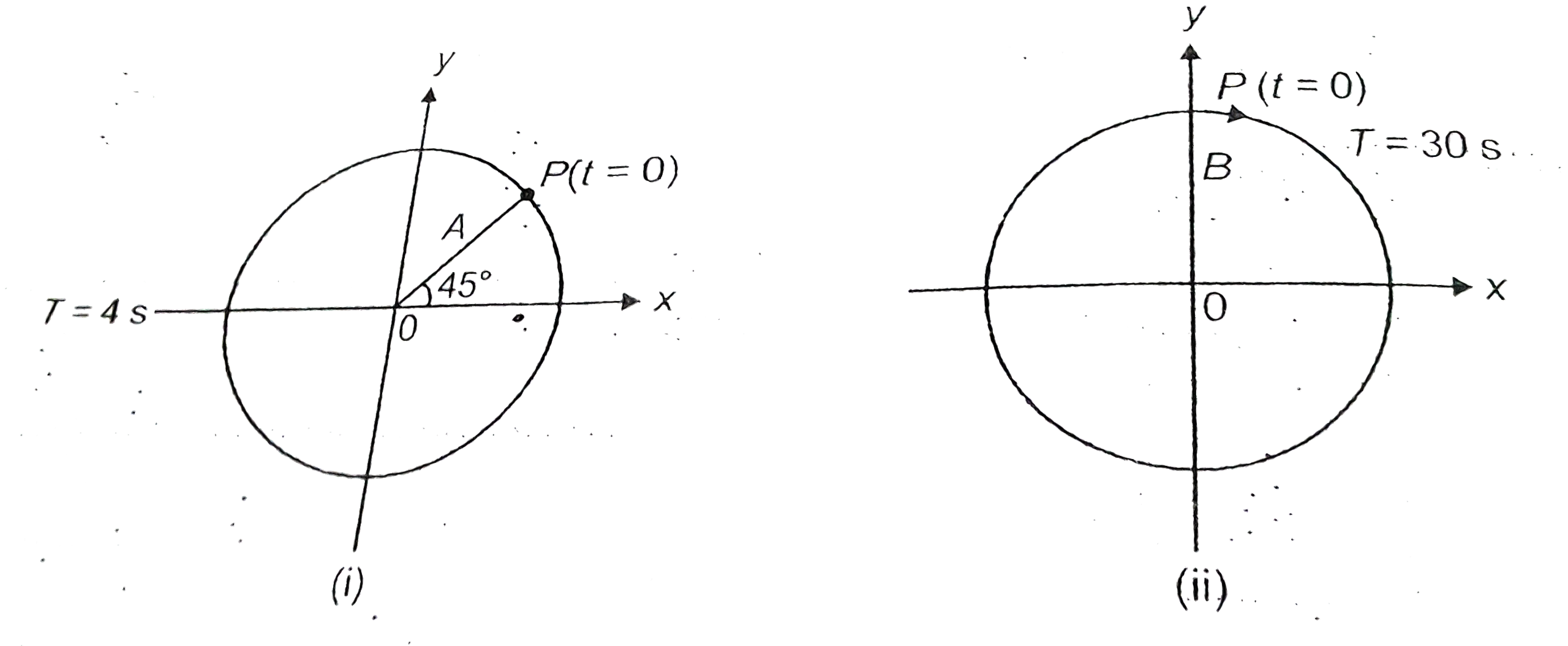
The following figure depicts two circular motions. The radius of the circle, the period of revolutin the initial position and the sense of revolution are indicated on the figure. Obtain the simple harmoic motion of the x-projection of the radius vector of the rotating particle P in each case.

Text Solution

Verified by Experts

Given that , time period , `T= 4s`
angular frequency , `omega = ( 2pi)/(T)= ( 2pi)/(4) = (pi)/(2) rad//s`
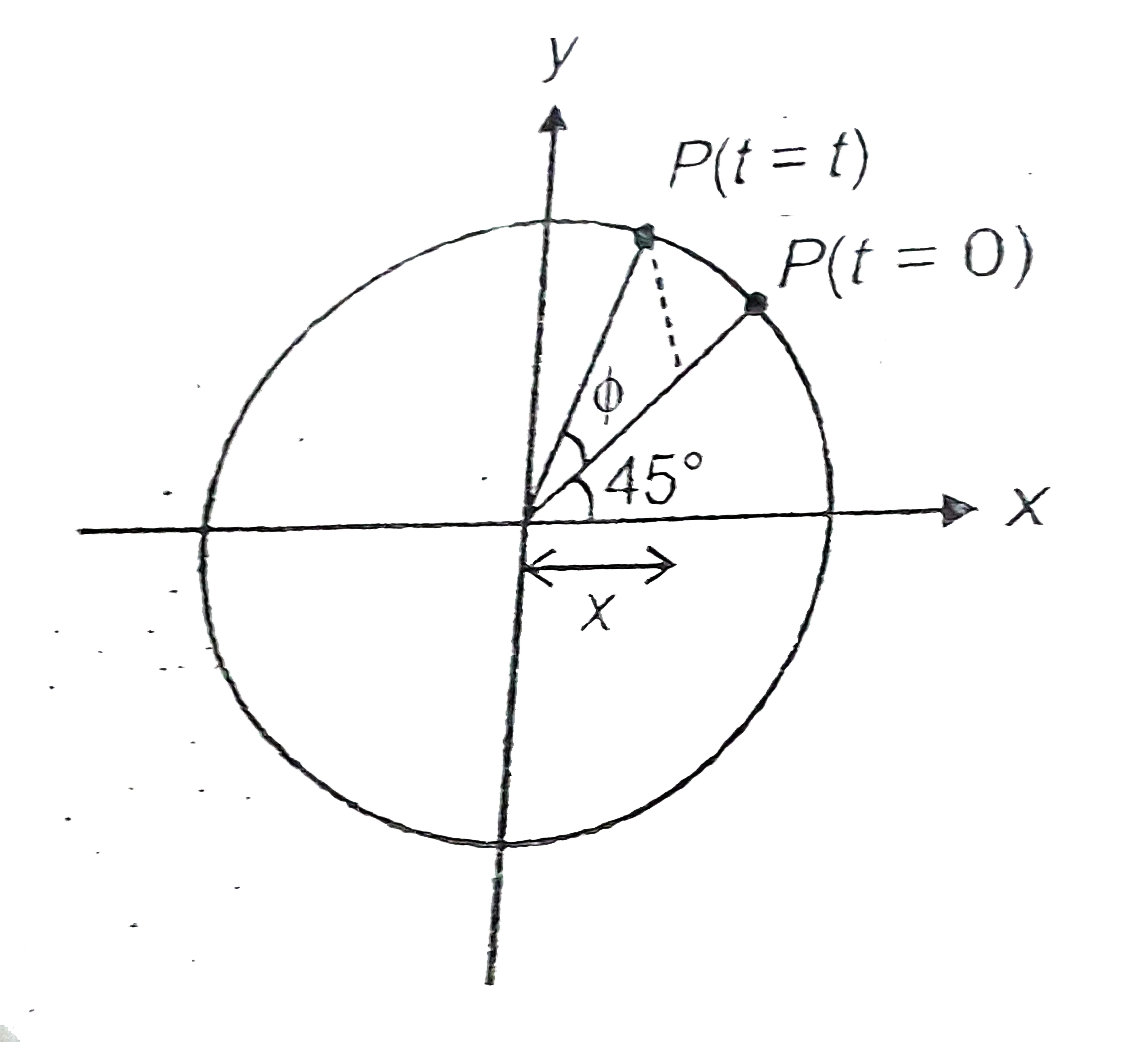
Angle traversed by paritcle in time, ` t, theta = omegat = (pi)/(2) t`
the radial position of the particle at time t makes an angle `( 45^(@) + theta)`
Displacement of particle `=`Projection of P on x-axis ` = A cos ( 45^(@) + theta) =A cos ( 45^(@) + ( pi)/(2)t)`
(ii)
Given that , time period ` T= 30 s`
`:.` angular frequency `omega = ( 2pi)/(T)`
`+ ( 2pi)/( 30)`
`= (pi)/(15)rad //s`
angle traversed by particle in time ` t , theta = omega t = (pi)/( 15) t`
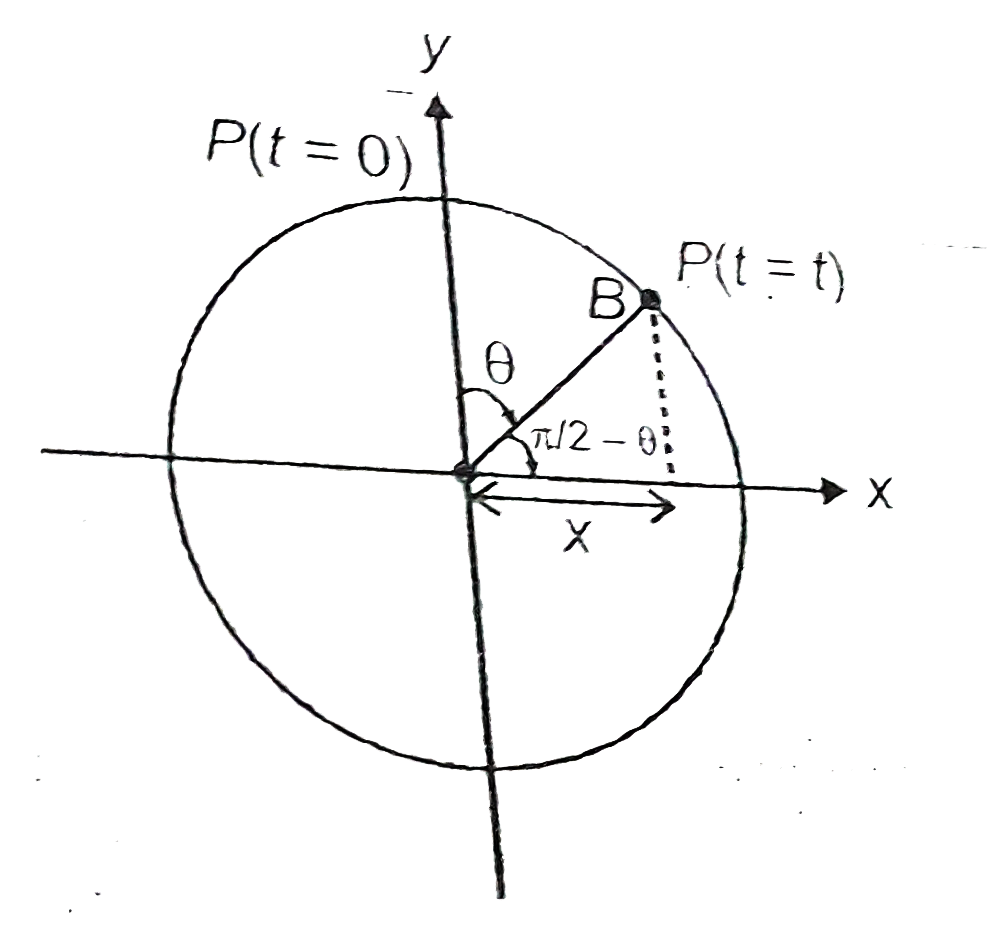
The radial position of the particle at any time t makes an angle
The displacement of the particle `=` projection of P on x-axis `((pi)/(2)-theta)`
`= B cos ((pi)/(2) - theta)`
`= B cos ((pi)/(2) - omegat)`
`= B cos ( (pi)/(2) - (pi)/(15))`
`=Bcos ((pi)/(15)t-(pi)/(2))` `( :' cos ( - theta) = cos theta)`
Promotional Banner

Topper's Solved these Questions

  • OSCILLATIONS

    AAKASH INSTITUTE ENGLISH|Exercise Try Yourself|86 Videos
  • OSCILLATIONS

    AAKASH INSTITUTE ENGLISH|Exercise ASSIGNMENT ( SECTION -A)|58 Videos
  • NUCLEI

    AAKASH INSTITUTE ENGLISH|Exercise ASSIGNMENT (SECTION-D)|10 Videos
  • PHYSICAL WORLD

    AAKASH INSTITUTE ENGLISH|Exercise ASSIGNMENT (Section-B)|4 Videos

Similar Questions

Explore conceptually related problems

Figure depicts two circular motions. The radius of the circle, the period of revolution, the initial position and the sense of revolution are indicated on the figure. Obtain the SHMs of the x-projection of the radius vector of the rotating particle P in each case.

Figure shows the circular motion of a particle. The radius of the circle, the period, sense of revolution and the initial positionn are indicated in the figure. The simple harmonic motion off the x-projection of the radius vector of the rotating particle P is

Figure shows the circular motion of a particle. The radius of the circle, the period, same of revolution and the initial position are indicated on the figure. The simple harmonic motion of the x-projection of the radius vector the rotating particle P is

Figure shows the circular motion of a particle. The radius of the circle, the period, same of revolution and the initial position are indicated on the figure. The simple harmonic motion of the x-projection of the radius vector the rotating particle P is

The radius of cirlcue, the period of revolution, initial position and sense of revolution are indicated in the figure. y-projection of the radius vector of rotating particle P is :

Read each statement below carefully and state, with reasons, if it is true or false : (a) The net acceleration of a particle in circular motion is always along the radius of the circle towards the center. (b) The velocity vector of a particle at a point is always along the tangent to the path of the particle at that point. (c) The acceleration vector of a particle in uniform circular motion averaged over one cycle is a null vector.

The following figure shows the displacement versus time graph for two particles A and B executing simple harmonic motions. The ratio of their maximum velocities is

The plot of velocity (v) versus displacement (x) of a particle executing simple harmonic motion is shown in figure. The time period of oscillation of particle is :-

An object of mass m is moving in unifrom circular motion in xy-plane. The circle has radius R and object is moving clockwise around the circle with speed v. The motion is projected onto the x-axis where it appears as simple harmonic motion accoding to x(t) = Rcos (omegat + phi) . The motion starts from pointof coordinates (0,R) In this projection omega is -

A particle starts from a point P at a distance of A//2 from the mean position O and travels towards left as shown in the figure. If the time period of SHM, executed about O is T and amplitude A then the equation of the motion of particle is