Home
Class 12
PHYSICS
A sound wave of wavelength 0.40 m enter...

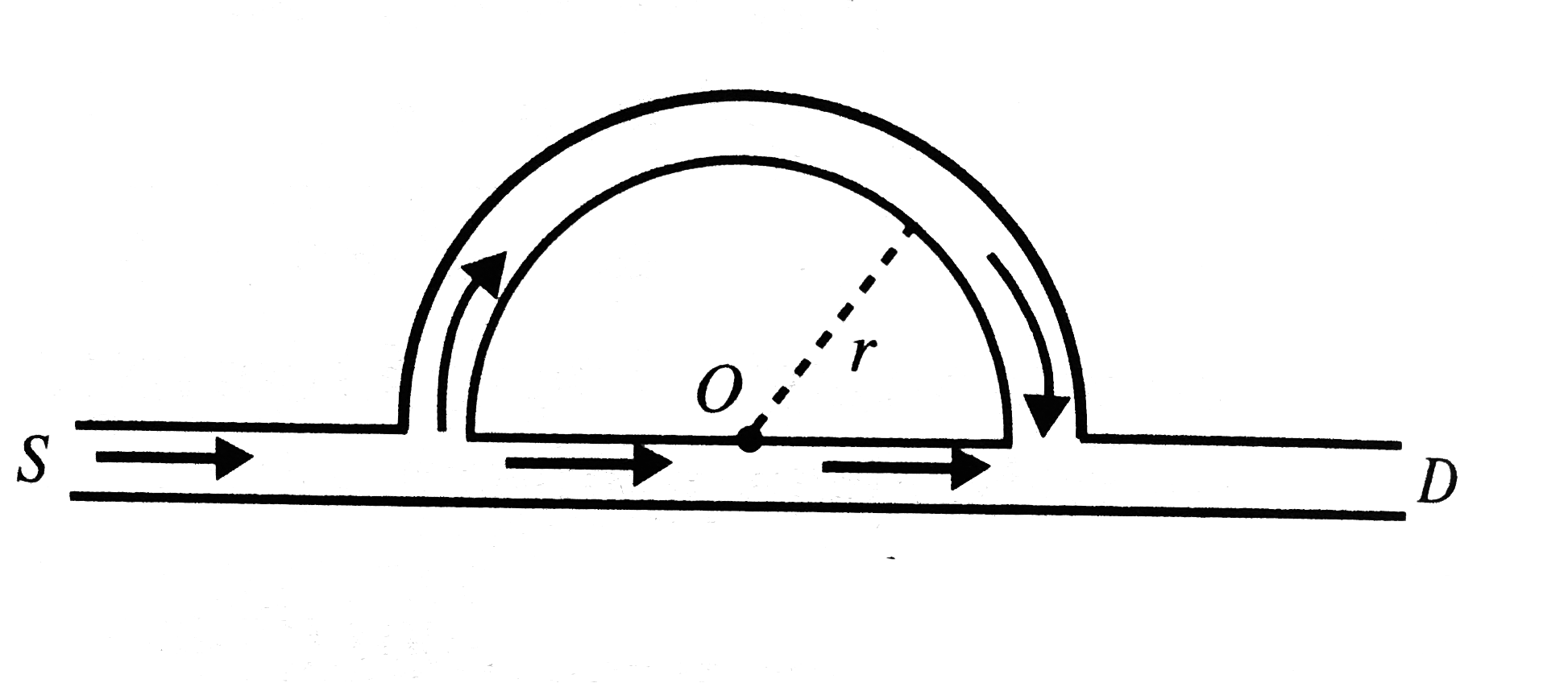
A sound wave of wavelength `0.40 m` enters the tube at `S`. The smallest radius `r` of the circular segment to hear minimum at detector `D` must be

Text Solution

Verified by Experts

The path difference between the waves moving along the straight path and the semicircular path is given by
`Deltaxpir-2r=(pi-2)r`
For minima this path difference should be at least `(lamda)/(2)` i.e., 20, hence we have, for the minimum value of r.
`(pi-2)r=20cm`
or `r=(20)/(pi-2)=17.54cm`
Promotional Banner

Topper's Solved these Questions

  • WAVES

    AAKASH INSTITUTE ENGLISH|Exercise Try Yourself|65 Videos
  • WAVES

    AAKASH INSTITUTE ENGLISH|Exercise Assignment (Section-A)|55 Videos
  • WAVE OPTICS

    AAKASH INSTITUTE ENGLISH|Exercise Assignment (Section-J (Aakash Challengers question))|1 Videos
  • WORK, ENERGY AND POWER

    AAKASH INSTITUTE ENGLISH|Exercise Assignment (SECTION - D)|13 Videos

Similar Questions

Explore conceptually related problems

Two sound waves of wavelength 1 m and 1.01 m in a gas produce 10 beats in 3 s. The velocity of sound in the gas is

Two sound waves of wavelength 1 m and 1.02 m produces 16 beats in 2 s in a medium then the velocity of the sound in that medium is

If sound wave of frequency 500Hz and wavelength 0.66m is travelling in a medium. Calculate the velocity of the wave in the medium.

Two sources of sound, S_1 and S_2 , emitting waves of equal wavelength 20.0 cm, are placed with a separation of 20.0 cm between them. A detector can be moved on a line parallel to S_1S_2 and at a distance of 20.0 cm from P it. Initially, the detector is equidistant from the two sources. Assuming that the waves emitted by the sources are in phase, find the minimum distance through wffich the detector should be shifted to detect a minimum of sound.

A source S and a detector D are placed at a distance d apart. A big cardboard is placed at a distance sqrt2d from the source and the detector as shown in figure. The source emits a wave of wavelength = d/2 which is received by the detector after reflection from the cardboard. It is found to be in phase with the direct wave received from the source. By what minimum distance should the cardboard be shifted away so that the reflected wave becomes out of phase with the direct wave ?

A sound wave travelling in water has wavelength 0.4 m. Is this wave audible in air ? (The speed of sound in water = 1400ms^(-1) )

Sound waves of wavelength lambda travelling in a medium with a speed of upsilon m//s enter into another medium where its speed is 2upsilon m//s. Wavelength of sound waves iin the second medium is

A narrow tube is bent in the form of a circle of radius R, as shown in figure. Two small holes S and D are made in the tube at the position at right angle to each other. A source placed at S generates a wave of intensity I_(0) which two parts: one part travels along the longer path, while the other travels along the shorter path. Both the waves meet at point D where a detector is placed. 1. If a maxima if formed at a detector, then the magnitude of wavelength lambda of the, wave produced is given by

A narrow tube is bent in the form of a circle of radius R, as shown in figure. Two small holes S and D are made in the tube at the position at right angle to each other. A source placed at S generates a wave of intensity I_(0) which two parts: one part travels along the longer path, while the other travels along the shorter path. Both the waves meet at point D where a detector is placed. 2. If a minima is formed at the detector, then the magnitude of wavelength lambda of the wave produced is given by

Two source of sound, S_(1) and S_(2) , emitting waves of equal wavelength 2 cm , are placed with a separation of 3 cm between them. A detector can be moved on a line parallel to S_(1) S_(2) and at a distance 24 cm from it. Initially, the detecor is equidistant from the two sources. Assuming that the waves emitted by the sources are in phase, find the minimum distance through which the detector should be shifted to detect a minimum of sound.
