Home
Class 12
PHYSICS
A block of mass M is kept in elevator (l...


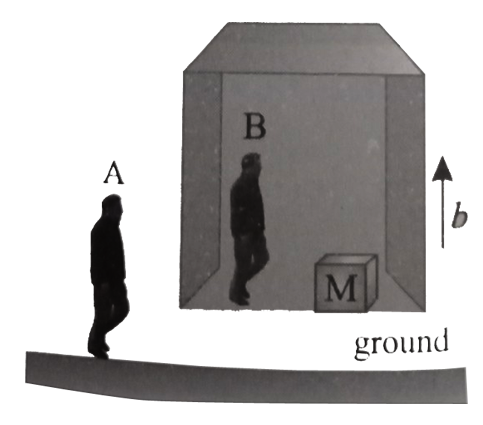
A block of mass M is kept in elevator (lift) which starts moving upward with constant acceleration b as shown in figure. Initially elevator at rest. The block is observed by two observers A and B for a time interval `t=0` to `t=T`. Observer B is at rest with respect to elevator and observer A is standing on the ground.
Q. The observer A finds that the work done by gravity on the block is

Text Solution

Verified by Experts

`2sqrt((L)/(g+a))`
Promotional Banner

Topper's Solved these Questions

  • WAVES

    AAKASH INSTITUTE ENGLISH|Exercise Assignment (Section-A)|55 Videos
  • WAVES

    AAKASH INSTITUTE ENGLISH|Exercise Assignment (Section-B)|35 Videos
  • WAVES

    AAKASH INSTITUTE ENGLISH|Exercise ASSIGNMENT ( SECTION-D ( Assertion - Reason Type Questions ))|12 Videos
  • WAVE OPTICS

    AAKASH INSTITUTE ENGLISH|Exercise Assignment (Section-J (Aakash Challengers question))|1 Videos
  • WORK, ENERGY AND POWER

    AAKASH INSTITUTE ENGLISH|Exercise Assignment (SECTION - D)|13 Videos

Similar Questions

Explore conceptually related problems

A block of mass M is kept in elevator (lift) which starts moving upward with constant acceleration b as shown in figure. Initially elevator at rest. The block is observed by two observers A and B for a time interval t=0 to t=T . Observer B is at rest with respect to elevator and observer A is standing on the ground. Q. According to observer B

A block of mass M is kept in elevator (lift) which starts moving upward with constant acceleration b as shown in figure. Initially elevator at rest. The block is observed by two observers A and B for a time interval t=0 to t=T . Observer B is at rest with respect to elevator and observer A is standing on the ground. Q. The observer A finds that work done by normal reaction acting on the blocks is

A block of mass M is kept in elevator (lift) which starts moving upward with constant acceleration b as shown in figure. Initially elevator at rest. The block is observed by two observers A and B for a time interval t=0 to t=T . Observer B is at rest with respect to elevator and observer A is standing on the ground. Q. The observer A finds that work done by normal reaction acting on the blocks is

A block of mass m is kept on a platform which starts from rest with constant acceleration g/2 upward, as shown in fig. Work done by normal reaction on block in time t is :

A block of mass 2 kg rests on the floor of an elevator , which is moving down with an acceleration 'g' , then the apparent weight of the block is [ take g = 10 m//s^(2) ]

A block of mass m_1 moves with an acceleration a_(12) relative to a trolley as shown in figure. The block is being observed by two observers (2) and (3). The observer (2) is at rest with respect to trolley which is moving with acceleration a_2 while the observer(3) is moving on ground with acceleration a_3 . What is the work done by the pseudo force as observed by the observers (2) and (3) on the block during time t? Assume zero intial velocities of the bodies and observers.

A block of mass m is suspended by a light thread from an elevator. The elevator is accelerating upward with uniform acceleration a. The work done by tension on the block during t seconds is (u = 0)

A man of mass M stands on a weighing machine in an elevator accelerating upwards with an acceleration a. Draw the free-body diagram of the man as observed by the observer A (stationary on the ground) and observer B (stationary on the elevator). Also, calculate the reading of the weighing machine.

A block is partially immeresed in a liquid and the vessel is accelerating upwards with an acceleration 'a'. The block is observed by two observers O_1 and O_2 , one at rest and the other accelerating with an acceleration 'a' upward. The total buoyant force on the block is :

An inclined plane is moving up with constant velocity v . A block kept on incline is at rest. Calculate the work done by gravity, friction force, and normal reaciton on block in time interval of t.

AAKASH INSTITUTE ENGLISH-WAVES-Try Yourself
  1. Explain the difference between the speed of a transverse wave travelli...

    Text Solution

    |

  2. A body executing shm completes 120 oscillations per minute. If the amp...

    Text Solution

    |

  3. A block of mass M is kept in elevator (lift) which starts moving upwar...

    Text Solution

    |

  4. A rope of length L and mass m hangs freely from the ceiling. The veloc...

    Text Solution

    |

  5. Find the temperature at which the velocity of sound in air is double t...

    Text Solution

    |

  6. Explain why transver waves cannot be propagated through fluids?

    Text Solution

    |

  7. What is common in mechanical longitudinal and transverse waves?

    Text Solution

    |

  8. The frequency of a mechanical wave is 256 Hz. Calculate its wavelength...

    Text Solution

    |

  9. A mechanical wave has a velocity of 330 m/s. calculate its frequency i...

    Text Solution

    |

  10. A steel wire 100 cm long has a mass of 10 gm. If the wire is under a t...

    Text Solution

    |

  11. What is the speed of a transverse wave in a rope of length 10 m and ma...

    Text Solution

    |

  12. Calculate the speed of longitudinal sound wave in a liquid. The bulk m...

    Text Solution

    |

  13. The speed of longitudinal mechanical wave in a material is 4300 m/s. y...

    Text Solution

    |

  14. The speed of sound waves in air at 300K is 332 m/s. At what temperatur...

    Text Solution

    |

  15. The velocity of sound in air at 20^(@)C is 340ms^(-1). Keeping the tem...

    Text Solution

    |

  16. Two waves represented by y(i)=3sin(200x-150t) and y(2)=3cos(200x-150t)...

    Text Solution

    |

  17. What is the phase difference between two waves of equal amplitude havi...

    Text Solution

    |

  18. A man fires a gun while standing between two parallel hills. If he hea...

    Text Solution

    |

  19. The equation of a transverse wave travelling along a string is y(xt)=0...

    Text Solution

    |

  20. The equation of a stationary wave is represented by y=2sin((2pix)/(3...

    Text Solution

    |
