Home
Class 12
PHYSICS
An ideal gas follows a cyclic process as...

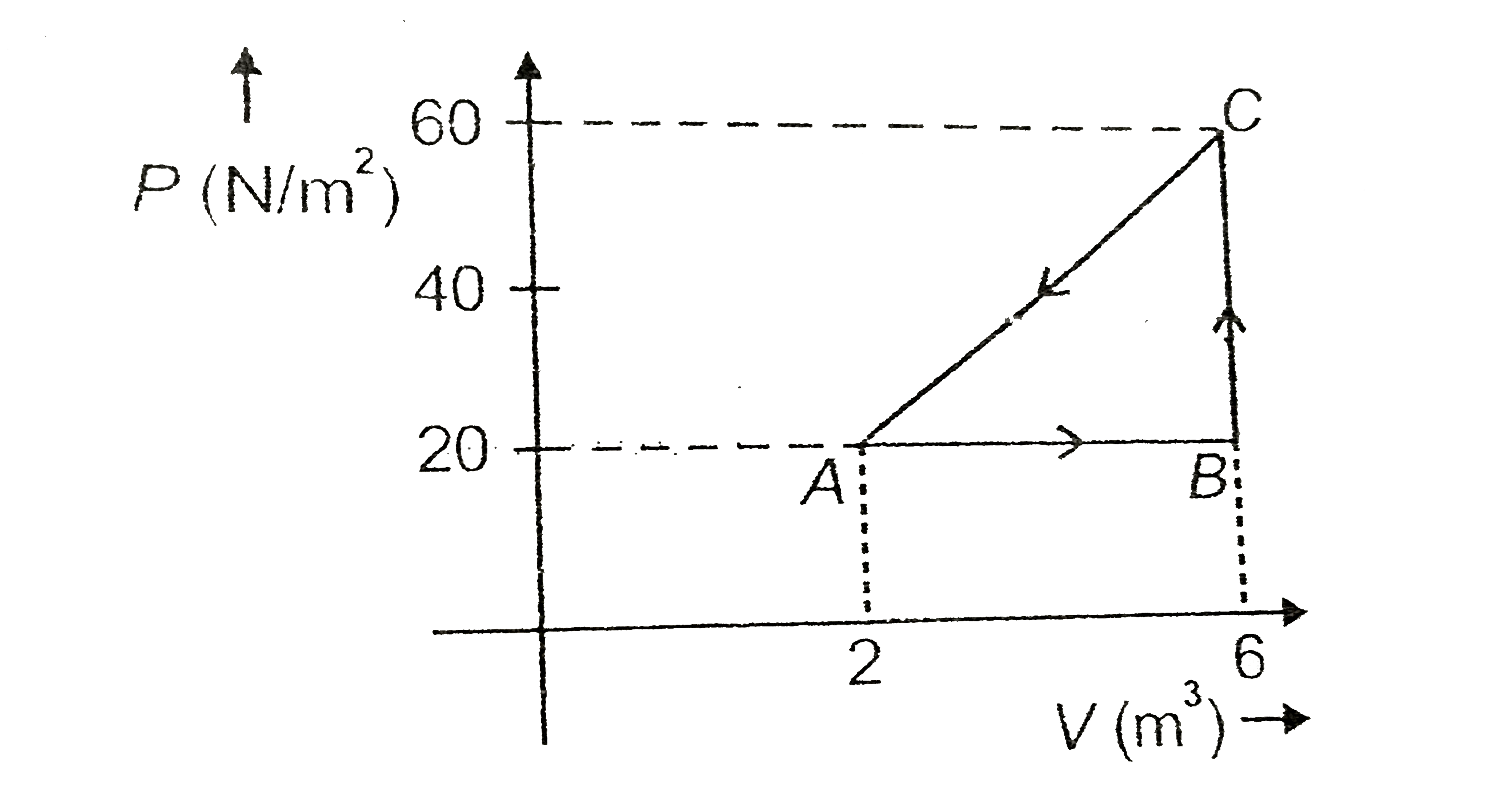
An ideal gas follows a cyclic process as shown in figure. Internal energy of gas at point A is 10 J while at B is 70 J. the heat absorbed by gas in BC is 120 J.
(a) How much heat is absorbed in process AB?
(b) Find heat energy rejected or absorbed by gas in process CA.

Text Solution

Verified by Experts

(a) Process AB is isobaric. For AB process,
`DeltaU=U_(B)-U_(A)=60J`
`W=PDeltaV=20(6-2)=80J`
`impliesQ_(AB)=DeltaU+W=60+80=140J`
(b) Net area enclosed by ABCA=net work done (which is negative since process is anticlockwise)
`impliessumW=-(1)/(2)xx40xx4=-80J`
For any cyclic process,
`sumQ=sumW` ltBrgt `impliesQ_(AB)+Q_(BC)+Q_(CA)=-80`
`implies140+120+Q_(CA)=-80`
`impliesQ_(CA)=-340J`.
Promotional Banner

Topper's Solved these Questions

  • THERMODYNAMICS

    AAKASH INSTITUTE ENGLISH|Exercise Try Youself|13 Videos
  • THERMODYNAMICS

    AAKASH INSTITUTE ENGLISH|Exercise Assignment (Section-A) Objective Type Questions (one option is correct)|50 Videos
  • THERMAL PROPERTIES OF MATTER

    AAKASH INSTITUTE ENGLISH|Exercise Assignment (Section-J) Akash Challengers Questions|7 Videos
  • UNITS AND MEASUREMENTS

    AAKASH INSTITUTE ENGLISH|Exercise ASSIGNMENT (SECTION - D)|15 Videos

Similar Questions

Explore conceptually related problems

An ideal gas is taken round a cyclic thermodynamic process ABCA as shown if Fig. If the internal energy of the gas at point A is assumed zero while at B it is 50 J. The heat absorbed by the gas in the process BC is 90 J. (a) What is the internal energy og the gas at point C ? (b) How much heat energy is absorbed by the gas in the process AB? (c ) Find the heat energy rejected or absorbed by the gas in the process CA. (d) What is the net work done by the gas in the complete cycle ABCA ?

In a thermodynamic cyclic process ABC, internal energy at A is 10J and at B is 70J. Heat given in process B to C is 100J, then heat released or absorbed in process C to A is

An ideal monoatomic gas undergoes a cyclic process ABCA as shown in the figure. The ratio of heat absorbed during AB to the work done on the gas during BC id

One mole of an ideal monatomic gas is taken round the cyclic process ABCA as shown in figure. Calculate (a) the work done by the gas. (b) the heat rejected by the gas in the path CA and the heat absorbed by the gas in the path AB, (c) the net heat absorbed by the gas in the path BC, (d) the maximum temperature attained by the gas during the cycle.

One mole of an ideal monatomic gas is taken round the cyclic process ABCA as shown in figure. Calculate (a) the work done by the gas. (b) the heat rejected by the gas in the path CA and the heat absorbed by the gas in the path AB, (c) the net heat absorbed by the gas in the path BC, (d) the maximum temperature attained by the gas during the cycle.

The PV-graph for a monatomic gas is shown in figure. Find the energy absorbed by the gas during this process.

One mole of monoatomic gas is taken round the cyclic process. Heat absorbed by gas in process AB is

A sample of an ideal gas is taken through the cyclic process abca and shown in the figure. The change in the internal energy of the gas along the path ca is -180J . The gas absorbs 250J of heat along the path ab and 60 J along the path bc. the work done by the gas along the path abc is:

One mole of ideal monoatomic gas is taken round the cyclic process as shown in figure. The heat rejected by the gas in the path CA is ………...and the heat absorbed by the gas in the path AB is ………...........

A gas is taken through a cyclic process ABCA as shown in, if 2.4 cal of heat is given in the process, what is the value of J ?
