Home
Class 12
PHYSICS
The force per unit length between two pa...

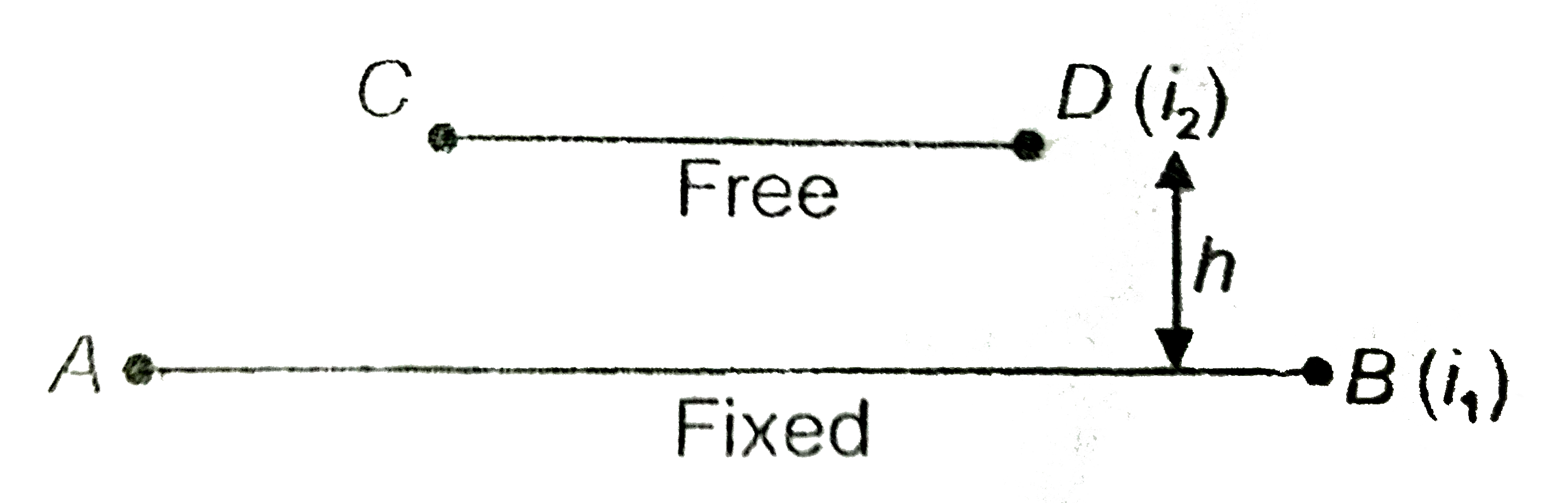
The force per unit length between two parallel current carrying wires `= (mu_(0)i_(1)i_(2))/(2pir)` . The force is attractive when the current is in same direction and repulsive, when the they are in opposite directions. The force between the wires of two parallel wires is shown. We can determine the equilibrium position. Then we displace upper wire by a small distance, keeping lower wire fixed. If the wire returns to or tries to return to its equilibrium position, its equilibrium is stable. We can thus show that upper wire can execute linear simple harmonic motion or not. The length of wire AB is large as compared to separation between the wires.

If `lamda` is mass per unit length of wire CD, then the equilibrium separation h is given by

A

`h = (mu_(0)i_(1) i_(2))/(2pi lamdag)`

B

`h = (2mu_(0)i_(1) i_(2))/(2pi lamdag)`

C

`h = (2pi lamdag)/(mu_(0)i_(1)i_(2))`

D

`h = (4pi lamda g)/(mu_(0)i_(1) i_(2))`

Text Solution

Verified by Experts

The correct Answer is:

A
Promotional Banner

Topper's Solved these Questions

  • MOVING CHARGES AND MAGNETISM

    AAKASH INSTITUTE ENGLISH|Exercise Assignment Section E (Assertion - Reason Type Questions)|9 Videos
  • MOVING CHARGES AND MAGNETISM

    AAKASH INSTITUTE ENGLISH|Exercise Assignment Section F (Matrix-Match Type Questions|6 Videos
  • MOVING CHARGES AND MAGNETISM

    AAKASH INSTITUTE ENGLISH|Exercise Assignment Section C (Objective Type Questions (More than one option are correct)|14 Videos
  • MOVING CHARGE AND MAGNESIUM

    AAKASH INSTITUTE ENGLISH|Exercise SECTION D|16 Videos
  • NUCLEI

    AAKASH INSTITUTE ENGLISH|Exercise ASSIGNMENT (SECTION-D)|10 Videos

Similar Questions

Explore conceptually related problems

The force per unit length between two parallel current carrying wires = (mu_(0)i_(1)i_(2))/(2pir) . The force is attractive when the current is in same direction and repulsive, when the they are in opposite directions. The force between the wires of two parallel wires is shown. We can determine the equilibrium position. Then we displace upper wire by a small distance, keeping lower wire fixed. If the wire returns to or tries to return to its equilibrium position, its equilibrium is stable. We can thus show that upper wire can execute linear simple harmonic motion or not. The length of wire AB is large as compared to separation between the wires. If wire CD is displaced upward to increase the separation by dh, the magnitude of net force per unit length acting on the wire CD becomes

The force per unit length between two parallel current carrying wires = (mu_(0)i_(1)i_(2))/(2pir) . The force is attractive when the current is in same direction and repulsive, when the they are in opposite directions. The force between the wires of two parallel wires is shown. We can determine the equilibrium position. Then we displace upper wire by a small distance, keeping lower wire fixed. If the wire returns to or tries to return to its equilibrium position, its equilibrium is stable. We can thus show that upper wire can execute linear simple harmonic motion or not. The length of wire AB is large as compared to separation between the wires. If wire CD is in equilibrium position then which of the following may represent the directions of current in the wires

The force between two parallel current carrying wires is independent of

When two wires have current in same direction then force is

If current in two parallel wires flow in opposite directions, the force between the wires will:

When two parallel wires carrying current l and 2l in same direction are placed at a distance d apart, the ratio of force per unit length acting upon the wire due to other is

The magnetic field midway between two parallel current carrying wires, carrying currents I and 2i in same direction is B. If the current in the wire with current I is switched off, the magnetic field will become

The force exerted on a current-carrying wire placed in magnetic field is zero when the angle between the wire and the direction of magnetic field is :

Write an expression for force per unit length between two long current carrying wires, kept parallel to each other, in vacuum and hence define an ampere, the SI unit of current

Two parallel wires 2 m apart carry currents of 2 A and 5 A respectively in same direction, the force per unit length acting between these two wires is
