Home
Class 12
PHYSICS
On an inclined plane, two conducting rai...

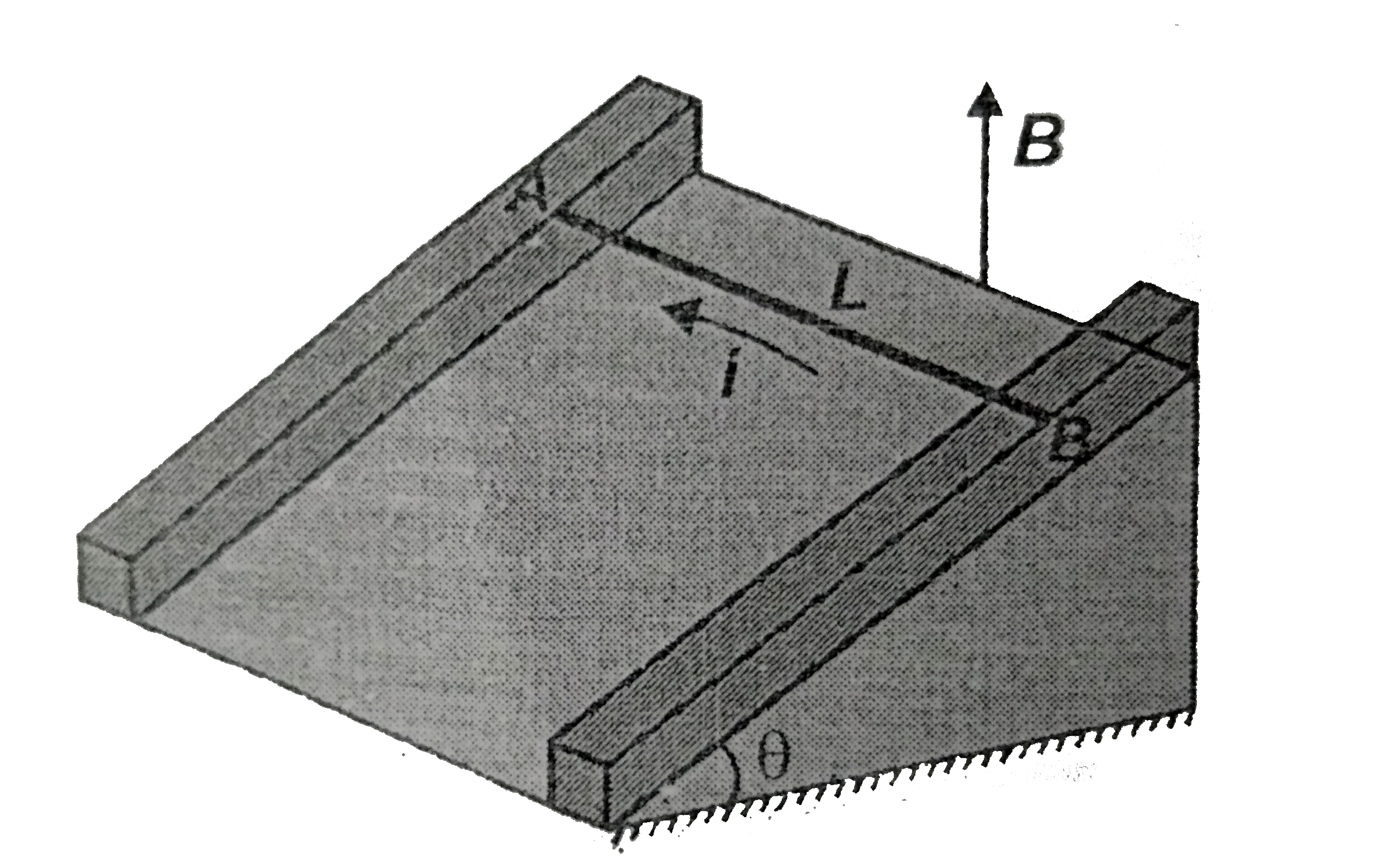
On an inclined plane, two conducting rails are fixed along the line of greatest slope. A conducting rod AB is placed on the radils so that it is horizontal. A vertically upward uniform magnetic field is present in the region. A current i flows through AB from B to A. The mass of AB is m and the coefficient of friction between the rod and rails is `mu`. Find the minimum and maximum value of B, so that the rod can stay in equilibrium. Assume that `mu lt tan theta`

Text Solution

Verified by Experts

`B_("min") = (mg (sin theta - mu cos theta))/(lL (cos theta + mu sin theta))`
`B_("max") = (mg (sin theta + mu cos theta))/(IL (cos theta - mu sin theta))`
For equilibrium `B_("min") le B le B_("max")`
Promotional Banner

Topper's Solved these Questions

  • MOVING CHARGES AND MAGNETISM

    AAKASH INSTITUTE ENGLISH|Exercise Assignment Section J (Aakash Challengers Questions)|5 Videos
  • MOVING CHARGES AND MAGNETISM

    AAKASH INSTITUTE ENGLISH|Exercise Assignment Section H (Multiple True-False Type Questions)|5 Videos
  • MOVING CHARGE AND MAGNESIUM

    AAKASH INSTITUTE ENGLISH|Exercise SECTION D|16 Videos
  • NUCLEI

    AAKASH INSTITUTE ENGLISH|Exercise ASSIGNMENT (SECTION-D)|10 Videos

Similar Questions

Explore conceptually related problems

A conductor (rod) of mass m, length l carrying a current i is subjected to a magnetic field of induction B. If the coefficients of friction between the conducting rod and rail is mu, find the value of I if the rod starts sliding.

If the coefficient of friction between M and the inclined surfaces is mu = 1//sqrt(3) find the minimum mass m of the rod so that the of mass M = 10 kg remain stationary on the inclined plane

AB and CD are fixed conducting smooth rails placed in a vertical plane and joined by a constant current source at its upper end. PQ is a conducting rod which is free to slide on the rails. A horizontal uniform magnetic field exists in space as shown in figure. If the rod PQ is released from rest then,

A copper rod of mass m rests on two horizontal rails distance L apart and carries a current of I from one rail to the other. The coefficient of static friction between rod and rails is mu_(s) What are the (a) magnitude and (b) angle (relative to the vertical) of the smallest magnetic field that puts the rod on the verge of sliding?

A pair of parallel conducting rails lie at right angle to a uniform magnetic field of 2.0T as shown in the fig. two resistor 10Omega and 5Omega are to slide without friction along the rail. The distance between the conducting rails is 0.1m . Then

A block of mass m is projected up with a velocity v_0 along an inclined plane of angle of inclination theta=37^@ . The coefficient of friction between the inclined plane AB and blocks is mu(=tan theta) . Find the values of v_0 so that the block moves in a circular path from B to C.

A block of mass m is placed at rest on an inclination theta to the horizontal. If the coefficient of friction between the block and the plane is mu , then the total force the inclined plane exerts on the block is

A conducting rod AB of length l is rotated about point O with an angular velocity velocity omega in a uniform magnetic field (B_0) directed perpendicular into the plane of rotation as shown in the figure. The value of V_B - V_A is

Shows a rod of length l and resistance r moving on two rails shorted by a resistance R . A uniform magnetic field B is present normal to the plane of rod and rails. Show the electrical equivalence of each branch.

Shows a rod of length l and resistance r moving on two rails shorted by a resistance R . A uniform magnetic field B is present normal to the plane of rod and rails. Show the electrical equivalence of each branch.
