Home
Class 12
PHYSICS
Two concave refracting surface of equal ...

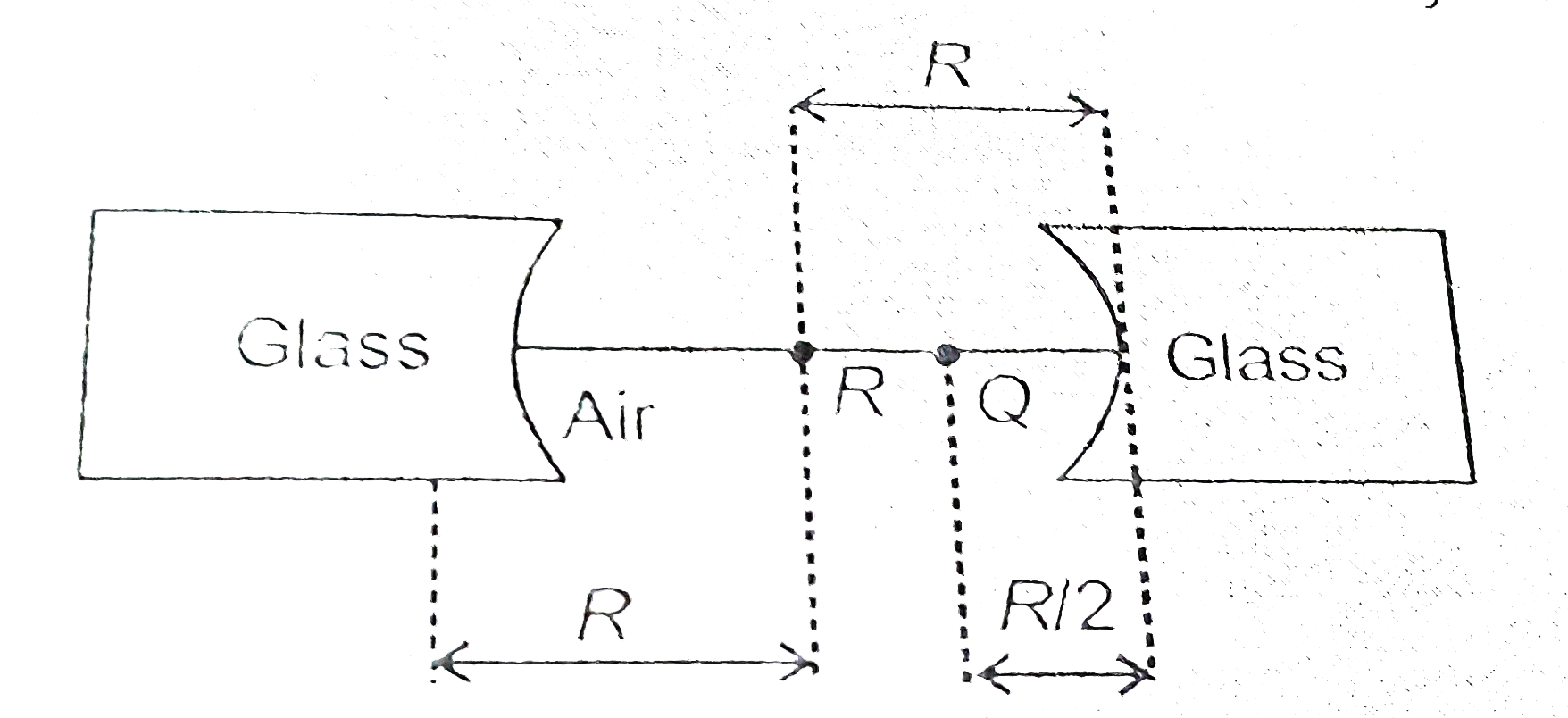
Two concave refracting surface of equal radii of curvature and refractive index 1.5 face each other in air as shown in figure. A point is placed midway in between the centre and one of the vertices. What is the separation between the image of O formed by each refracting surface ?

Text Solution

Verified by Experts

We have for the image formed by the surface on the right side.
`mu_(1) = 1, mu_(2) = 1.5, u = - R//2, R_(1) = -R`
`(mu_(2))/(v) - (mu_(1))/(u) = (mu_(2)-mu_(1))/(2)`
`(1.5)/(v) - (2)/(-R) = (1.50-1.00)/(-R)`
`:. v = -(3R)/(5)`
The image is at a distance of (R - 3R/5) = 0.4 R from the centre P towards the right side. For the surface on the left side,
`mu_(1) = 1, mu_(2) = 1.5, u = 3R//2, R_(2) = R`
`(mu_(2))/(v) - (mu_(1))/(u) = (mu_(2) - mu_(1))/(R_(2))`
`(1.5)/(v) - (2)/(-3R) = (1.50 - 1.00)/(R)`
`(1.5)/(v) = (1)/(2R) + (2)/(3R) = (7)/(6R)`
`:. v = (9R)/(7)`
Hence, the image is at distance of `((9R)/(7-R) = (2R)/(7))` from the centre O towards the right hand side. The distance between the two images = 0.4R - 2R/7 = 0.114R.
Promotional Banner

Topper's Solved these Questions

  • RAY OPTICS AND OPTICAL INSTRUMENTS

    AAKASH INSTITUTE ENGLISH|Exercise Assignment (Section - A) Objective Type Questions (One option is correct)|38 Videos
  • RAY OPTICS AND OPTICAL INSTRUMENTS

    AAKASH INSTITUTE ENGLISH|Exercise Assignment (Section - B) Objective Type Questions (One option is correct)|15 Videos
  • PHYSICAL WORLD

    AAKASH INSTITUTE ENGLISH|Exercise ASSIGNMENT (Section-B)|4 Videos
  • SEMICONDUCTOR ELECTRONICS (MATERIAL, DEVICES AND SIMPLE CIRUITS )

    AAKASH INSTITUTE ENGLISH|Exercise Assignment SECTION - D (Assertion & reason type Question)|10 Videos

Similar Questions

Explore conceptually related problems

A double convex lens has two surfaces of equal radii R and refractive index m=1.5, we have

The radius curvature of each surface of a convex lens of refractive index 1.5 is 40 cm. Calculate its power.

Locate the image of the point object O in the situation shown in figure. The point C denotes the centre of curvature of the separating surface.

A convex refracting surface of radius of curvature 20 cm separates two media of refractive indices 4//3 and 1.60 . An object is placed in the first medium (mu = 4//3) at a distance of 200 cm from the refracting surface. Calculate the position of image formed.

A concave spherical surface of radius of curvature 100 cm separates two media of refractive indices 1.50 and (4)/(3) . An object is kept in the first medium at a distance of 30 cm from the surface. Calculate the position of the image.

A lens is made of three thin different mediums. Radius of curvature and refractive index of each medium is shown iin Figure., Surface AB is straight. An object is placed at some distance from the lens by which a real image is formed on the screen placed at a distance of 10cm from the lens. Find the distance of the object from the lens.

In the figure, a point object O is placed in air. A spherical boundry separates two media of radius of curvature 1.0 m. AB is principal axis. The separation between the images formed due to refraction at spherical surface is

A concave spherical refractive surface with radius R separates a medium of refractive index 5//2 from air. As an object is approaching the surface from far away from the surface along the central axis, its image

Locate the image formed by refraction in the situation shown in figure. The point C is the centre of curvature

A plano-convex lens P and a concavo-convex lens Q are in contact as shown in figure. The refractive index o fthe material of the lens P and Q is 1.8 and 1.2 respectively. The radius of curvature of the concave surface of the lens Q is double the radius of curvature of the convex surface. The convex surface of Q is silvered. An object is placed on the placed on the principal axis at a distance 10 cm form the plane surface. The image is formed at a distance 40 cm from the plane surfaces on the same side. The focal length of the system is

AAKASH INSTITUTE ENGLISH-RAY OPTICS AND OPTICAL INSTRUMENTS-ASSIGNMENT (SECTION - D)
  1. Two concave refracting surface of equal radii of curvature and refract...

    Text Solution

    |

  2. A : Plane and convex mirrors can produce real images of objects. R :...

    Text Solution

    |

  3. A : A virtual image cannot be caught on a screen but it can be photogr...

    Text Solution

    |

  4. A : When a diver under water looks obliquely at a fisherman standing o...

    Text Solution

    |

  5. A : The apparent depth of a tank of water decreases if viewed obliquel...

    Text Solution

    |

  6. A : Proper cutting of diamond makes it sparkle. R : Diamond has very...

    Text Solution

    |

  7. A : The angle subtended at the eye by an object is equal to the angle ...

    Text Solution

    |

  8. The total plane angle subtended by a circle at its centre is

    Text Solution

    |

  9. A : Magnifying power of a simple microscope cannot be increased beyond...

    Text Solution

    |

  10. A : The objective and the eye-piece of a compound microscope should ha...

    Text Solution

    |

  11. A : When viewing through a compound microscope, our eyes should be pos...

    Text Solution

    |

  12. A uniform capillary tube of inner radius r is dipped vertically into a...

    Text Solution

    |

  13. A : A virtual image cannot be produced on screen. R : The light ener...

    Text Solution

    |

  14. A : Lenses of large aperture suffer from spherical aberration. R : T...

    Text Solution

    |

  15. A : The image formed by a concave lens is always virtual. R : The ra...

    Text Solution

    |

  16. A : When two lenses in contact form an achromatic doublet, then the ma...

    Text Solution

    |

  17. A : A reflecting type of telescope is preferred over refracting type i...

    Text Solution

    |
