Home
Class 12
PHYSICS
Light falls at normal incidence on one f...

Light falls at normal incidence on one face of a glass prism of refractive index 1.5, what will be the angle of emergence when the angle of the prism is (a) `30^(@)` (b) `50^(@)` ?

Text Solution

Verified by Experts
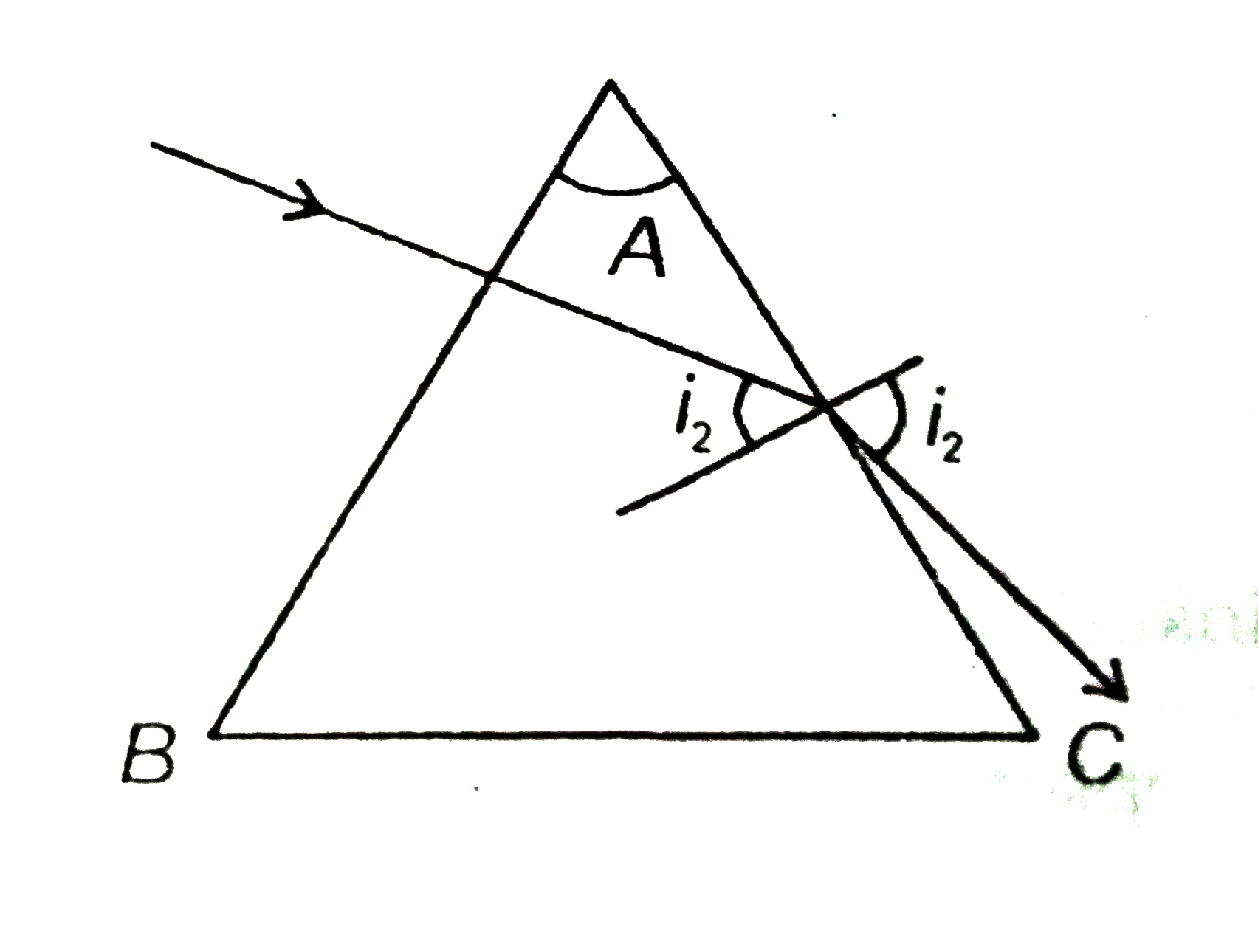
The incident ray is normal to the face AB of the prism shown in the figure. So, the angle of incidence, `i_(1) = 0` making `r_(1) = 0`
When light undergoes refraction through a prism, `r_(1) + r_(2) = A`
(a) `0 + r_(2) = 30^(@)`
`r_(2) = 30^(@)`
`sin i_(2) = mu sin r_(2) = 1.5 sin 30^(@) = 1.5 (0.5) = 0.75`
(b) `A = 50^(@)`
Substituting in `r_(1) + r_(2) = A`
`0 + r_(2) = 50^(@), r_(2) = 50^(@)`
`sin i_(2) = mu sin r_(2) = 1.5 sin 50^(@) = 1.5 (0.7660) = 1.149`
No value of `i_(2)` can satisfy this relation. So, there is not refraction at the second surface i.e., there is no emergent ray from the face AC of the prism. The light is totally reflected as `r_(2)` is greater than the critical angle.
Promotional Banner

Topper's Solved these Questions

  • RAY OPTICS AND OPTICAL INSTRUMENTS

    AAKASH INSTITUTE ENGLISH|Exercise Assignment (Section - A) Objective Type Questions (One option is correct)|38 Videos
  • RAY OPTICS AND OPTICAL INSTRUMENTS

    AAKASH INSTITUTE ENGLISH|Exercise Assignment (Section - B) Objective Type Questions (One option is correct)|15 Videos
  • PHYSICAL WORLD

    AAKASH INSTITUTE ENGLISH|Exercise ASSIGNMENT (Section-B)|4 Videos
  • SEMICONDUCTOR ELECTRONICS (MATERIAL, DEVICES AND SIMPLE CIRUITS )

    AAKASH INSTITUTE ENGLISH|Exercise Assignment SECTION - D (Assertion & reason type Question)|10 Videos

Similar Questions

Explore conceptually related problems

A light ray is normally incident onone face of equilateral glass prism of refractive index sqrt(2) . The deviation of light ray is

A ray of light is normally incident on one face of an equilateral glass prism. Answer the following : (a) What is the angle of incidence on the first face of the prism? (b) What is the angle of refraction from the first face of the prism ? (c) What will be the angle of incidence at the second face of the prism ? (d) Will the light ray suffer minimum deviation by the prism ?

A ray of light is incident on a prism whose refractive index is 1.52 at an angle of 40^(@) . If the angle of emergence is 60^(@) , calculate the angle of the prism.

The least angle of deviation for a glass prism is equal to its refracting angle. The refractive index of glass is 1.5. Then the angle of the prism is

The least angle of deviation for a glass prism is equal to its refracting angle. The refractive index of glass is 1.5. Then the angle of the prism is

A ray of light is incident normally on one face of an equilateral prism of refractive index 1.5 . The angle of deviation is: (Given sin^-1.(2)/(3)=42^@ )

If a light ray incidents normally on one of the faces of the prism of refractive index 2 and the emergent ray just grazes the second face of the prism, then the angle of deviation is

If a light ray incidents normally on one of the faces of the prism of refractive index 2 and the emergent ray just grazes the second face of the prism, then the angle of deviation is

Calculate the angle of incidence on the face of a prism of refracting angle 60^(@) and of refractive index 1.5, for which the emergent ray just grazes the other face.

A light ray is incident by grazing one of the face of a prism and after refraction ray does not emerge out, what should be the angle of prism while critical angle is C ?

AAKASH INSTITUTE ENGLISH-RAY OPTICS AND OPTICAL INSTRUMENTS-ASSIGNMENT (SECTION - D)
  1. Light falls at normal incidence on one face of a glass prism of refrac...

    Text Solution

    |

  2. A : Plane and convex mirrors can produce real images of objects. R :...

    Text Solution

    |

  3. A : A virtual image cannot be caught on a screen but it can be photogr...

    Text Solution

    |

  4. A : When a diver under water looks obliquely at a fisherman standing o...

    Text Solution

    |

  5. A : The apparent depth of a tank of water decreases if viewed obliquel...

    Text Solution

    |

  6. A : Proper cutting of diamond makes it sparkle. R : Diamond has very...

    Text Solution

    |

  7. A : The angle subtended at the eye by an object is equal to the angle ...

    Text Solution

    |

  8. The total plane angle subtended by a circle at its centre is

    Text Solution

    |

  9. A : Magnifying power of a simple microscope cannot be increased beyond...

    Text Solution

    |

  10. A : The objective and the eye-piece of a compound microscope should ha...

    Text Solution

    |

  11. A : When viewing through a compound microscope, our eyes should be pos...

    Text Solution

    |

  12. A uniform capillary tube of inner radius r is dipped vertically into a...

    Text Solution

    |

  13. A : A virtual image cannot be produced on screen. R : The light ener...

    Text Solution

    |

  14. A : Lenses of large aperture suffer from spherical aberration. R : T...

    Text Solution

    |

  15. A : The image formed by a concave lens is always virtual. R : The ra...

    Text Solution

    |

  16. A : When two lenses in contact form an achromatic doublet, then the ma...

    Text Solution

    |

  17. A : A reflecting type of telescope is preferred over refracting type i...

    Text Solution

    |

