Home
Class 12
PHYSICS
Two prisms of same glass (mu = sqrt(2)) ...

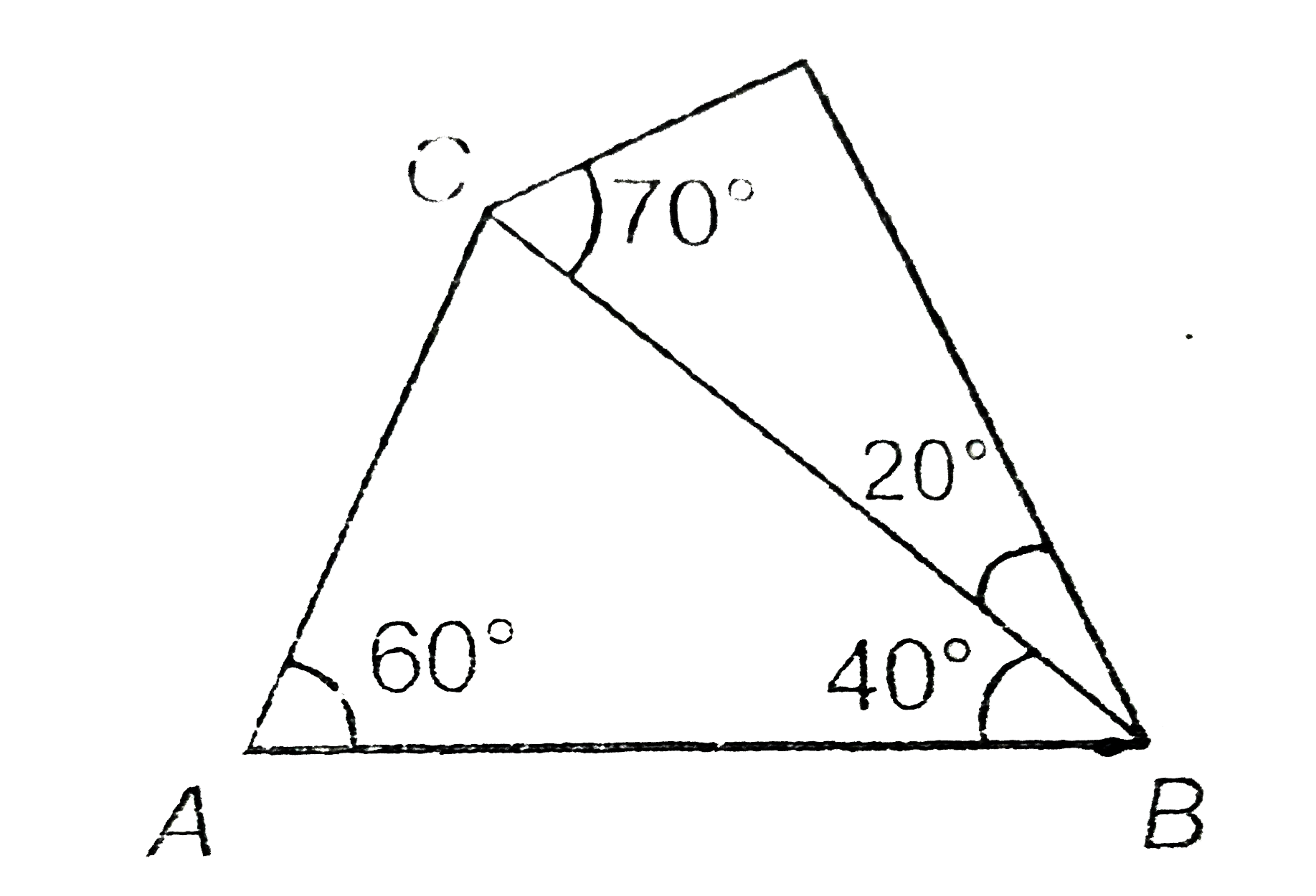
Two prisms of same glass `(mu = sqrt(2))` are stuck together without gap as shown. Find the angle of incidence i on the face AC such that the deviation produced by the combination is minimum ?

A

`60^(@)`

B

`15^(@)`

C

`30^(@)`

D

`45^(@)`

Text Solution

Verified by Experts

The correct Answer is:

D
Promotional Banner

Topper's Solved these Questions

  • RAY OPTICS AND OPTICAL INSTRUMENTS

    AAKASH INSTITUTE ENGLISH|Exercise Assignment (Section - C) Objective Type Questions (More than one option are correct)|9 Videos
  • RAY OPTICS AND OPTICAL INSTRUMENTS

    AAKASH INSTITUTE ENGLISH|Exercise Assignment (Section - D) Linked Comprehension Type Questions|12 Videos
  • RAY OPTICS AND OPTICAL INSTRUMENTS

    AAKASH INSTITUTE ENGLISH|Exercise Assignment (Section - A) Objective Type Questions (One option is correct)|38 Videos
  • PHYSICAL WORLD

    AAKASH INSTITUTE ENGLISH|Exercise ASSIGNMENT (Section-B)|4 Videos
  • SEMICONDUCTOR ELECTRONICS (MATERIAL, DEVICES AND SIMPLE CIRUITS )

    AAKASH INSTITUTE ENGLISH|Exercise Assignment SECTION - D (Assertion & reason type Question)|10 Videos

Similar Questions

Explore conceptually related problems

Light falls from glass (mu=1.5) to air. Find the angle of incidence for which the angle of deviation is 90^@ .

The ray PQ shown in the figure , surface minimum deviation in an equilateral prism A. Two more identical prism B and C and of the same material as A are now placed in contact as. Show in the figure . If prism A produces a minimum deviation delta_m , the deviation produced by the combination of prisms A, B and C will be

A ray of light is incident on the surface of a transparent sphere of R.I. mu = (sqrt(7))/(2) . After refraction is is internally reflected and refracted out of the sphere as shown in the figure. Find the angle of incidence 'I' so that the total deviation produced is minimum. 'C' is the centre of the sphere. .

A ray of light is incident on a prism ABC of mu = sqrt(3) as shown in Fig. Find the angle of incidence for which the deviation of light by the prism ABC is minimum. By what angle should the second prism be rotated so that final ray suffers net minimum deviation ?

A ray of light is normally incident on one face of an equilateral glass prism. Answer the following : (a) What is the angle of incidence on the first face of the prism? (b) What is the angle of refraction from the first face of the prism ? (c) What will be the angle of incidence at the second face of the prism ? (d) Will the light ray suffer minimum deviation by the prism ?

The relation between angle of incidence i , angle of prism A and angle of minimum deviation for a triangular prism is.

In the figure two triangular prism are shown each of refractive index sqrt3 . (a) Find the angle of incidence on the face AB for minimum deviation from the prism ABC ? (b) Find the angle through which the prism DCE should be rotated about the edge passing through point C so that there should be minimum deviation from the system ?

Answer the following: (i) A ray of light incident on face AB of an equilateral glass prism, shows minimum deviation of 30^(@) . Calculate the speed of the light through the prism. (ii) Find the angle of incidence at face AB so that the emergent ray grazes along the face AC.

A thin prism of angle 6.0^@, omega'=0.07 and mu_y'=1.50 is combined with another thin prism having omega = 0.08 and mu_y = 1.60 . The combination produces no deviation in the mean ray. (a) Find the angle of the second prism. (b) Find the net angular dispersion produced by the combination when a beam of white light passes through it. (c) If the prisms are similarly directed, what will be the deviation in the mean ray ? (d) Find the angular dispersion in the situation described in (c).

A prism of apex angle A=60^@ has the refractive index mu=sqrt2. The angle of incidence for minimum deviation is

AAKASH INSTITUTE ENGLISH-RAY OPTICS AND OPTICAL INSTRUMENTS-Assignment (Section - B) Objective Type Questions (One option is correct)
  1. A lens forms a sharp image on a screen. On inserting a parallel sided ...

    Text Solution

    |

  2. For an eye kept at a depth h inside water is refractive index mu, and ...

    Text Solution

    |

  3. A convex lens A of focal length 20cm and a concave lens B of focal len...

    Text Solution

    |

  4. An equilateral triangular prism is made of glass (mu = 1.5). A ray of ...

    Text Solution

    |

  5. White light is incident on the interface of glass and air as shown in ...

    Text Solution

    |

  6. In a spherical paper weight (R = 10 cm) made of glass of refractive in...

    Text Solution

    |

  7. A concave mirror is placed on a horizontal table with its axis directe...

    Text Solution

    |

  8. Two prisms of same glass (mu = sqrt(2)) are stuck together without gap...

    Text Solution

    |

  9. A short linear object of length b lies along the axis of a concave mir...

    Text Solution

    |

  10. An object is placed 1m in front of the curved surface of a plano-conve...

    Text Solution

    |

  11. Figure shows a torch sending a parallel beam of light fixed on a wall ...

    Text Solution

    |

  12. A ray of light passes from vaccum into a medium of refractive index n....

    Text Solution

    |

  13. A plane mirror is placed horizontally inside water (mu=4/3). A ray fal...

    Text Solution

    |

  14. A thin lens focal length f and its aperture has diameter d. It forms a...

    Text Solution

    |

  15. A tank contains a transparent liquid of refractive index mu. The botto...

    Text Solution

    |
