
Home
Class 12
PHYSICS
Which circuit will not show current in a...

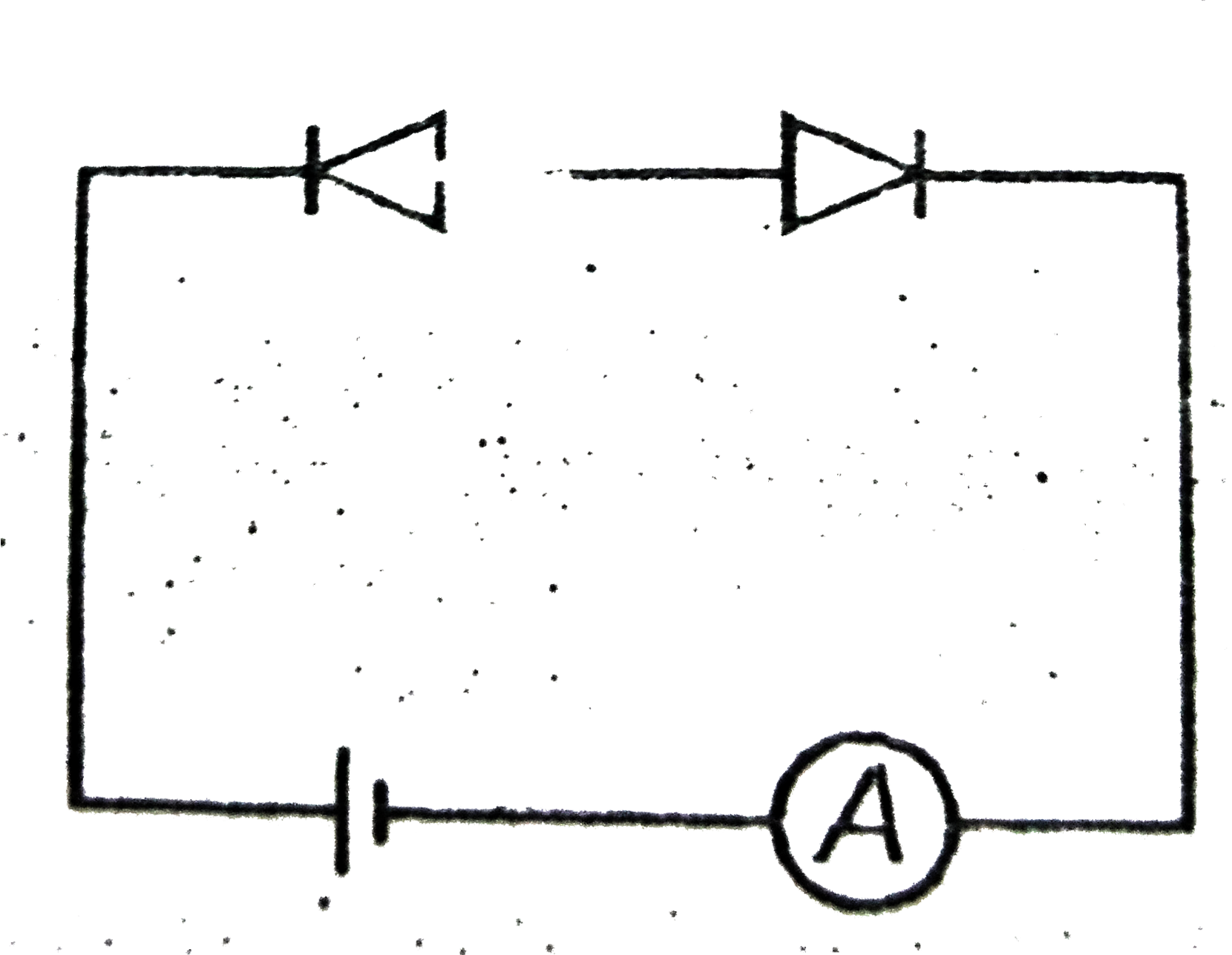
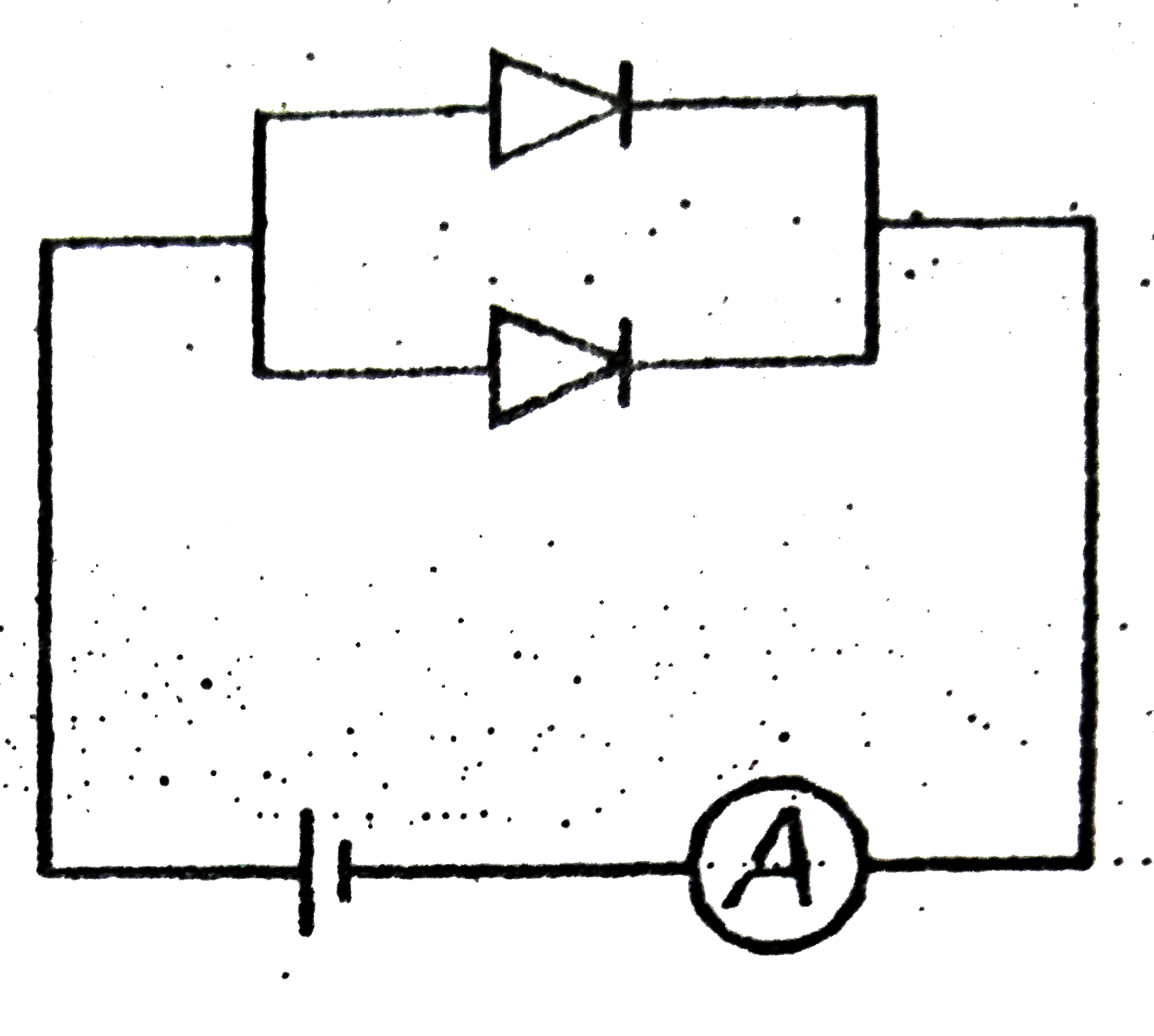
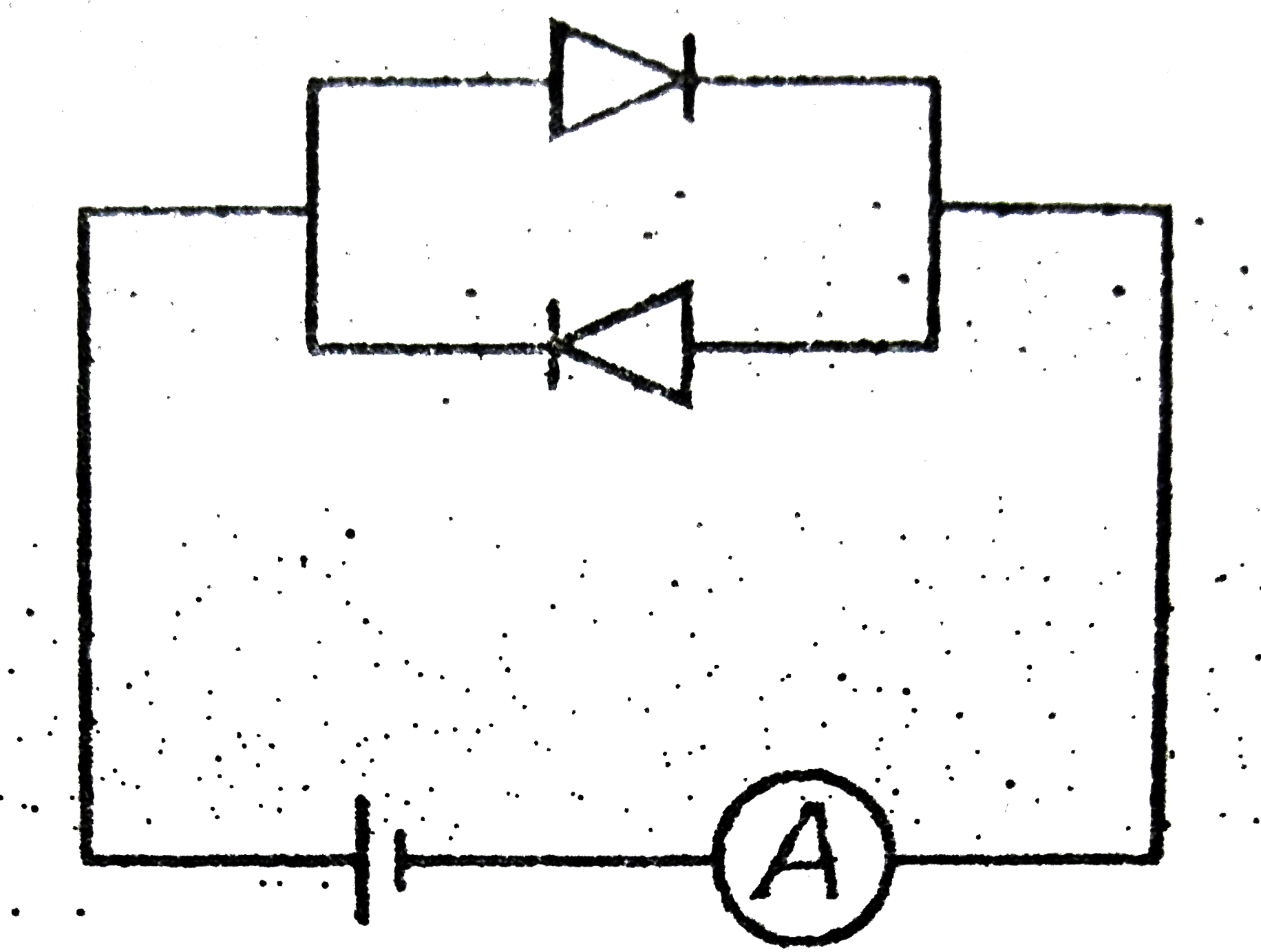
Which circuit will not show current in ammeter ?

A

B

C

D

Text Solution

AI Generated Solution

The correct Answer is:

To determine which circuit will not show current in the ammeter, we need to analyze each circuit option provided. Let's go through the steps systematically. ### Step-by-Step Solution: 1. **Understanding the Circuit Components**: Recognize that diodes have two terminals: anode and cathode. A diode allows current to flow in one direction (forward bias) and blocks it in the opposite direction (reverse bias). 2. **Analyzing Option 1**: - In this circuit, we have two diodes connected in series. - The first diode is reverse biased (anode connected to the negative terminal and cathode to the positive terminal). - The second diode is forward biased (anode connected to the positive terminal and cathode to the negative terminal). - Since one diode is reverse biased, it will not allow current to flow through the circuit, making it an open circuit. - **Conclusion for Option 1**: No current flows; hence, the ammeter will show zero current. 3. **Analyzing Option 2**: - This circuit has two diodes connected in series, both in forward bias. - Both diodes will conduct electricity as they are oriented correctly. - **Conclusion for Option 2**: Current will flow; the ammeter will show current. 4. **Analyzing Option 3**: - Here, two diodes are connected in parallel, both with the same polarity. - Both diodes are forward biased and will conduct electricity. - **Conclusion for Option 3**: Current will flow; the ammeter will show current. 5. **Analyzing Option 4**: - In this circuit, two diodes are connected in series but with opposite polarities. - One diode is forward biased while the other is reverse biased. - The forward biased diode will conduct, while the reverse biased diode will block current. - **Conclusion for Option 4**: Current will flow through the forward biased diode; the ammeter will show current. 6. **Final Conclusion**: After analyzing all options, only Option 1 does not allow current to flow due to the reverse bias of one of the diodes. Therefore, the circuit that will not show current in the ammeter is Option 1. ### Final Answer: **Option 1 is the correct answer; it will not show current in the ammeter.**
Promotional Banner

Topper's Solved these Questions

  • SEMICONDUCTOR ELECTRONICS: MATERIALS, DEVICES AND SIMPLE CIRCUITS

    AAKASH INSTITUTE ENGLISH|Exercise Assignment (Section -B (Objective type question (one option is correct))|29 Videos
  • SEMICONDUCTOR ELECTRONICS: MATERIALS, DEVICES AND SIMPLE CIRCUITS

    AAKASH INSTITUTE ENGLISH|Exercise Assignment (Section -C(Linked comprehension type question))|3 Videos
  • SEMICONDUCTOR ELECTRONICS: MATERIALS, DEVICES AND SIMPLE CIRCUITS

    AAKASH INSTITUTE ENGLISH|Exercise Try yourself|20 Videos
  • SEMICONDUCTOR ELECTRONICS (MATERIAL, DEVICES AND SIMPLE CIRUITS )

    AAKASH INSTITUTE ENGLISH|Exercise Assignment SECTION - D (Assertion & reason type Question)|10 Videos
  • SYSTEM OF PARTICLES AND ROTATIONAL MOTION

    AAKASH INSTITUTE ENGLISH|Exercise Try Yourself|63 Videos

Similar Questions

Explore conceptually related problems

Consider a circular as shows in Fig. 6.5 (a). We want to measure the current i flowing in the circuit. For this we connect an ammeter of resistance R_(A) as shows in Fig. 6.5 (b). Find the percentage error in the current.

In the circuit shown in figure, reading of ammeter will

In the circuit shown in figure, the current is to measured. What is the value of the current if the ammeter shown (i) is a galvanometer with a resistance R_G=60*00Omega . (ii) is a galvanometer described in (i) but converted to an ammeter by a shunt resistance r_s=0*02Omega , (iii) is an ideal ammeter with zero resistance?

In the circuit shown in figure the reading of ammeter is the same with both switches open as with both closed. Then find the resistance R . (ammeter is ideal).

In the circuit shown in figure the reading of ammeter is the same with both switches open as with both closed. Then find the resistance R . (ammeter is ideal).

The figure shows a circuit. When the circuit is switched on, the ammeter reads 0.5A. Calculate the value of the unknown resistor R.

The figure shows a circuit. When the circuit is switched on, the ammeter reads 0.5A. Calculate the power dissipated in the 3Omega resistor.

The figure shows a circuit. When the circuit is switched on, the ammeter reads 0.5A. Calculate the charge passing through the 3Omega resistor in 120 s.

In the circuit shown, A and V are ideal ammeter and voltmeter respectively. Reading of the voltmeter will be

In the given circuit in which case will the ammeter reading not change when R_2 is varied?

AAKASH INSTITUTE ENGLISH-SEMICONDUCTOR ELECTRONICS: MATERIALS, DEVICES AND SIMPLE CIRCUITS-Assignment (Section -A (Objective Type question (One option is correct))
  1. The mobility of free electrons is greater then that of free holes beca...

    Text Solution

    |

  2. Carbon , silicon and germanium have four valence electrons each . At r...

    Text Solution

    |

  3. Which circuit will not show current in ammeter ?

    Text Solution

    |

  4. A p-n photodiode is made of a material with a band gap of 2 e V. The m...

    Text Solution

    |

  5. Zener breakdown takes place if

    Text Solution

    |

  6. In the depletion region of an unbiased p-n junction diode there are

    Text Solution

    |

  7. Function of rectifier is

    Text Solution

    |

  8. In a p–n junction photo cell, the value of the photo electromotive for...

    Text Solution

    |

  9. Serious draw back of the semiconductor device is

    Text Solution

    |

  10. The reason of current flow in P-N junction forward biase is

    Text Solution

    |

  11. In the energy band diagram of a material shown below, the open circles...

    Text Solution

    |

  12. An oscillator is nothing but an amplifier with

    Text Solution

    |

  13. When a n-p-n transistor is used as an amplifier, then

    Text Solution

    |

  14. If l(1),l(2),l(3) are the lengths of the emitter, base and collector o...

    Text Solution

    |

  15. A common emitter amplifier gives an output of 3 V for an input of 0.01...

    Text Solution

    |

  16. In a common base amplifier the phase difference the input signal volta...

    Text Solution

    |

  17. In a common emitter amplifier the input signal is applied across

    Text Solution

    |

  18. The concentration of impurities in a transistor is

    Text Solution

    |

  19. In a transistor, the collector current is always · less then the emitt...

    Text Solution

    |

  20. The minimum potential difference between the base and emitter required...

    Text Solution

    |
