Home
Class 12
PHYSICS
Two inclined planes OA and OB having inc...

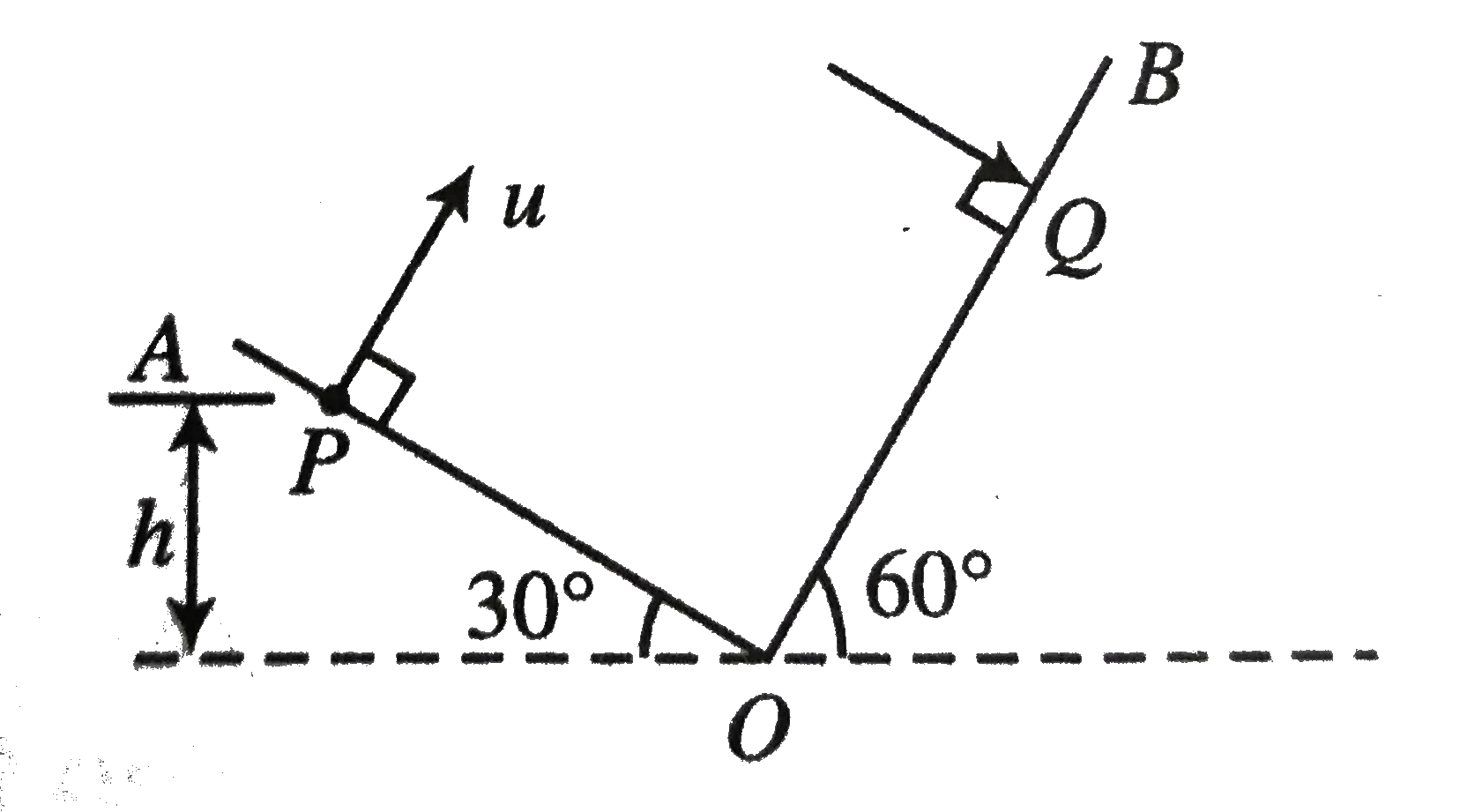
Two inclined planes OA and OB having inclination (with horizontal) `30^(@)` and `60^(@)`, respectively, intersect each other at O as shown in figure. A particle is projected from point P with velocity `u = 10(sqrt3) ms^(-1)` along a direction perpendicular to plane OA. If the particle strikes plane OB perpendicularly at Q, calculate

The velocity with which particle strikes the plane OB,

Text Solution

Verified by Experts

In the shown co-ordnate system for motion of the particle along x-axis .
` U_(x) = u`
` a_(x) = -g sin 60^(@)`
For motion of the paricle along y-axis.
` U_(y) = 0, a_(y) = - g cos 60^(@)`
(i) If particle strikes the plane ON after time t then ` v_(x) = u_(x) + a_(x) t`
Now ` v_(x) =0 ` therefore ,
` Rightarrow t = u/(g sin 60^(@))`
` = ( 10sqrt3)/(1 0xx sqrt3/2)`
= 2s
(ii) For velocity of the particle after time t = ( 2s)
` v_(y) = u_(y) +a_(y)t`
= ` 0 - gcos 60^(@) xx 2`
` - 10xx 1/2 xx2`
10 m/s
(iii) For distance AO
` y_(AO) |u_(y) + 1/2a_(y)t^(2)|`
`|0+ 1/2 ( - g cos 60^(@)t^(2)|`
` |-1/2 xx 10 xx 1/2 xx 2^(2)|`
= | - 10 m|
10 m
Now height A from the horizontal level of O
`h = OA sin 30^(@)`
` 10 xx 1/2`
(iv) For distance OB
Considering motion along x-axis
` v_(x)^(2) = u_(x)^(2) + 2a_(x) (OB) Rightarrow 0 = ( 10sqrt3)^(2) - 2g sin 60^(@) xx ( OB)`
`Rightarrow 0 =300 - 2 xx 10 xx sqrt3/2 xx ( OB)`
` Rightarrow OB = 10sqrt3 ` m
Now , from right angle ` triangle AOB`
Distance AB = ` sqrt(OA^(2) +OB^(2))`
` = sqrt(10^(2) + (10sqrt3)^(2))`
= 20m
Promotional Banner

Topper's Solved these Questions

  • MOTION IN A PLANE

    AAKASH INSTITUTE ENGLISH|Exercise llustration 1 :|1 Videos
  • MOTION IN A PLANE

    AAKASH INSTITUTE ENGLISH|Exercise Try yourself|48 Videos
  • MOCK_TEST_17

    AAKASH INSTITUTE ENGLISH|Exercise Example|15 Videos
  • MOTION IN A STRAIGHT LINE

    AAKASH INSTITUTE ENGLISH|Exercise ASSIGNMENT (SECTION - D)|15 Videos

Similar Questions

Explore conceptually related problems

Two inclined planes OA and OB having inclination (with horizontal) 30^(@) and 60^(@) , respectively, intersect each other at O as shown in figure. A particle is projected from point P with velocity u = 10sqrt3 ms^(-1) along a direction perpendicular to plane OA. If the particle strikes plane OB perpendicularly at Q, calculate The vertical height h of P from O,

Two inclined planes OA and OB having inclination (with horizontal) 30^(@) and 60^@ (with horizontal), respectively, intersect each other at O as shown in figure. A particle is projected from point P with velocity u = 10sqrt3 ms^(-1) along a direction perpendicular to plane OA. If the particle strikes plane OB perpendicularly at Q, calculate The maximum height attained by the particle (from the line O)

Two inclined planes OA and OB having inclinations 30^@ and 60^@ with the horizontal respectively intersect each other at O, as shown in figure. A particle is projected from point P with velocity u=10 sqrt(3) m//s along a direction perpendicular to plane OA. If the particle strikes plane OB perpendicular at Q. Calculate. (a) time of flight, (b) velocity with which the particle strikes the plane OB, (c) height h of point P from point O, (d) distance PQ. (Take g=10m//s^(2) )

Two inclined planes OA and OB intersect in a horizontal plane having their inclinations alpha and beta with the horizontal as shown in figure. A particle is projected from P with velocity u along a direction perpendicular to plane OA. The particle strikes plane OB perpendicularly at Q. The path of the particle from P to Q is

Two inclined planes OA and OB intersect in a horizontal plane having their inclinations alpha and beta with the horizontal as shown in figure. A particle is projected from P with velocity u along a direction perpendicular to plane OA. The particle strikes plane OB perpendicularly at Q. If alpha = 30^@ , beta = 30^@ the time of flight from P to Q is

Two inclined planes OA and OB intersect in a horizontal plane having their inclinations alpha and beta with the horizontal as shown in figure. A particle is projected from P with velocity u along a direction perpendicular to plane OA. The particle strikes plane OB perpendicularly at Q. If alpha = 30^@ , beta = 30^@ the time of flight from P to Q is

Two inclined planes OA and OB intersect in a horizontal plane having their inclinations alpha and beta with the horizontal as shown in figure. A particle is projected from P with velocity u along a direction perpendicular to plane OA. The particle strikes plane OB perpendicularly at Q. If alpha = 30^@ , beta = 30^@ and a = 4.9 m, the initial velocity of projection is

Two inclined planes OA and OB intersect in a horizontal plane having their inclinations alpha and beta with the horizontal as shown in figure. A particle is projected from P with velocity u along a direction perpendicular to plane OA. The particle strikes plane OB perpendicularly at Q. If alpha = 30^@ , beta = 30^@ and a = 4.9 m, the initial velocity of projection is

A ball is projected from point A with velocity 10 ms^(-1) perpendicular to the inclined plane as shown in figure. Range of the ball on the inclined plane is

A particle is projected from a point A with velocity sqrt(2)u an angle of 45^(@) with horizontal as shown in figure. It strikes the plane BC at right angles. The velocity of the particle at the time of collision is
