Home
Class 12
PHYSICS
A particles is projected from the foot o...

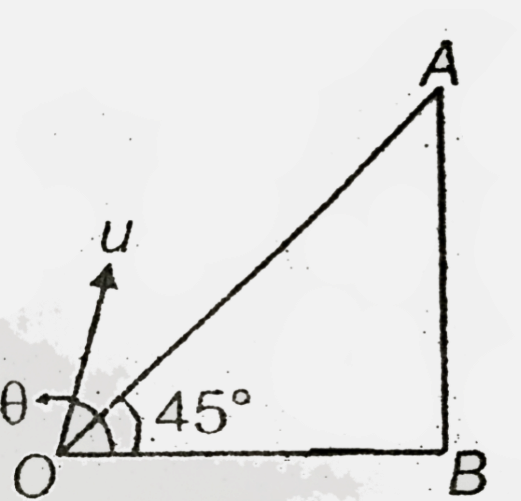
A particles is projected from the foot of an inclined plane having inclination `45^(@)` , with the velocity u at angle `theta( gt 45^(@))` with the horizontal in a vertical plane containing the line of greatest slope through the point of projection. Find the value of ` tantheta` if the particle stikes the plane.
(i) Horizontally
(ii) Normally

Text Solution

Verified by Experts

Let A be the point where the particel strikes the plane after time t.
and OB = AB =h
` Rightarrow OA = hsqrt2`
(i) As the paticle strikes the plane horinzontally, vetical component of its velocity at A will be zero.
For horizontal motion.
`OB = ( u cos theta)t Rightarrow h = u cos theta t`
For vertical motion from equation v = u + at
` 0 = u sintheta - gt `
` or usin theta = "gt" `
again, BP ` = ( u sin theta) t - 1/2 "gt"^(2)`
`h = ( U sin theta) - 1/2 "gt"^(2) `
From equations (i),(ii) and (iii)
` u cos thetat = u sin theta t - 1/2 ( u sin tehta) t`
` Rightarrow tan theta = 2`
(ii) As the particle hits the plane normally, component of its velocity parallel to the plane at this instant will be zero and displancement perpendicular to the plane will be zero.
for the motion along the plane,.
From v = u +at
` 0 = u cos ( theta - 45^(@)) - g sin45^(@)t`
` Rightarrw u cos ( theta - 45^(@)) = g/sqrt2 t`
Again , for the motion perpendicular to the plane from s` = ut + 1/2 at^(2`
` 0 = u sin ( theta - 45^(@) ) t - 1/2 g cos 45^(@) t^(2)`
` Rightarrow t= ( 2sqrt2 u)/g sin ( theta - 45^(@))`


From equation (i) & (ii)
` u cos ( theta - 45^(@)) = g/sqrt2 [ (2sqrt2u)/g sin ( theta - 45^(@))]`
` Rightarrow u cos (theta - 45^(@)) = 2 usin ( theta - 45^(@))`
` Rightarrow tan ( theta -45^(@)) = 1/2`
` Rightarrow ( tan theta -1)/(1 + tan theta) = 1/2 `
` Rightarrow tan theta = 3`
Promotional Banner

Topper's Solved these Questions

  • MOTION IN A PLANE

    AAKASH INSTITUTE ENGLISH|Exercise llustration 1 :|1 Videos
  • MOTION IN A PLANE

    AAKASH INSTITUTE ENGLISH|Exercise Try yourself|48 Videos
  • MOCK_TEST_17

    AAKASH INSTITUTE ENGLISH|Exercise Example|15 Videos
  • MOTION IN A STRAIGHT LINE

    AAKASH INSTITUTE ENGLISH|Exercise ASSIGNMENT (SECTION - D)|15 Videos

Similar Questions

Explore conceptually related problems

A particle is projected from the bottom of an inclined plane of inclination 30^@ . At what angle alpha (from the horizontal) should the particle be projected to get the maximum range on the inclined plane.

A particle is projected from the bottom of an inclined plane of inclination 30^@ with velocity of 40 m//s at an angle of 60^@ with horizontal. Find the speed of the particle when its velocity vector is parallel to the plane. Take g = 10 m//s^2 .

A particle is projected at t = 0 with velocity u at angle theta with the horizontal. Then the ratio of the tangential acceleration and the radius of curvature at the point of projection is :

A ball is projected from the bottom of an inclined plane of inclination 30^@ , with a velocity of 30 ms^(-1) , at an angle of 30^@ with the inclined plane. If g = 10 ms^(-2) , then the range of the ball on given inclined plane is

A particle is projected with velocity v at an angle theta aith horizontal. The average angle velocity of the particle from the point of projection to impact equals

A particle is projected up an inclined plane of inclination beta at an elevation prop to the horizontal. Find the ratio between tan prop and tan beta , if the particle strikes the plane horizontally.

A particle is projected from horizontal making an angle of 53^(@) with initial velocity 100 ms^(-1) . The time taken by the particle to make angle 45^(@) from horizontal is

A particle is projected horizontally with a speed u from the top of plane inclined at an angle theta with the horizontal. How far from the point of projection will the particle strike the plane ?

A particle of mass m is projected with speed u at an angle theta with the horizontal. Find the torque of the weight of the particle about the point of projection when the particle is at the highest point.

A particle of mass m is projected with speed u at an angle theta with the horizontal. Find the torque of the weight of the particle about the point of projection when the particle is at the highest point.

