Home
Class 12
PHYSICS
A dc motor works on the principle that a...

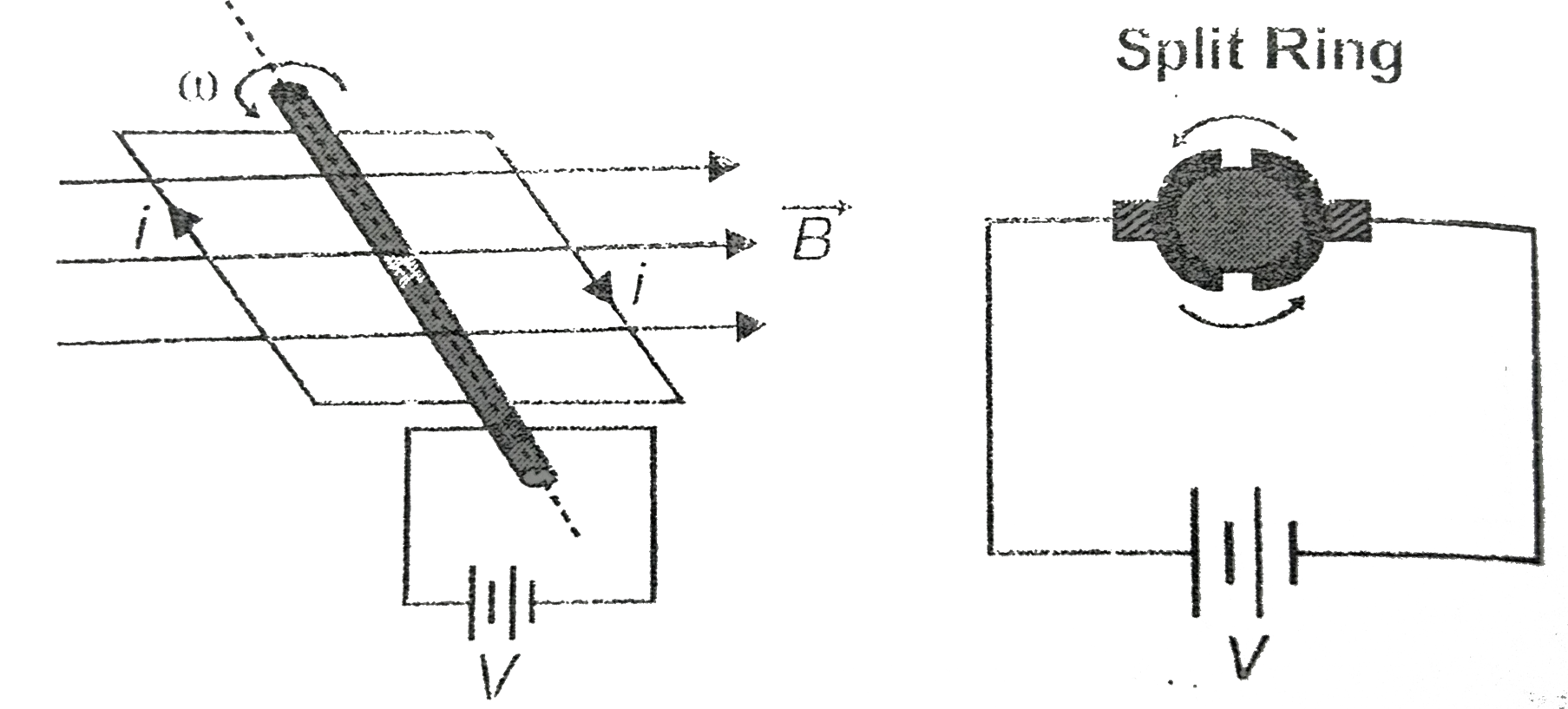
A dc motor works on the principle that a current carrying coil, when placed in a magnetic field experiences a torque. The arrangement consists of a coil suspended in a region of magnetic field. When a current is passed through the coil, it experiences torque and starts rotating. A simple arrangement is shown below.

The coil rotates under the action of torque. The current is supplied to the coil by an arrangement of two sliding contacts and a split ring. As the coil rotates, the magnetic flux linked with the coil changes. This leads to production of an induced emf `epsilon` in the coil. By Lenz's law, the induced emf opposes the applied voltage and therefore, it is called back emf. If R is the resistance in the coil, the current `i` flowing through the coil at any instant is `i=(V-epsilon)/(R)`. The back emf is developed due to induction and it is directly proportional to speed of rotation and it is directly proportional to speed of rotation of the motor. There is a continuous power loss `i^(2)R` in the motor, in form of heat.
When a dc motor is running unloaded (full speed) the current through it is 1 A. What will be the current flowing through the motor, when it is loaded to run at half its maximum speed, it applied voltage is 10 V and armature resistance is `5 Omega`

A

0.5 A

B

`1A`

C

`1.5 A`

D

`2A`

Text Solution

Verified by Experts

The correct Answer is:

C
Promotional Banner

Topper's Solved these Questions

  • ELECTROMAGNETIC INDUCTION

    AAKASH INSTITUTE ENGLISH|Exercise Assignment (SECTION - E)|8 Videos
  • ELECTROMAGNETIC INDUCTION

    AAKASH INSTITUTE ENGLISH|Exercise Assignment (SECTION - F)|2 Videos
  • ELECTROMAGNETIC INDUCTION

    AAKASH INSTITUTE ENGLISH|Exercise Assignment (SECTION - C)|10 Videos
  • ELECTRIC CHARGES AND FIELDS

    AAKASH INSTITUTE ENGLISH|Exercise comprehension|3 Videos
  • ELECTROMAGNETIC WAVES

    AAKASH INSTITUTE ENGLISH|Exercise ASSIGNMENT SECTION - D Assertion-Reason Type Questions|25 Videos

Similar Questions

Explore conceptually related problems

A dc motor works on the principle that a current carrying coil, when placed in a magnetic field experiences a torque. The arrangement consists of a coil suspended in a region of magnetic field. When a current is passed through the coil, it experiences torque and starts rotating. A simple arrangement is shown below. The coil rotates under the action of torque. The current is supplied to the coil by an arrangement of two sliding contacts and a split ring. As the coil rotates, the magnetic flux linked with the coil changes. This leads to production of an induced emf epsilon in the coil. By Lenz's law, the induced emf opposes the applied voltage and therefore, it is called back emf. If R is the resistance in the coil, the current i flowing through the coil at any instant is i=(V-epsilon)/(R) . The back emf is developed due to induction and it is directly proportional to speed of rotation and it is directly proportional to speed of rotation of the motor. There is a continuous power loss i^(2)R in the motor, in form of heat. The mechanical power output of a dc motor is maximum, when the current through the motor is

A dc motor works on the principle that a current carrying coil, when placed in a magnetic field experiences a torque. The arrangement consists of a coil suspended in a region of magnetic field. When a current is passed through the coil, it experiences torque and starts rotating. A simple arrangement is shown below. The coil rotates under the action of torque. The current is supplied to the coil by an arrangement of two sliding contacts and a split ring. As the coil rotates, the magnetic flux linked with the coil changes. This leads to production of an induced emf epsilon in the coil. By Lenz's law, the induced emf opposes the applied voltage and therefore, it is called back emf. If R is the resistance in the coil, the current i flowing through the coil at any instant is i=(V-epsilon)/(R) . The back emf is developed due to induction and it is directly proportional to speed of rotation and it is directly proportional to speed of rotation of the motor. There is a continuous power loss i^(2)R in the motor, in form of heat. In a dc motor, V is applied voltage, epsilon is back emf, i is current through the motor and R is resistance of the coil. mechanical power output of the motor is

A moving coil type of galvanometer is based upon the principle that a current carrying loop in a magnetic field experiences a net

A current carrying conductor placed in a magnetic field experiences maximum force when angle between current and magnetic field is :

A coil carrying electric current is placed in uniform magnetic field

When a current carrying coil is placed in a uniform magnetic field with its magnetic moment anti-parallel to the field.

When a current carrying coil is placed in a uniform magnetic field with its magnetic moment anti-parallel to the field.

The magnetic field at the centre of the current carrying coil is

A current carrying coil is subjected to a uniform magnetic field. The coil will orient so that its plane become

A current carrying coil is subjected to a uniform magnetic field. The coil will orient so that its plane become
