Home
Class 12
PHYSICS
A monochromatic beam of light falls on Y...

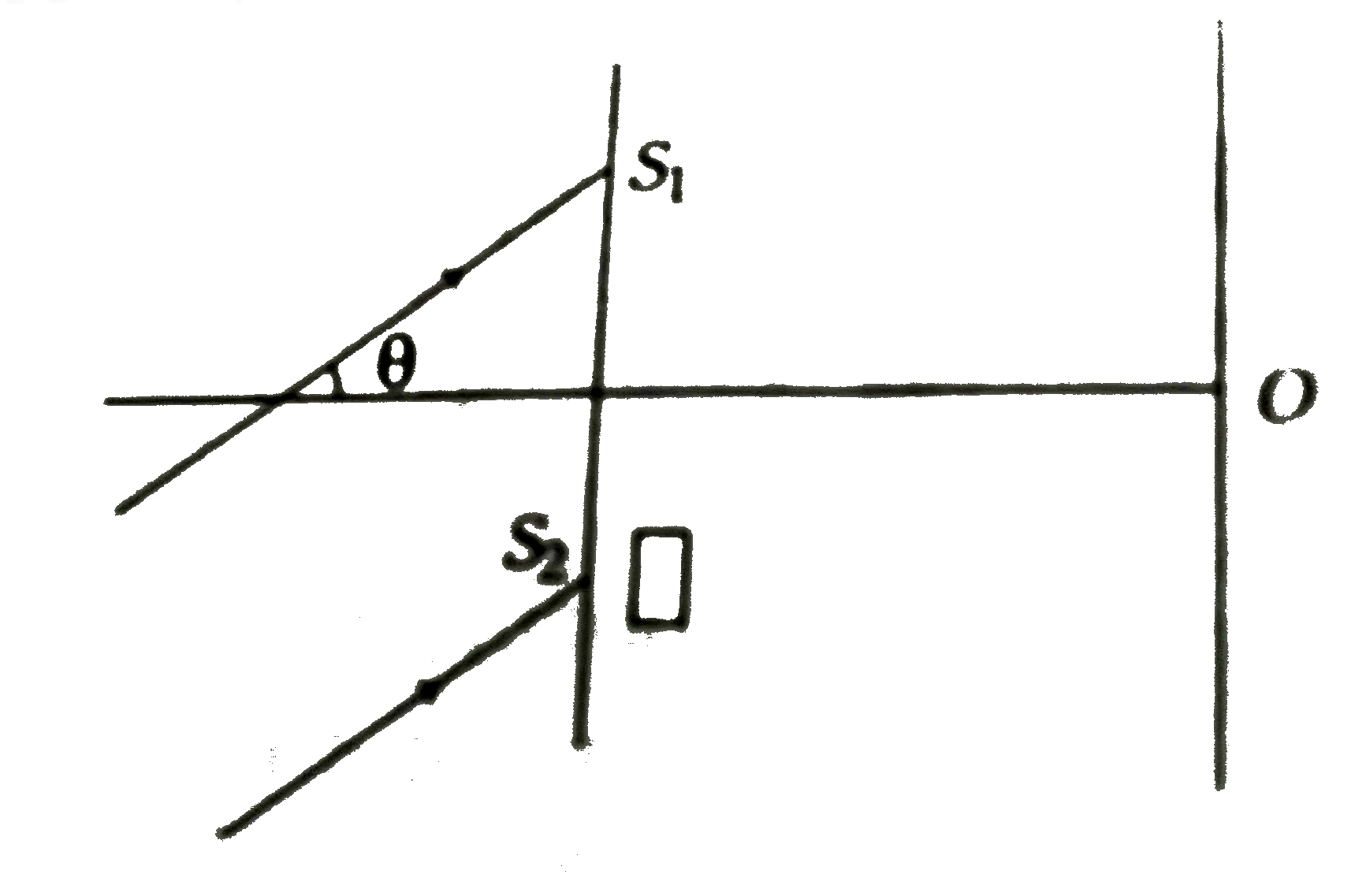
A monochromatic beam of light falls on YDSE apparatus at some angle `(say theta)` as shown in the figure, A thin sheet of glass is inserted in front of the lower slit `S_(2)` The central bright fringe (path difference =0) will be obtained

A

Central maxima will be at O always

B

If `(mu-1) t=d sin theta`, central maxima will be at O

C

if `(mu-1)t gt d sin theta`, central maxima will be below O

D

If `(mu-1)t=d sin theta+ lambda`, a maxima is formed at O

Text Solution

Verified by Experts

The correct Answer is:

B, C, D
Promotional Banner

Topper's Solved these Questions

  • WAVE OPTICS

    AAKASH INSTITUTE ENGLISH|Exercise Assignment (Section-D (Linked comprehension type questions))|6 Videos
  • WAVE OPTICS

    AAKASH INSTITUTE ENGLISH|Exercise Assignment (Section-E (Assertion-Reason type question))|3 Videos
  • WAVE OPTICS

    AAKASH INSTITUTE ENGLISH|Exercise Assignment (Section-B (objective type question(one option is correct)))|5 Videos
  • UNITS AND MEASUREMENTS

    AAKASH INSTITUTE ENGLISH|Exercise ASSIGNMENT (SECTION - D)|15 Videos
  • WAVES

    AAKASH INSTITUTE ENGLISH|Exercise ASSIGNMENT ( SECTION-D ( Assertion - Reason Type Questions ))|12 Videos

Similar Questions

Explore conceptually related problems

A monochromatic beam of light fall on YDSE apparatus at some angle (say theta ) as shown in figure. A thin sheet of glass is inserted in front of the lower slit s_(2) . The central bright fringe (path difference = 0 ) will be obtained

A monochromatic beam of light fall on YDSE apparatus at some angle (say theta ) as shown in figure. A thin sheet of glass is inserted in front of the lower slit s_(2) . The central bright fringe (path difference = 0 ) will be obtained

A monochromatic beam of light fall on YDSE apparatus at some angle (say theta ) as shown in figure. A thin sheet of glass is inserted in front of the lower slit s_(2) . The central bright fringe (path difference = 0 ) will be obtained

A monochromatic beam of light falls on YDSE apparatus at some angle (theta) as shown, a thin sheet of glas (R.I. = mu , thickness = t) is insdted in front of the lower slit S_(2) . Select the correct alternative.

A vessel ABCD of 10 cm width has two small slits S_(1) and S_(2) sealed with idebtical glass plates of equal thickness. The distance between the slits is 0.8 mm . POQ is the line perpendicular to the plane AB and passing through O, the middle point of S_(1) and S_(2) . A monochromatic light source is kept at S, 40 cm below P and 2 m from the vessel, to illuminate the slits as shown in the figure. Calculate the position of the central bright fringe on the other wall CD with respect of the line OQ . Now, a liquid is poured into the vessel and filled up to OQ . The central bright fringe is fiund to be at Q. Calculate the refractive index of the liquid.

Assertion In the YDSE set up shown in figure a glass slab is inserted in front of the slit S_(1) as shown in figure Then zero order maxima (where path difference =0) will lie above point O. Reason Glass slab will produce an extra path difference in the path of the ray passing through S_(1)

In a Young's double slit experimental arrangement shown here, if a mica sheet of thickness t and refractive indec mu is placed in front of the slit S_1 , then the path difference (S_1P-S_2P) is

In the YDSE apparatus shown in figure Deltax is the path difference between S_(2)P and S_(1)P . Now a glass slab is introduced in front of S_(2) , then match the following.

Young's double slit experiment is conducted in a liquid of refractive index mu_1 as shown in figure. A thin transparent slab of refractive index mu_2 is placed in front of the slit s_2 . The magnitude of optical path difference at 'O' is

A YDSE is performed in a medium of refractive index 4 // 3 , A light of 600 nm wavelength is falling on the slits having 0.45 nm separation . The lower slit S_(2) is covered b a thin glass plate of thickness 10.4 mm and refractive index 1.5. The interference pattern is observed on a screen placed 1.5 m from the slits as shown in figure. (All the wavelengths in this problem are for the given medium of refractive index 4 // 3 , ignore absorption.) The location of the central maximum (bright fringe with zero path difference) on the y-axis will be
