Home
Class 12
PHYSICS
Two objects each of mass 5 kg are moving...

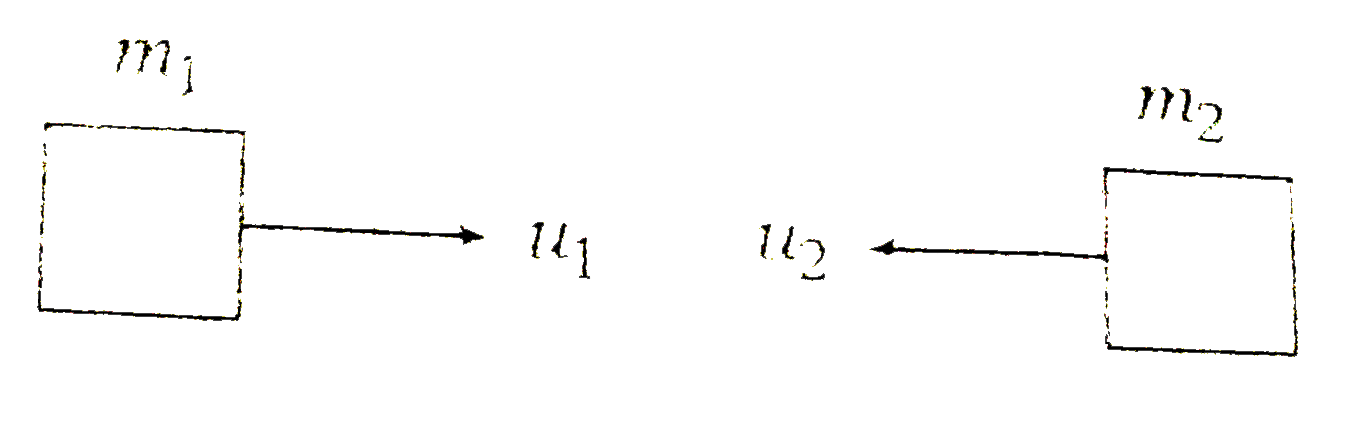
Two objects each of mass 5 kg are moving in the same straight line but in the opposite direction towards each other with some speed of 3 m/s. They stick to each other after collision. What will be the velocity of the combined object after collision?

Text Solution

Verified by Experts

Before collision ,

` m _(1) = m_(2) = 5 kg `
`u_(1)= 3 m//s`
`u_(2) = -3 m//s`
At collision,
After collision,

Let the velocity of the combined object be v
Total momentum before collision is
` m_(1) u_(1) + m_(2) u_(2) = 5 xx 3 + 5 xx (-3)`
Total momentum of the system after collision is
` m_(1)v + m_(2)v = (m_(1) + m_(2))v `
` = (5+ 5) v`
` n= 10v`
According to the conservation of momentum ,
Momentum before collision = Momentum after collision
` :. 0 = 10 v `
` :. v = 0 `
Hence , the velocity of the combined object after collision is zero .
Promotional Banner

Topper's Solved these Questions

  • LAWS OF MOTION

    AAKASH INSTITUTE ENGLISH|Exercise Illustration|7 Videos
  • LAWS OF MOTION

    AAKASH INSTITUTE ENGLISH|Exercise TRY YOURSELF|69 Videos
  • KINETIC THEORY

    AAKASH INSTITUTE ENGLISH|Exercise EXERCISE (ASSIGNMENT) SECTION - D Assertion - Reason Type Questions|10 Videos
  • MAGNETISM AND MATTER

    AAKASH INSTITUTE ENGLISH|Exercise ASSIGNMENT (SECTION D)|26 Videos

Similar Questions

Explore conceptually related problems

Two object, each of mass 1.5 kg , are moving in the same straight line but in opposite directions, The velocity of each object is 2.5 ms^(-1) before the collision during which they stick together. What will be the velocity of the combined object after collision?

Two train are moving in a straight line in the same direction with a speed of 80 km/h. The relative velocity of one trains w.r.t. each other is

Two objects of masses 100g and 200g are moving along the same line in the same direction with velocities of 2m//s and 1m//s , respectively. They collide and after the collison, the first object moves at a velocity of 1.67 m//s in the same direction. Determine the velocity of the second object.

Two identical balls each of mass m moving on straight track approaching towards each other with same speed. Find kinetic energy of the two ball system is equal to the total energy loss during collision E is the total kinetic energy of the balls before collision and E' is after collision and coefficient of restitution is e. Then choose the correct options.

Two masses of 0.25 kg each moves toward each other with speed 3 ms^(-1) collide and stick together. Find the final velocity

Two particle, each having a mass m are placed at a separation d in a uniform magnetic field B as shown in figure.They have opposite charges of equal magnitude q .At time t=0 , the particles are projected towards each other, each with a speed v . Suppose v=2v_(m) and they stick to each other after the collision.Describe the motion after the collision (neglect the magnetic, gravitational & electric forces between charges).

A block of mass 5 kg moves from left to right with a velocity of 2ms^(-1) and collides with another block of mass 3 kg moving along the same line in the opposite direction with velocity 4 ms^(-1) . (i) If the collision is perfectly elastic, determine velocities of both the blocks after their collision. (ii) If coefficient of restitution is 0.6, determine velocities of both the blocks after their collision.

An object of mass 1kg travelling in a straight line with a velocity of 10m//s collides with, and sticks to, a stationary wooden block of mass 5kg . Then, they both move off together in the same straight line. Calculate the total momentum just before the impact and just after the impact. Also, calculate the velocity of the combined object.

Two identical balls moving in opposite directions with speed 20 m/s and 25 m/s undergo head on perfectly inelastic collision. The speed of combined mass after collision is

AAKASH INSTITUTE ENGLISH-LAWS OF MOTION-Assignment (SECTION-D) (Assertion-Reason Type Questions)
  1. Two objects each of mass 5 kg are moving in the same straight line but...

    Text Solution

    |

  2. A : Due to inertia an object is unable to change by itself its state o...

    Text Solution

    |

  3. A : Acceleration of an object in uniform motion is zero. R : No forc...

    Text Solution

    |

  4. A : Newton's second law of motion gives the measurement of force. R ...

    Text Solution

    |

  5. A : According to Newton's third law of motion for every action, there ...

    Text Solution

    |

  6. A : Inertia depends on the mass of an object. R : Greater the mass, ...

    Text Solution

    |

  7. Assertion : In the case of free fall of the lift, the man will feel ...

    Text Solution

    |

  8. A : Static friction force is a self adjusting force. R : The interat...

    Text Solution

    |

  9. Assertion : The value of dynamic friction is less than the limiting fr...

    Text Solution

    |

  10. A : During horizontal circular turn of a car, the centripetal force re...

    Text Solution

    |

  11. A : A person on a frictionless surface can get away from it by blowing...

    Text Solution

    |

  12. A : It is difficult to move a cycle along a road with its brakes on. ...

    Text Solution

    |

  13. A : It makes easier to walk on slippery muddy road if we throw some sa...

    Text Solution

    |

  14. A : Banking of roads reduces the wear and tear of the tyres of automob...

    Text Solution

    |

  15. A : The centripetal and centrifugal forces never cancel each other. ...

    Text Solution

    |

  16. A : Work done by friction can increase the kinetic energy of the body...

    Text Solution

    |

