Home
Class 12
PHYSICS
Calculate angle of friction between wedg...

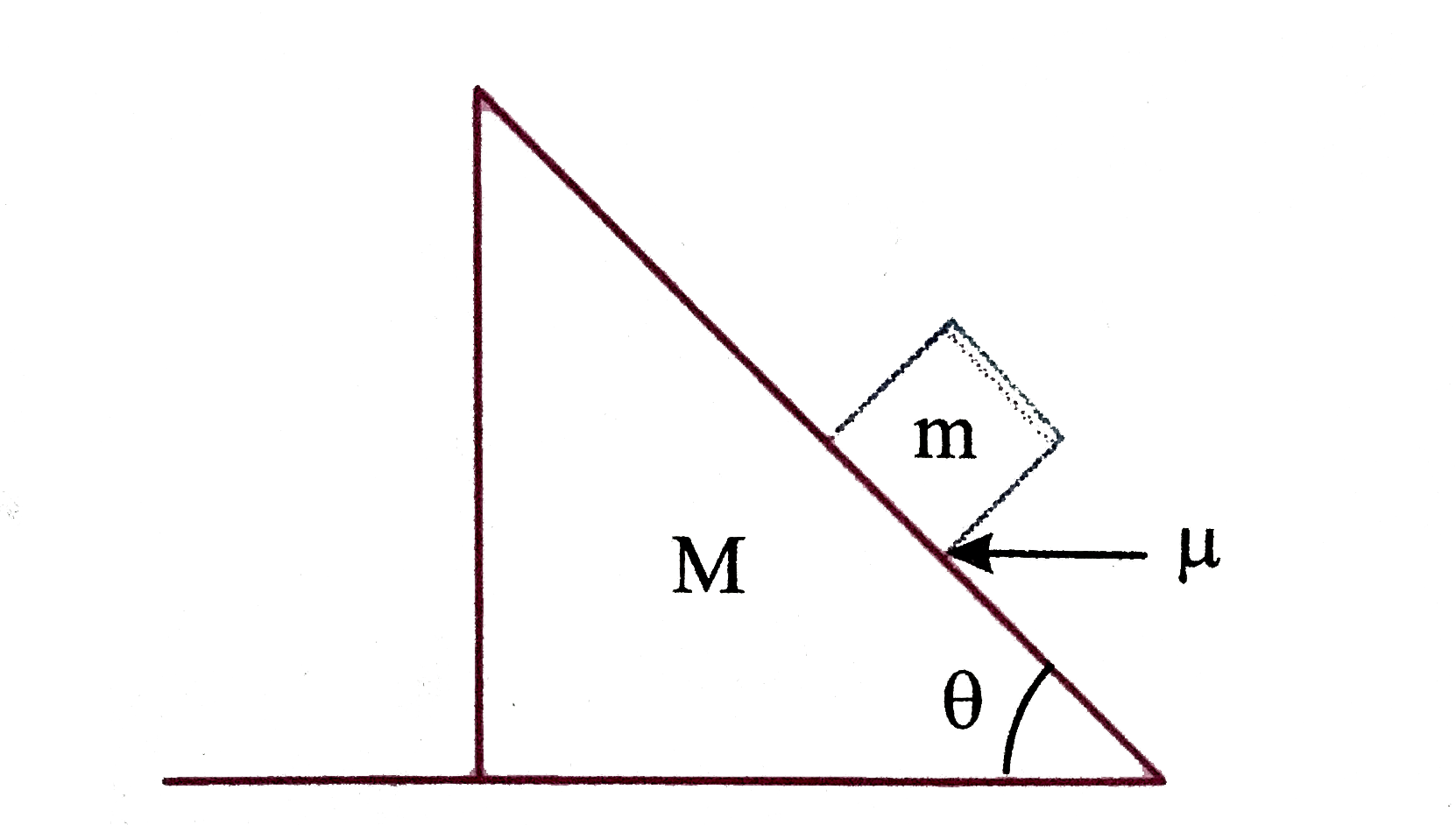
Calculate angle of friction between wedge and block system is at rest M coefficient of friction between wedge and block.

Text Solution

Verified by Experts

Let a be the common acceleration .
`F= (M +ma)" "` …(A)
Let us solve this question in the f.o.r of wedge , which is non- inertial .
When `F= F_(max)`
The tendency of block is to move up the plane of wedge . Hence friction will act down the plane of wedge .
From (A) ,
`F_(max) = (M+m)a_(max) " "` ...(i)
As the block is stationary on the wedge,
` sum F_(y)=0`
`rArr N = m (gcos theta + a_(max)sin theta) " "` ...(ii)
sum` F_(x) = 0 `
`rArr ma_(max) cos theta = muN + mgsintheta" " ` ...(iii)
From (i) and (iii)
`ma_(max) cos theta = mu m (gcos theta + a_(max) sin theta) + mg sin theta`
or `a_(max) [ cos theta - mu m sin theta] = g [mu cos theta + sin theta]`
` or a_(max) = (sintheta + mu cos theta)/(cos theta + mu sin theta)g`
or ` a_(max) = ((tan theta + mu)/(1-mu tantheta))g`
From (i) ` F_(max) = (M+m) ((tantheta + mu)/(1-mu tantheta))g`
When F = `F_(min)`
The tendency of block is to move downcard along the plane . Hence frictional force will act in upward direction .
From (A)
` F_(min) = (M + m) a_(min) " " `...(iv)
` sumF_(y) = 0 `
` rArr N = mg cos theta+ ma _(min) sin theta" " `...(v)
` sum F_(x) = 0`
` rArr mgsintheta = muN+ma_(min) cos theta " " `...(vi)
From (v) and (vi) ,
` mu (mg cos theta + ma_(min) sin theta) + ma_(min)cos theta = mg sin theta `
` rArr _(min) (cos theta + mu sin theta) = g (sin theta - mu cos theta)`
` rArr a_(min) = (sin theta - mu cos theta)/(cos theta +mu sin theta)g`
or ` or a_(min) = ((tan theta - mu)/(1+ mu tan theta))g`
From (iv),
` F_(min) = (M+m) ((tan theta - mu)/(1+mu tan theta ))g`
When `F= F_(min)`
The tendency of block is to move downward along the plane . Hence frictional force will act in upward direction.

Promotional Banner

Topper's Solved these Questions

  • LAWS OF MOTION

    AAKASH INSTITUTE ENGLISH|Exercise Illustration|7 Videos
  • LAWS OF MOTION

    AAKASH INSTITUTE ENGLISH|Exercise TRY YOURSELF|69 Videos
  • KINETIC THEORY

    AAKASH INSTITUTE ENGLISH|Exercise EXERCISE (ASSIGNMENT) SECTION - D Assertion - Reason Type Questions|10 Videos
  • MAGNETISM AND MATTER

    AAKASH INSTITUTE ENGLISH|Exercise ASSIGNMENT (SECTION D)|26 Videos

Similar Questions

Explore conceptually related problems

a Block of mass m is placed on a wedge of mass M there is no friction between the block and the wedge .The minmum coefficient of friction between the wedge and the gound so that wedge does not move is,

Two small blcok m=2kg each kept on wedge of mass 12kg. There is no friction between blocks and wedge coefficient of friction between wedge and ground in μ=0.3. Calculate frictional force by ground on wedge.

A cube of mass m is placed on top of a wedge of mass 2m, as shown in figure. There is no friction between the cube and the wedge. The minimum co - efficient of friction between the wedge and the horizontal surface, so that the wedge does not move is

An arrangement is shown in the figure . The mass of the wedge is 4 kg and that of the block is 1 kg . There is no friction between wedge and ground , but coefficient of friction between vertical surface of the wedge and to the block is mu= 0.1. . (Assume ideal pulley and string) (g = 10 m//s^(2)) and assuming the pulley to be massless and friction. calucalate the maximum possible values of force upto while bock remain stationary relative to wedge.

A block of mass m slides down a wedge of mass M as shown . The whole system is at rest , when the height of the block is h above the ground. The wedge surface is smooth and gradually flattens. There is no friction between wedge and ground. If there would have been friction wedge and block , which of the following quantities would still remains conserved ?

A block of mass m is kept over another block of mass M and the system rests on a horizontal surface. A constant horizontal force F acting on the lower block produces an acceleration (F)/(2(m+M)) in the sytem. The two blocks always move together. Consider displacement d of the system. a. Find the work done by friction on bigger block. b. Find the coefficient of kinetic friction between the bigger block and the horizontal surface. c. Find the frictional acting on the smaller block. d. Find the work done by the force of friction on the smaller block by the bigger block. e. Find the work done by static friction on bigger block.

A block A of mass m which is placed a rough inclined face of a wedge of same mass being pulled through light string and with force F as shown in figure The coefficient of friction between inclined face and block A is mu while there is no friction between the ground and wedge it the whole system moves with same acceleration then find the value of F

A block of mass m slides over a smooth wedge of mass M which is placed over a rough horizontal surface . The centre of mass of the system will move towards left Here mu = coefficient of friction between the wedge and the ground .

In figure, the pulley shown is smooth. The spring and the string are light. Block B slides down from the top along the fixed rough wedge of inclination theta . Assuming that the block reaches the end of the wedge, find the speed of the block at the end. Take the coefficient of friction between the block and the wedge to be mu and that the spring was relaxed when the block was released from the top of the wedge.

A block on table shown in figure is just on the wedge of slipping. Find the coefficient of static friction between the block and table top.

AAKASH INSTITUTE ENGLISH-LAWS OF MOTION-Assignment (SECTION-D) (Assertion-Reason Type Questions)
  1. Calculate angle of friction between wedge and block system is at rest ...

    Text Solution

    |

  2. A : Due to inertia an object is unable to change by itself its state o...

    Text Solution

    |

  3. A : Acceleration of an object in uniform motion is zero. R : No forc...

    Text Solution

    |

  4. A : Newton's second law of motion gives the measurement of force. R ...

    Text Solution

    |

  5. A : According to Newton's third law of motion for every action, there ...

    Text Solution

    |

  6. A : Inertia depends on the mass of an object. R : Greater the mass, ...

    Text Solution

    |

  7. Assertion : In the case of free fall of the lift, the man will feel ...

    Text Solution

    |

  8. A : Static friction force is a self adjusting force. R : The interat...

    Text Solution

    |

  9. Assertion : The value of dynamic friction is less than the limiting fr...

    Text Solution

    |

  10. A : During horizontal circular turn of a car, the centripetal force re...

    Text Solution

    |

  11. A : A person on a frictionless surface can get away from it by blowing...

    Text Solution

    |

  12. A : It is difficult to move a cycle along a road with its brakes on. ...

    Text Solution

    |

  13. A : It makes easier to walk on slippery muddy road if we throw some sa...

    Text Solution

    |

  14. A : Banking of roads reduces the wear and tear of the tyres of automob...

    Text Solution

    |

  15. A : The centripetal and centrifugal forces never cancel each other. ...

    Text Solution

    |

  16. A : Work done by friction can increase the kinetic energy of the body...

    Text Solution

    |

