Home
Class 12
PHYSICS
In the arrangment shown in figure , the ...

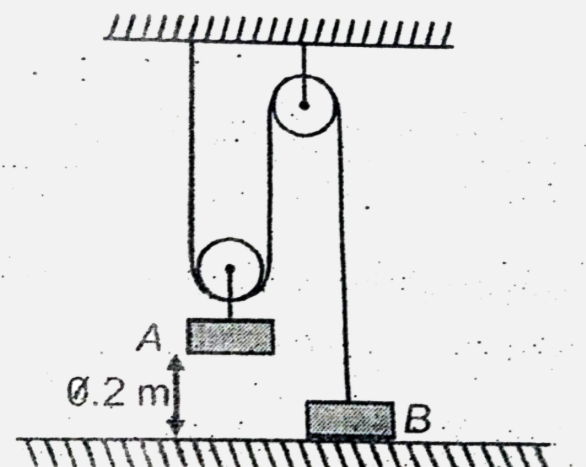
In the arrangment shown in figure , the mass of the body A is 4 m and that of body B is m . The height `h = 0*2` m . If the body B is released , then till what maximum height the body B will go up ? (g = `10 m//s^(2))`

Text Solution

Verified by Experts

Let the body A go down with acceleration `a_(1)` and the body B go up with acceleration `a_(2)` ( just after release ) , then `a_(2) = 2a_ 2 a_(1) `
`4mg - 2T = 4ma_(1) " " ` …(i)
` T - mg = ma_(2) " " ` ….(ii)
Multiplying equation (ii) by 2 and adding it to equation (i)
` 2mg = 4 ma_(1) + 2ma_(2)`
` a_(1) = (2mg)/(8m) = g/4`
So, `a_(2) = 2a_(1) = g/2 `
The time till the body A reaches the floor, both bodies will be moving with above mentioned accelerations. Just after the body A strikes the floor, all strings will get slack , ie tension in acceleration will be g downwards .
From the constraint reletions , the body B will be at height 0.4 m from floor, when A strikes the floor. As the body B starts from rest , so we can write

`v^(2) = u^(20 + 2as = 0 + 2a_(2) (0.4) `
` v^(2) = 2(g/2) 0.4 = 4 `
or `rArr v = 2 m//s`
After this body B will retard and at highest point velocity of body B will again become zero
so , `v^(2) = u^(2) + 2as`
` 0 = 4-2 ( 10 h) rArr h = 0.2 m `
So height from ground is ` 0.4+ 0.2+ 0.6 m`
Promotional Banner

Topper's Solved these Questions

  • LAWS OF MOTION

    AAKASH INSTITUTE ENGLISH|Exercise Illustration|7 Videos
  • LAWS OF MOTION

    AAKASH INSTITUTE ENGLISH|Exercise TRY YOURSELF|69 Videos
  • KINETIC THEORY

    AAKASH INSTITUTE ENGLISH|Exercise EXERCISE (ASSIGNMENT) SECTION - D Assertion - Reason Type Questions|10 Videos
  • MAGNETISM AND MATTER

    AAKASH INSTITUTE ENGLISH|Exercise ASSIGNMENT (SECTION D)|26 Videos

Similar Questions

Explore conceptually related problems

In the arrangement shown in figure the masses of the wedge M and the body m are known. The appreciable friction exists only between the wedge and the body m , the friction coefficient being equal to k . The masses of the pulley and the thread are negligible. Find the acceleration of the body m relative to the horizontal surface on which the wedge slides.

A ball is thrown up at a speed of 4.0 m/s. Find the maximum height reached by the ball. Take g=10 m//s^2 .

In the arrangement show in figure, the track is frictionless until the body reaches the higher level. A frictional force stops the body in a distance d from A. The initial speed of the body v_(0) is 6 m/s the height h is 1 m and the coefficient of kinetic friction is 0.2. The speed of body at the higher level A is

In the arrangement shown in figure, the track is frictionless until the body reaches the higher level. A frictional force stops the body in a distance d from A. The initial speed of the body v_(0) is 6 m/s the height h is 1 m and the coefficient of kinetic friction is 0.2. What is the maximum distance d travelled by body on rough surface?

The weight of a body is 2.0 N. What is the mass of the body ? (g = 10 m s^(-2) )

A body is projected up a smooth inclined plane of length 20sqrt(2)m from point A as shown in the figure. The top of B of the inclined plane is connected to a well of diameter 40 m. If the body just manages to cross the well then the velocity of projection is (Acceleration due to gravity, g=10ms^(-2) )

A body is thrown vertically upward from a point A 125 m above the ground. It goes up to a maximum height of 250 m above the ground and passes through A on its downward journey. The velocity of the body when it is at a height of 70 m above the ground is (g=10 m//s^(2))

A body is thrown vertically up reaches a maximum height of 78.4 m. After what time it will reach the ground from the maximum height reached ?

If a body of mass m is raised to height 2 R from the earth s surface, then the change in potential energy of the body is (R is the radius of earth)

Two bodies are thrown with the same initial velocity of 30 m/s. One at 17°, other at 73° to the horizontal. The sum of the maximum heights reached by them is [g = 10 m//s^(2) ]

AAKASH INSTITUTE ENGLISH-LAWS OF MOTION-Assignment (SECTION-D) (Assertion-Reason Type Questions)
  1. In the arrangment shown in figure , the mass of the body A is 4 m and ...

    Text Solution

    |

  2. A : Due to inertia an object is unable to change by itself its state o...

    Text Solution

    |

  3. A : Acceleration of an object in uniform motion is zero. R : No forc...

    Text Solution

    |

  4. A : Newton's second law of motion gives the measurement of force. R ...

    Text Solution

    |

  5. A : According to Newton's third law of motion for every action, there ...

    Text Solution

    |

  6. A : Inertia depends on the mass of an object. R : Greater the mass, ...

    Text Solution

    |

  7. Assertion : In the case of free fall of the lift, the man will feel ...

    Text Solution

    |

  8. A : Static friction force is a self adjusting force. R : The interat...

    Text Solution

    |

  9. Assertion : The value of dynamic friction is less than the limiting fr...

    Text Solution

    |

  10. A : During horizontal circular turn of a car, the centripetal force re...

    Text Solution

    |

  11. A : A person on a frictionless surface can get away from it by blowing...

    Text Solution

    |

  12. A : It is difficult to move a cycle along a road with its brakes on. ...

    Text Solution

    |

  13. A : It makes easier to walk on slippery muddy road if we throw some sa...

    Text Solution

    |

  14. A : Banking of roads reduces the wear and tear of the tyres of automob...

    Text Solution

    |

  15. A : The centripetal and centrifugal forces never cancel each other. ...

    Text Solution

    |

  16. A : Work done by friction can increase the kinetic energy of the body...

    Text Solution

    |

