Home
Class 12
PHYSICS
The magnitud of difference in accelerati...

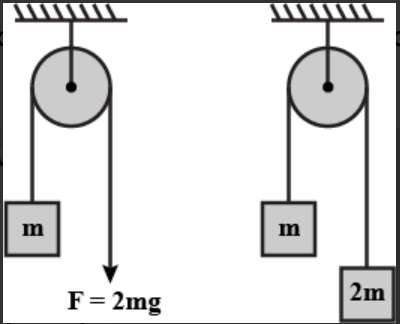
The magnitud of difference in accelerations of blocks of mass m in . Both the cases shown below is

A

g

B

`(2g)/3`

C

Zero

D

`g/3`

Text Solution

Verified by Experts

The correct Answer is:

B
Promotional Banner

Topper's Solved these Questions

  • LAWS OF MOTION

    AAKASH INSTITUTE ENGLISH|Exercise ASSIGNMENT ( SECTION -C) objective type questions (More than one options are correct)|21 Videos
  • LAWS OF MOTION

    AAKASH INSTITUTE ENGLISH|Exercise ASSIGNMENT ( SECTION -D) Linked Comprehension Type Question|1 Videos
  • LAWS OF MOTION

    AAKASH INSTITUTE ENGLISH|Exercise ASSIGNMENT ( SECTION -A)|50 Videos
  • KINETIC THEORY

    AAKASH INSTITUTE ENGLISH|Exercise EXERCISE (ASSIGNMENT) SECTION - D Assertion - Reason Type Questions|10 Videos
  • MAGNETISM AND MATTER

    AAKASH INSTITUTE ENGLISH|Exercise ASSIGNMENT (SECTION D)|26 Videos

Similar Questions

Explore conceptually related problems

34.The magnitude of acceleration of blocks of mass

In the figure shown acceleration of the block is

Determine the magnitude of frictional force and acceleration of the block in each of the following cases :

Two blocks A and B of equal masses are attached to a string passing over a smooth pulley fixed to a wedge as shown in figure. Find the magnitude of acceleration of centre of mass of the two blocks when they are released from rest. Neglect friction.

Two blocks A and B of equal masses are attached to a string passing over a smooth pulley fixed to a wedge as shown in figure. Find the magnitude of acceleration of centre of mass of the two blocks when they are released from rest. Neglect friction.

A block of mass 5 kg is (i) pushed in case (A) and (ii) pulled in case (B), by a force F=20 N , making an angle of 30^(@) with the horizontal, as shown in the figures. The coefficient of friction between the block and floor is mu = 0.2 . The difference between the accelerattion of the block, in case (B) and case (A) will be : (g = 10 ms^(-2)) . .

In the figure shown, the acceleration of block of mass m_(2) is 2m//s^(2) . The acceleration of m_(1) :

A block A of mass 2m is hanging from a vertical massless spring of spring constant k and is in equilibrium. Another block B of mass m strikes the block A with velocity u and sticks to it as shown in the figure. The magnitude of the acceleration of the combined system of the blocks just after the collision is

In the situation shown in fig., all the strings are light and inextensible and pullies are light. There is no friction at any surface and all blocks are of cuboidal shape. A horizontal force of magnitude F si applied to right most free end of string in both cases shown in the figure. At the instant shown, the tension in all strings are non-zero. Let the magnitudes of acceleration of large blocks (of mass M) in fig. be a_(1) and a_(2) respectively. Then,

In the arrangement shown in Figure, m_A=2kg and m_B=1kg . String is light and inextensible. Find the acceleration of centre of mass of both the blocks. Neglect friction everywhere.

AAKASH INSTITUTE ENGLISH-LAWS OF MOTION-ASSIGNMENT ( SECTION -B) objective type questions (one option is correct)
  1. For the system shown in figure , to be in equilibrium , determine mass...

    Text Solution

    |

  2. If two identical masses, attached by a light string passing over a lig...

    Text Solution

    |

  3. The magnitud of difference in accelerations of blocks of mass m in . B...

    Text Solution

    |

  4. In the figure the blocks A, B and C of mass m each , having accelerat...

    Text Solution

    |

  5. Figure shows a block of mass 2m sliding on a block of mass m. Find the...

    Text Solution

    |

  6. Two identical masses are attached by a light string that passes over a...

    Text Solution

    |

  7. A mass 2m lies on a fixed , smooth cylinder . An ideal string attached...

    Text Solution

    |

  8. A block is suspended by two light ropes r(1) and r(2) as shown in fi...

    Text Solution

    |

  9. Two blocks of masses m and M are connected by an inextensible light st...

    Text Solution

    |

  10. A block of mass 10 kg is suspended through two light spring balances a...

    Text Solution

    |

  11. Two blocks of masses M and 2M are connected to each other through a ...

    Text Solution

    |

  12. Three masses m(1) ,m(2) and m(3) are attached to a string -pulley syst...

    Text Solution

    |

  13. The block Q moves to the right with a constant velocity v(0) as shown ...

    Text Solution

    |

  14. The pull P is just sufficient to keep the 14 N block in equilibrium as...

    Text Solution

    |

  15. A block of mass m on a smooth horizontal surface is. Connected to a se...

    Text Solution

    |

  16. With what force must a man pull on the rope to hold the plank in posit...

    Text Solution

    |

  17. Blocks P and R starts from rest and moves to the right with accelera...

    Text Solution

    |

  18. In the arrangement , shown below pulleys are massless and frictionless...

    Text Solution

    |

  19. In the arrangement shown in fig. m(1)=1kg, m(2)=2 kg. Pulleys are mass...

    Text Solution

    |

  20. In the figure shown m(1) = 1 kg , m(2) = 2 kg , pulley is ideal . At t...

    Text Solution

    |
