Home
Class 12
PHYSICS
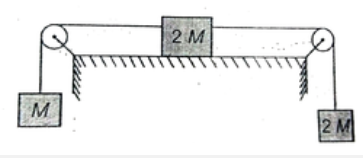
The three blocks in figure are released ...

The three blocks in figure are released from rest and accelerate at the rate of 2 `m/s^(2) `. If M = 5 kg , what is the coefficient of friction between the surface and the block B ?

Text Solution

Verified by Experts

The correct Answer is:

`mu=0`
Promotional Banner

Topper's Solved these Questions

  • LAWS OF MOTION

    AAKASH INSTITUTE ENGLISH|Exercise ASSIGNMENT ( SECTION -J ) Aakash Challengers Questions|12 Videos
  • LAWS OF MOTION

    AAKASH INSTITUTE ENGLISH|Exercise Example|24 Videos
  • LAWS OF MOTION

    AAKASH INSTITUTE ENGLISH|Exercise ASSIGNMENT ( SECTION -H ) Multiple True - False Type Questions (Identify the correct combination of true (T) and false (F) of the given three statements.)|8 Videos
  • KINETIC THEORY

    AAKASH INSTITUTE ENGLISH|Exercise EXERCISE (ASSIGNMENT) SECTION - D Assertion - Reason Type Questions|10 Videos
  • MAGNETISM AND MATTER

    AAKASH INSTITUTE ENGLISH|Exercise ASSIGNMENT (SECTION D)|26 Videos

Similar Questions

Explore conceptually related problems

A solid block of mass 2 kg is resting inside a cube shown in figure The cube is moving with a velocity hatv= 5 hati + 2hatj ms^(-1) If the coefficient of friction between the surface of cube and block is 0.2 then the force of friction between the block and cube is

Three blocks A , B and C , whose masses are 9kg , 9kg and 18kg respectively as shown in the figure, are released from rest. The co-efficient of friction between block A and the horizontal surface is 0.5 & the co-efficient of friction between block B and the horizontal surface is 0.5 . Find the acceleration of block C just release [Take g=10m//s^(2) ]. All strings and pulleys are ideal

Calculate angle of friction between wedge and block system is at rest M coefficient of friction between wedge and block.

A block A of mass 2 kg rests on a horizontal surface. Another block B of mass 1 kg moving at a speed of m/s when at a distance of 16 cm from A. collides elastically with A. The coefficeint of friction between the horizontal surface and earth of the blocks is 0.2. Then (g = 10 m//s^(2))

In the arrangement shown in figure m_(A)=4.kg and m_(B)=1.0kg . The system is released from rest and block B is found to have a speed 0.3m//s after it has descended through a distance of 1.m find the coefficient of friction between the block and the table. Neglect friction elsewhere. (Take g=10 m//s^(2) ). .

In the arrangement shown in figure m_(A)=4.kg and m_(B)=1.0kg . The system is released from rest and block B is found to have a speed 0.3m//s after it has descended through a distance of 1.m find the coefficient of friction between the block and the table. Neglect friction elsewhere. (Take g=10 m//s^(2) ). .

Consider the situatioin shown in figure. The system is released from rest and the block of mass 1.0 kg is found to have a speed 0.3 m/s ater it has descended thrugh a distance of 1 m. find the coefficient of kinetic friction between the block and the table.

Two blocks of masses 2kg and M are at rest on an inclined plane and are separated by a distance of 6.0m as shown. The coefficient of friction between each block and the inclined plane is 0.25 . The 2kg block is given a velocity of 10.0m//s up the inclined plane. It collides with M, comes back and has a velocity of 1.0m//s when it reaches its initial position. The other block M after the collision moves 0.5m up and comes to rest. Calculate the coefficient of restitution between the blocks and the mass of the block M. [Take sintheta=tantheta=0.05 and g=10m//s^2 ]

As shown in the figure, M is a man of mass 60 kg standing on a block of mass 40 kg kept on ground. The co-efficient of friction between the feet of the man and the block is 0.3 and that between B and the ground is 0.1. If the man accelerates with an acceleration 2(m)/(s^2) in the forward direction, then,
