Home
Class 12
PHYSICS
An object was at x = 50 m at t = 0, then...

An object was at x = 50 m at t = 0, then it starts moving uniformly towards origin at time t = 5 s. It is at origin. Draw the position versus time (x-t) graph for the object under this situation.

Text Solution

Verified by Experts
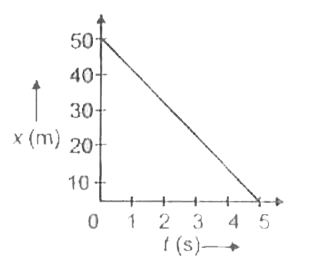
From the given values we can draw the following position - time graph.
Promotional Banner

Topper's Solved these Questions

  • MOTION IN A STRAIGHT LINE

    AAKASH INSTITUTE ENGLISH|Exercise TRY YOURSELF|40 Videos
  • MOTION IN A STRAIGHT LINE

    AAKASH INSTITUTE ENGLISH|Exercise EXERCISE|29 Videos
  • MOTION IN A PLANE

    AAKASH INSTITUTE ENGLISH|Exercise Assignement section -J (Aakash Challengers Questions)|7 Videos
  • MOTION IN STRAIGHT LINE

    AAKASH INSTITUTE ENGLISH|Exercise Assignment (SECTION - J)|2 Videos

Similar Questions

Explore conceptually related problems

Draw the position-time graph of an object moving with positive accceleration.

Draw the position-time graph of a stationary object.

Draw the x-t graph of an object in uniform motion.

Draw the position-time graph of a moving object, moving with zero acceleration.

What is the slope of x-t graph of a stationary object?

The position - time (x-t) graph of an object in uniform motion is shown below, the velocity of object is

A body is at rest at x =0 . At t = 0 , it starts moving in the positive x - direction with a constant acceleration . At the same instant another body passes through x= 0 moving in the positive x - direction with a constant speed . The position of the first body is given by x_(1)(t) after time 't', and that of the second body by x_(2)(t) after the same time interval . which of the following graphs correctly describes (x_(1) - x_(2)) as a function of time 't' ?

Acceleration of a particle is given by a= 3t^(2)+2t +1 Where t is time . Find (i) its velocity at time t assuming velocity to be 10 m/s at t = 0. (ii) its position at time t assuming that the particle is at origin at t = 0. (iii) What is the average speed of the particle in the duration t = 0 to t = 1s? (iv) What is the average acceleration of the particle in the duration t = 0 to t = 1s?

The acceleration of a cart started at t=0 varies with time as shown in figure. Find the distance travelled in 30 seconds and draw the position time graph.

A particle is moving with uniform acceleration. Its position (x) is given in terms of time (t in s) as X =(5t2+4t+8)m ,then

AAKASH INSTITUTE ENGLISH-MOTION IN A STRAIGHT LINE-ASSIGNMENT (SECTION - D)
  1. An object was at x = 50 m at t = 0, then it starts moving uniformly to...

    Text Solution

    |

  2. A : It is not possible to have constant velocity and variable accelera...

    Text Solution

    |

  3. A : The direction of velocity of an object can be reversed with consta...

    Text Solution

    |

  4. A : When the velocity of an object is zero at an instant, the accelera...

    Text Solution

    |

  5. A : A body moving with decreasing speed may have increasing accelerati...

    Text Solution

    |

  6. A : for a moving particle distance can never be negative or zero. R ...

    Text Solution

    |

  7. A : If speed of a particle is never zero than it may have zero averag ...

    Text Solution

    |

  8. A : The magntidue of average velocity in an interval can never be grea...

    Text Solution

    |

  9. A : The area under acceleration - time graph is equal to velocity of o...

    Text Solution

    |

  10. A : The motion of body projected under the effect of gravity without a...

    Text Solution

    |

  11. A : The relative acceleration of two objects moving under the effect o...

    Text Solution

    |

  12. A : In the presence of air resistance, if the ball is thrown verticall...

    Text Solution

    |

  13. A : The following graph can't exist actually R :Total path length...

    Text Solution

    |

  14. A : The displacement (s) time graph shown in the figure represents an ...

    Text Solution

    |

  15. A : Average velocity can be zero, but average speed of a moving body c...

    Text Solution

    |

  16. A : For a particle moving in a straight line, its acceleration must be...

    Text Solution

    |

