Home
Class 12
PHYSICS
A particle moves along x - axis in such ...

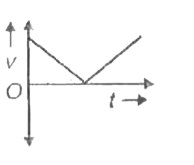
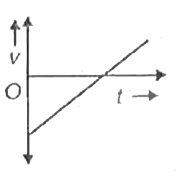
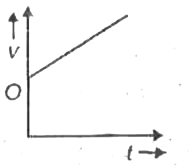
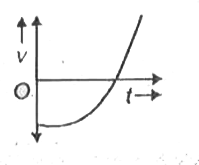
A particle moves along x - axis in such a way that its x - co - ordinate varies with time according to the equation `x=4-2t+t^(2)`. The speed of the particle will vary with time as

A

B

C

D

Text Solution

AI Generated Solution

The correct Answer is:

To solve the problem step by step, we need to analyze the motion of the particle given by the equation \( x = 4 - 2t + t^2 \). ### Step 1: Differentiate the displacement function to find velocity The velocity \( v(t) \) of the particle is the first derivative of the displacement \( x(t) \) with respect to time \( t \). \[ v(t) = \frac{dx}{dt} = \frac{d}{dt}(4 - 2t + t^2) \] ### Step 2: Calculate the derivative Now we differentiate each term: - The derivative of \( 4 \) is \( 0 \). - The derivative of \( -2t \) is \( -2 \). - The derivative of \( t^2 \) is \( 2t \). Putting it all together, we get: \[ v(t) = 0 - 2 + 2t = 2t - 2 \] ### Step 3: Analyze the velocity function The velocity function \( v(t) = 2t - 2 \) is a linear function of time \( t \). ### Step 4: Determine when the velocity is zero To find when the particle changes direction, we set the velocity to zero: \[ 2t - 2 = 0 \] Solving for \( t \): \[ 2t = 2 \implies t = 1 \] ### Step 5: Determine the sign of velocity - For \( t < 1 \), \( v(t) < 0 \) (the particle is moving in the negative direction). - For \( t = 1 \), \( v(t) = 0 \) (the particle is at rest). - For \( t > 1 \), \( v(t) > 0 \) (the particle is moving in the positive direction). ### Step 6: Determine the speed Speed is the absolute value of velocity. Therefore, we can express speed \( s(t) \) as: \[ s(t) = |v(t)| = |2t - 2| \] ### Step 7: Write the piecewise function for speed The speed can be expressed as a piecewise function: \[ s(t) = \begin{cases} -(2t - 2) & \text{if } t < 1 \\ 2t - 2 & \text{if } t \geq 1 \end{cases} \] This means: - For \( t < 1 \), \( s(t) = 2 - 2t \) - For \( t \geq 1 \), \( s(t) = 2t - 2 \) ### Step 8: Graph the speed function To graph the speed function: - For \( t < 1 \), the graph will be a decreasing line starting from \( s(0) = 2 \) down to \( s(1) = 0 \). - For \( t \geq 1 \), the graph will be an increasing line starting from \( s(1) = 0 \) and continuing upwards. ### Conclusion The speed of the particle varies with time as described by the piecewise function above, and the graph will reflect these changes in speed.
Promotional Banner

Topper's Solved these Questions

  • MOTION IN A STRAIGHT LINE

    AAKASH INSTITUTE ENGLISH|Exercise ASSIGNMENT (SECTION - B)|33 Videos
  • MOTION IN A STRAIGHT LINE

    AAKASH INSTITUTE ENGLISH|Exercise ASSIGNMENT (SECTION - C)|36 Videos
  • MOTION IN A STRAIGHT LINE

    AAKASH INSTITUTE ENGLISH|Exercise EXERCISE|29 Videos
  • MOTION IN A PLANE

    AAKASH INSTITUTE ENGLISH|Exercise Assignement section -J (Aakash Challengers Questions)|7 Videos
  • MOTION IN STRAIGHT LINE

    AAKASH INSTITUTE ENGLISH|Exercise Assignment (SECTION - J)|2 Videos

Similar Questions

Explore conceptually related problems

A particle moves along X-axis in such a way that its coordinate X varies with time t according to the equation x = (2-5t +6t^(2))m . The initial velocity of the particle is

A particle moves along the x-axis in such a way that its x-co-ordinate varies with time as x = 2 – 5t + 6t^(2) . The initial velocity and acceleration of particle will respectively be-

A particle moves in an XY-plane in such a way that its x and y-coordinates vary with time according to x(t)=t^(3)-32t, y(t)=5t^(2)+12 Find the acceleration of the particle, if t = 3 s.

A particle moves in the x-y plane. It x and y coordinates vary with time t according to equations x=t^(2)+2t and y=2t . Possible shape of path followed by the particle is

A particle moves along x-axis such that its position veries with time as x=50t-5t^2 . Select the correct alternative (s).

An object moves along x-axis such that its position varies with time according to the relation x=50t-5t^(2) Here, x is in meters and time is in seconds. Find the displacement and distance travelled for the time interval t = 0 to t = 6 s.

A particle moves along the X-axis as x=u(t-2s)=at(t-2)^2 .

The co-ordinates of a moving particles at time t, given by x = at^(2), y = bt^(2) . The speed of the particle is

The co-ordinates of a moving particle at any time t are given by x=ct^(2) and y=bt^(2) The speed of the particle is

A particle moves along the X-axis as x=u(t-2 s)+a(t-2 s)^2 .

AAKASH INSTITUTE ENGLISH-MOTION IN A STRAIGHT LINE-ASSIGNMENT (SECTION - A)
  1. A body is projected vertically upward from ground. If we neglect the e...

    Text Solution

    |

  2. Which of the following position-time graphs correctly represents two m...

    Text Solution

    |

  3. The displacement - time graph for two particles A and B is as follows....

    Text Solution

    |

  4. For the acceleration - time (a - t) graph shown in figure, the change ...

    Text Solution

    |

  5. Figure shows the graph of x - coordinate of a particle moving along x ...

    Text Solution

    |

  6. Position - time graph for a particle is shown in figure. Starting from...

    Text Solution

    |

  7. The velocity versus time graph of a body moving in a straight line is ...

    Text Solution

    |

  8. Acceleration - time graph for a particle is given in figure. If it sta...

    Text Solution

    |

  9. Figure shows the position of a particle moving on the x - axis as a fu...

    Text Solution

    |

  10. A particle moves along x - axis in such a way that its x - co - ordina...

    Text Solution

    |

  11. Two balls are projected upward simultaneously with speeds 40 m/s and 6...

    Text Solution

    |

  12. The position (x) of a particle moving along x - axis veries with time ...

    Text Solution

    |

  13. The position (x) - time (t) graph for a particle moving along a straig...

    Text Solution

    |

  14. A ball is dropped from a height h above ground. Neglect the air resist...

    Text Solution

    |

  15. A train of 150 m length is going towards north direction at a speed of...

    Text Solution

    |

  16. Two cars are moving in the same direction with the same speed 30 km//h...

    Text Solution

    |

  17. Two cars A and B are moving in same direction with velocities 30 m/s a...

    Text Solution

    |

  18. Two trains each of length 100 m moving parallel towards each other at ...

    Text Solution

    |

  19. A ball is dropped from the top of a building of height 80 m. At same i...

    Text Solution

    |

  20. A particle move with velocity v(1) for time t(1) and v(2) for time t(2...

    Text Solution

    |
