Home
Class 12
PHYSICS
Two objects each of mass 5 kg are moving...

Two objects each of mass 5 kg are moving in the same straight line but in the opposite direction towards each other with some speed of 3 m/s. They stick to each other after collision. What will be the velocity of the combined object after collision?

Text Solution

Verified by Experts
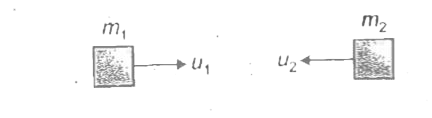

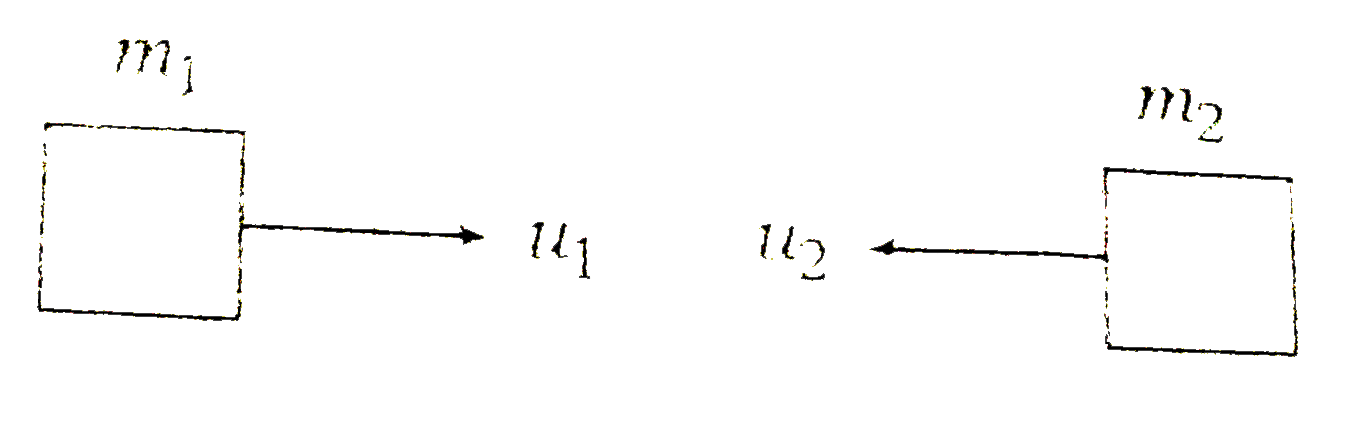
Before collision,
`m_(1)=m_(2)=5kg`
`u_(1)=3m//s`
`u_(2)= -3m//s`
At collision,
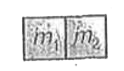
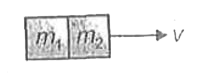
After collision,
Let the velocity of the combined object be v.
Total momentum before collision is
`m_(1)u_(1)+m_(2)u_(2)=5xx3+5xx(-3)=0`
Total momentum of the system after collision is
`m_(1)v +m_(2)v=(m_(1)+m_(2))v=(5+5)v=10v`
According to the conservation of momentum,
Momentum before collision = Momentum after collision
`therefore 0 = 10v`
`therefore v =0`
Hence, the velocity of the combined object after collision is zero.
Promotional Banner

Topper's Solved these Questions

  • LAWS OF MOTION

    AAKASH INSTITUTE ENGLISH|Exercise EXERCISE|69 Videos
  • LAWS OF MOTION

    AAKASH INSTITUTE ENGLISH|Exercise Assignment (SECTION-A)|65 Videos
  • LAWS OF MOTION

    AAKASH INSTITUTE ENGLISH|Exercise ASSIGNMENT ( SECTION -J ) Aakash Challengers Questions|12 Videos
  • KINETIC THEORY

    AAKASH INSTITUTE ENGLISH|Exercise EXERCISE (ASSIGNMENT) SECTION - D Assertion - Reason Type Questions|10 Videos
  • MAGNETISM AND MATTER

    AAKASH INSTITUTE ENGLISH|Exercise ASSIGNMENT (SECTION D)|26 Videos

Similar Questions

Explore conceptually related problems

Two object, each of mass 1.5 kg , are moving in the same straight line but in opposite directions, The velocity of each object is 2.5 ms^(-1) before the collision during which they stick together. What will be the velocity of the combined object after collision?

Two train are moving in a straight line in the same direction with a speed of 80 km/h. The relative velocity of one trains w.r.t. each other is

Two objects of masses 100g and 200g are moving along the same line in the same direction with velocities of 2m//s and 1m//s , respectively. They collide and after the collison, the first object moves at a velocity of 1.67 m//s in the same direction. Determine the velocity of the second object.

Two identical balls each of mass m moving on straight track approaching towards each other with same speed. Find kinetic energy of the two ball system is equal to the total energy loss during collision E is the total kinetic energy of the balls before collision and E' is after collision and coefficient of restitution is e. Then choose the correct options.

Two masses of 0.25 kg each moves toward each other with speed 3 ms^(-1) collide and stick together. Find the final velocity

Two particle, each having a mass m are placed at a separation d in a uniform magnetic field B as shown in figure.They have opposite charges of equal magnitude q .At time t=0 , the particles are projected towards each other, each with a speed v . Suppose v=2v_(m) and they stick to each other after the collision.Describe the motion after the collision (neglect the magnetic, gravitational & electric forces between charges).

A block of mass 5 kg moves from left to right with a velocity of 2ms^(-1) and collides with another block of mass 3 kg moving along the same line in the opposite direction with velocity 4 ms^(-1) . (i) If the collision is perfectly elastic, determine velocities of both the blocks after their collision. (ii) If coefficient of restitution is 0.6, determine velocities of both the blocks after their collision.

An object of mass 1kg travelling in a straight line with a velocity of 10m//s collides with, and sticks to, a stationary wooden block of mass 5kg . Then, they both move off together in the same straight line. Calculate the total momentum just before the impact and just after the impact. Also, calculate the velocity of the combined object.

Two identical balls moving in opposite directions with speed 20 m/s and 25 m/s undergo head on perfectly inelastic collision. The speed of combined mass after collision is

AAKASH INSTITUTE ENGLISH-LAWS OF MOTION-Example
  1. A bus starts from rest and moves down a hill with constant acceleratio...

    Text Solution

    |

  2. A stone of mass 1 kg is thrown with a velocity of 20ms^(-1) across the...

    Text Solution

    |

  3. An iron block of mass m = 500 kg is kept at the back of a truck moving...

    Text Solution

    |

  4. A force F=(2thati+3t^(2)hatj)N acts on an object moving in XY-plane. F...

    Text Solution

    |

  5. A ball of mass m strikes a rigid wall with speed v and gets reflected ...

    Text Solution

    |

  6. A 800 kg rocket is fired from earth so that exhaust speed is 1200 m/s....

    Text Solution

    |

  7. Akhtar, Kiran and Rahul were riding in a motorcar that was a high velo...

    Text Solution

    |

  8. A bullet of mass 50 g is fired from a gun with initial velocity of 35 ...

    Text Solution

    |

  9. Two objects each of mass 5 kg are moving in the same straight line but...

    Text Solution

    |

  10. A 1000 kg engine pulls a train of 4 wagons each of 2500 kg along a hor...

    Text Solution

    |

  11. Find the tension in the horizontal string PQ and the string QR in the ...

    Text Solution

    |

  12. Two masses 2 kg and 4 kg are connected at the two ends of light inext...

    Text Solution

    |

  13. A block of mass 8 kg is sliding on a surface inclined at an angle of 4...

    Text Solution

    |

  14. A wooden block of mass 0.8 kg is dragged along a level frictionless su...

    Text Solution

    |

  15. A body of mass 10 kg is kept on a horizontal floor of coefficent of st...

    Text Solution

    |

  16. A block of mass 5 kg rests on a inclined plane at an angle of 30^(@) w...

    Text Solution

    |

  17. Find the maximum speed with which a car can turn on a bend without ski...

    Text Solution

    |

  18. A circular racetrack of radius 100 m is banked at an angle of 45^(@). ...

    Text Solution

    |

  19. A cyclist speeding at 4.5 km/h on a level road takes a sharp circular ...

    Text Solution

    |

  20. A wooden block of mass 1 kg rests on a soft horizontal floor. When an ...

    Text Solution

    |