Home
Class 12
PHYSICS
Figure shows tow cases. In first case a ...

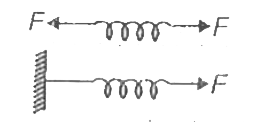
Figure shows tow cases. In first case a spring (spring constant K) is pulled by two equal and opposite forces F at both ends and in second case is pulled by a force F at one end. Extensions (x) in the springs will be

A

In both cases `x=(2F)/(K)`

B

In both cases `x=(F)/(K)`

C

In first case `x=(2F)/(K)`, in second case `x=(F)/(K)`

D

In first case `x=(F)/(K)`, In second case `x=(2F)/(K)`

Text Solution

Verified by Experts

Promotional Banner

Topper's Solved these Questions

  • LAWS OF MOTION

    AAKASH INSTITUTE ENGLISH|Exercise Assignment (SECTION-C)|63 Videos
  • LAWS OF MOTION

    AAKASH INSTITUTE ENGLISH|Exercise Assignment (SECTION-D) (Assertion-Reason Type Questions)|15 Videos
  • LAWS OF MOTION

    AAKASH INSTITUTE ENGLISH|Exercise Assignment (SECTION-A)|65 Videos
  • KINETIC THEORY

    AAKASH INSTITUTE ENGLISH|Exercise EXERCISE (ASSIGNMENT) SECTION - D Assertion - Reason Type Questions|10 Videos
  • MAGNETISM AND MATTER

    AAKASH INSTITUTE ENGLISH|Exercise ASSIGNMENT (SECTION D)|26 Videos

Similar Questions

Explore conceptually related problems

Figure a) shows a spring of force constant k clamped rigidly at once end and a mass m attached to its free end. A force F applied at the free end stretches the spring. Figure b) shows the same spring with both ends free and attached to a mass m at either end. Each end of the spring in figure is stretched by the same force F. (a) What is the maximum extension of the spring in the two cases ? (b) If the mass in figure and the two masses in figure are released free, what is the period of oscillation in each case?

Figure a) shows a spring of force constant k clamped rigidly at once end and a mass m attached to its free end. A force F applied at the free end stretches the spring. Figure b) shows the same spring with both ends free and attached to a mass m at either end. Each end of the spring in figure is stretched by the same force F. (a) What is the maximum extension of the spring in the two cases ? (b) If the mass in figure and the two masses in figure are released free, what is the period of oscillation in each case?

An ideal spring with spring constant k is hung from the ceiling and a block of mass M is attached to its lower end. The mass is released with the spring initially unstretched. Then the maximum extension in the spring is

An ideal spring with spring constant k is hung from the ceiling and a block of mass M is attached to its lower end. The mass is released with the spring initially unstretched. Then the maximum extension in the spring is

One end of a light spring of spring constant k is fixed to a wall and the other end is tied to a block placed on a smooth horizontal surface. In a displacement, the work by the spring is 1/2kx^2 . The possible cases are

Figure. (a) shows a spring of force constant k fixed at one end and carrying a mass m at the other end placed on a horizontal frictionless surface. The spring is stretched by a force F. Figure. (b) shows the same spring with both endsf free and a mass m fixed at each free end Each of the spring is streched by the same force F. The mass in case (a) and the masses in case (b) are then released. Which of the following statements are true?

In Fig. three identical massless springs are kept horizontal. The left end of the first is tied to a wall. The left end of the second spring is tied to a block of mass m placed on rough ground and the ,eft end of the third spring is tied to a block of mass m placed frictionless ground. The right end of each spring is pulled by a force that is increased gradually from zero to F. Extensions in these springs are x_(1) , x_(2) and x_(3) , respectively. Find the relationship between x_(1) , x_(2) , and x_(3)

One end of a light spring of spring constant k is fixed to a wall and the other end is tied to a block placed on a smooth horizontal surface. In a displacment, the work done by the spring is +(1/2)kx^(2) . The possible cases are.

One end of a light spring of spring constant k is fixed to a wall and the other end is tied to a block placed on a smooth horizontal surface. In a displacement, the work done by the spring is +(1/2)kx^(2) . The possible cases are.

A rope of length L is pulled by a constant force F. What is the tension in the rope at a distance x from the end where the force is applied ?

AAKASH INSTITUTE ENGLISH-LAWS OF MOTION-Assignment (SECTION-B)
  1. Two blocks of mass M and m are kept on the trolley whose all surfaces ...

    Text Solution

    |

  2. Find the acceleration of 3 kg mass when acceleration of 2 kg mass is 2...

    Text Solution

    |

  3. What is the minimum value of F needed so that block begins to move upw...

    Text Solution

    |

  4. A force barF=hati+4hatj acts on block shown. The force of friction act...

    Text Solution

    |

  5. Figure shows tow cases. In first case a spring (spring constant K) is ...

    Text Solution

    |

  6. A money of mass 40 kg climbs up a rope, of breaking load 600 N hanging...

    Text Solution

    |

  7. Coefficient of friction between A and B is mu . The minimum force F wi...

    Text Solution

    |

  8. A block of mass 10 kg is held at rest against a rough vertical wall [...

    Text Solution

    |

  9. A block is projected with speed 20 m/s on a rough horizontal surface. ...

    Text Solution

    |

  10. An object starts from rest and is acted upon by a variable force F as ...

    Text Solution

    |

  11. A particle of mass m moves with constant speed v on a circular path of...

    Text Solution

    |

  12. The frictional force acting on 1 kg block is

    Text Solution

    |

  13. The tension T in the string shown in figure is

    Text Solution

    |

  14. An object of mass 2 kg at rest at origin starts moving under the actio...

    Text Solution

    |

  15. A block of mass m is at rest on a rough inclined plane of angle of inc...

    Text Solution

    |

  16. A block of mass m takes time t to slide down on a smooth inclined plan...

    Text Solution

    |

  17. A person stands in contact against the inner wall of a rotor of radius...

    Text Solution

    |

  18. The magnitude of force acting on a particle moving along x-axis varies...

    Text Solution

    |

  19. Three forces vecF(1)=(2hati+4hatj)N : vecF(2)=(2hatj-hatk)N and vecF(...

    Text Solution

    |

  20. The momentum p of an object varies with time (t) as shown in figure. T...

    Text Solution

    |

