Home
Class 12
PHYSICS
A square plate has a moment of inertia l...

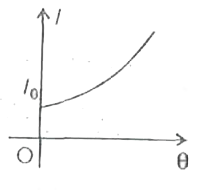
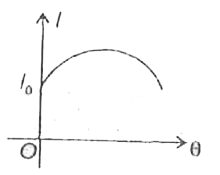
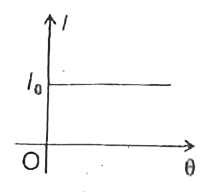
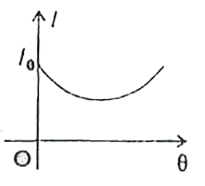
A square plate has a moment of inertia `l_(0)` about an axis lying in its plane, passing through its centre and making an angle `theta` with one of the sides. Which graph represents the variation of l with `theta` ?

A

B

C

D

Text Solution

AI Generated Solution

The correct Answer is:

To solve the problem of how the moment of inertia \( I \) of a square plate varies with the angle \( \theta \) of the axis passing through its center, we can follow these steps: ### Step-by-Step Solution: 1. **Understanding the Moment of Inertia**: The moment of inertia \( I \) of an object about a given axis is a measure of how difficult it is to change its rotational motion about that axis. For a square plate, the moment of inertia depends on the distribution of mass relative to the axis of rotation. 2. **Defining the Square Plate**: Consider a square plate with uniform mass distribution. Let the side length of the square be \( a \). The mass of the plate can be denoted as \( m \). 3. **Identifying the Axis of Rotation**: The axis of rotation is in the plane of the square and passes through its center, making an angle \( \theta \) with one of the sides of the square. 4. **Using the Parallel Axis Theorem**: The moment of inertia about an axis through the center of mass (CM) can be calculated using the formula: \[ I_{CM} = \frac{1}{6} m a^2 \] This is the moment of inertia about an axis perpendicular to the plane of the square. 5. **Considering the Angle \( \theta \)**: When the axis is tilted at an angle \( \theta \), the distribution of mass relative to the new axis changes. However, due to the symmetry of the square, the moment of inertia remains constant regardless of the angle \( \theta \). 6. **Conclusion**: Since the axis divides the square symmetrically and the mass distribution remains uniform, the moment of inertia \( I \) does not depend on the angle \( \theta \). Thus, we can conclude that: \[ I(\theta) = I_0 \quad \text{(constant)} \] 7. **Graph Representation**: The graph representing the variation of \( I \) with \( \theta \) will be a horizontal line, indicating that \( I \) remains constant as \( \theta \) varies. Therefore, the correct graph is option C.
Promotional Banner

Similar Questions

Explore conceptually related problems

The moment of inertia of a semicircular ring of mass M and radius R about an axis which is passing through its centre and at an angle theta with the line joining its ends ( as shown ) is

The moment of inertia of a solid sphere, about an axis parallel to its diameter and at a distance of x form it is, 'I(x)'. Which one of the graphs represents the variation of 'I(x) with x correctly ?

The moment of inertia of a copper disc, rotating about an axis passing through its centre and perpendicular to its plane

The moment of inertia of a uniform rod of length 2l and mass m about an axis xy passing through its centre and inclined at an enable alpha is

Moment of inertia of a ring of mass M and radius R about an axis passing through the centre and perpendicular to the plane is

Calculate the moment of inertia of a ring of mass 2kg and radius 2cm about an axis passing through its centre and perpendicular to its surface.

Calculate the moment of inertia of a ring of mass 2kg and radius 2cm about an axis passing through its centre and perpendicular to its surface.

Figure shows the variation of the moment of inertia of a uniform rod, about an axis passing through itss centre and inclined at an angle theta to the length. The moment of inertia of the rod about an axis passing through one of its ends and making an angle theta=(pi)/(3) will be

A square is made by joining four rods each of mass M and length L . Its moment of inertia about an axis PQ, in its plane and passing through one one of its corner is

A square is made by joining four rods each of mass M and length L. Its moment of inertia about an axis PQ, in its plane and passing through one of its corner is
