Home
Class 12
PHYSICS
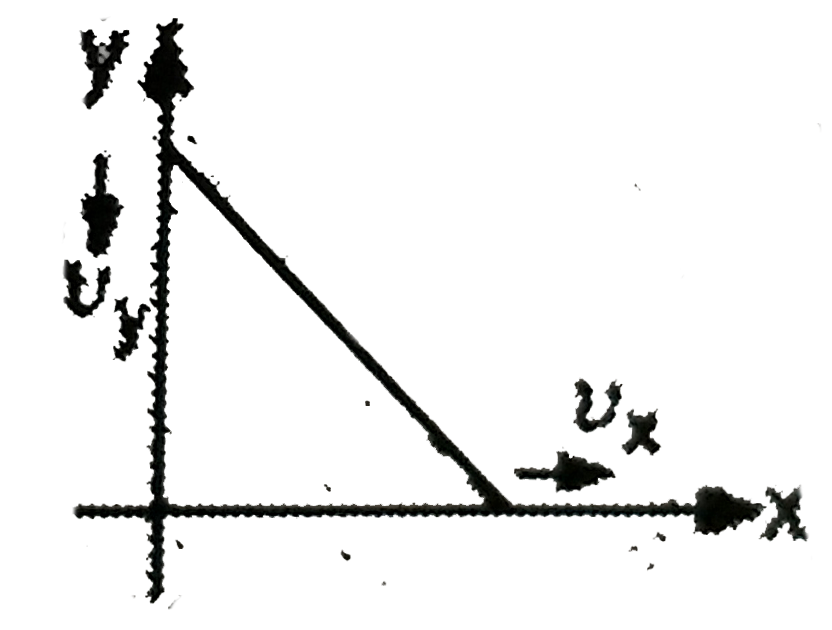
A rod of length I leans by its upper end...

A rod of length I leans by its upper end against a smooth vertical wall, while its other end leans against the floor. The end that leans against the wall moves uniformly downward. Then:

A

The speed of lower end increases at a constant rate

B

The speed of the lower end decreases but never becomes zero

C

The speed of the lower and gets smaller and smaller and vanishes when the upper end touches the ground

D

The speed of the lower end remain constant till upper end touches the ground

Text Solution

Verified by Experts

The correct Answer is:

C
Promotional Banner

Similar Questions

Explore conceptually related problems

A uniform ladder which is 5m long has a mass of 25kg , leans with its upper end against a smooth vertical wall and its lower end on rough ground. The bottom of the ladder is 3m from the wall. Calculate the frictional force between the ladder and the ground . (g=10ms^(-2) )

If a ladder is not in balance against a smooth vertical wall, then it can be made in balance by :-

A ladder of length l and mass m is placed against a smooth vertical wall, but the ground is not smooth. Coefficient of friction between the ground and the ladder is mu . The angle theta at which the ladder will stay in equilibrium is

A rod of length 'l' is inclined at an angle 'theta' with the floor against a smooth vertical wall. If the end A moves instantaneously with velocity v_(1) , what is the velocity of end B at the instant when rod makes 'theta' angle with the horizontal.

A light stick of length l rests with its one end against the smooth wall and other end against the smooth horizontal floor as shown in the figure. The bug starts at rest from point B and moves such that the stick always remains at rest. a_(P) is the magnitude of acceleration of but of mass m , which depends upon its distance of x from the top end of the stick. Choose the correct option (s)

A uniform ladder of length 3.25 m and weight 250 N is placed against a smooth vertical wall with its lower end 1.25 m from the wall. If coefficient of friction between the ladder and the floor is 0.3, then, find the frictional force acting on the ladder at the point of contact between ladder and floor.

A ladder 10 metres long rests with one end against a vertical wall, the other on the floor. The lower end moves away from the wall at the rate of 2 metres/minute. The rate at which the upper end falls when its base is 6 metres away from the wall

A uniform ladder of mass 10 kg leans against a smooth vertical wall making an angle of 53^0 with it. The other end rests on a rough horizontal floor. Find the normal force and the frictional force that the floor exerts on the ladder

A ladder of length L is slipping with its ends against a vertical wall and a horizontal floor. At a certain moment, the speed of the end in contact with the horizontal floor is v and the ladder makes an angle theta=30^@ with horizontal. Then, the speed of the ladder's centre of mass must be

The one end of a 20 m long ladder is on the floor and the other end is in the contact of vertical wall. Its lower end slides on the floor. Show that the rate of sliding of the upper end is 4/3 times the rate of sliding the lower end when the lower end is 16 m away from the wall.
