Home
Class 12
PHYSICS
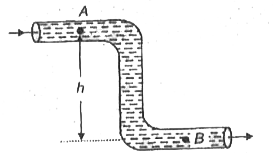
In this figure, an ideal liquid flows th...

In this figure, an ideal liquid flows through the tube having uniform area of cross-section and is held in vertical plane. Find the ratio of speed of liquid at A and B and also find the pressure difference between- these points.

Text Solution

Verified by Experts

As area of cross-section is uniform therefore according to equation of continuity speed of liquid is same at all points
i.e. `v_(A) = v_(B)`
But during motion of liquid from A to B the potential energy decreases
`therefore` According to Bernoullis theorem
`1/2 v^(2) + gh + P/rho` =constant
`implies gh + P_(A)/rho = P_(B)/rho`
`implies P_(B) - P_(A)= rhogh`
Promotional Banner

Similar Questions

Explore conceptually related problems

An ideal fluid flows through a pipe of circular cross - section with diameters 5 cm and 10 cm as shown in the figure. The ratio of velocities of fluid at A and B is

The water flowing through the same tube having two different cross section areas has different flow rates .

Figure shows a siphon. The liquid shown in water. The pressure difference P_B-P_A between the points A and B is

In the figure, an ideal liquid flows through the tube, which is of uniform cross section. The liquid has velocities v_(A) and v_(B) , and pressures P_(A) and P_(B) at the points A and B , respectively. Then

Figure shows an ideal fluid flowing through a uniform cross-sectional tube in the vertical tube with liquid velocities v_(A) and v_(B) and pressure P_(A) and P_(B) . Knowing that offers no resistance to fluid flow then which of the following is true.

An ideal liquid (water) flowing through a tube of non-uniform cross section area at A and B are 40 cm^2 and 20 cm^2 respectively. If pressure difference between A & B is 700 N/(m^2) then volume flow rate is

A viscous liquid flows through a horizontal pipe of varying cross-sectional area. Identify the option which correctly represents the variation of height of rise of liquid in each vertical tube

A liquid flows through two capillary tubes A and B connected in series. The length and radius of B are twice that of A. What is the ratio of the pressure difference across A to that across B ?

water is flowing through a tube of non-uniform cross-section. If the radii of the tube at the entrance and the exit are in the ratio 3:2 then the ratio of the velocites of flow of watern at the entrance and the exit is

A liquid is flowing through a pipe of non-uniform cross-section. At a point where area of cross-section of the pipe is less, match the following columns.
