Home
Class 12
PHYSICS
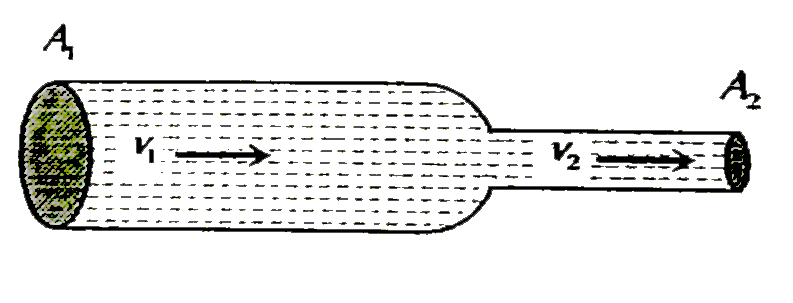
A liquid flows in a tube from left to ri...

A liquid flows in a tube from left to right as shown in figure. `A_(1)` and `A_(2)` are the cross-section of the portions of the tube as shown. Then the ratio of speeds `v_(1)//v_(2)` will be

A

`A_(1)/A_(2)`

B

`A_(2)/A_(1)`

C

`sqrt(A_(2)/A_(1))`

D

`sqrt(A_(1)/A_(2))`

Text Solution

Verified by Experts

Promotional Banner

Similar Questions

Explore conceptually related problems

In the situation shown , the readings of ideal ammeters A_(1) and A_(2) are in the ratio.

Water flows through the tube shown in figure. The areas of cross section of the wide and the narrow portions of the tube are 5cm^2 and 2cm^2 respectively. The rate of flow of water through the tube is 500 cm^3s^-1 . Find the difference of mercury levels in the U-tube.

Water flows through the tube shown in figure. The areas of cross section of the wide and the narrow portions of the tube are 5cm^2 and 2cm^2 respectively. The rate of flow of water through the tube is 500 cm^3s^-1 . Find the difference of mercury levels in the U-tube.

An incompressible liquid flows through a horizontal tube as shown in the figure. Then the velocity 'v' of the fluid is:

A liquid flows through a horizontal tube as shown in figure. The velocities of the liquid in the two sections, which have areas of cross-section A_(1) and A_(2) and v_(1) and v_(2) respectively. The differnece in the levels of the liquid in the two vertical tubes is h . then

What are the readint of the ammeters A_(1) and A_(2) shown in figure. Neglect the resistance of the maters.

A non viscous liquid is flowing through a frictionless duct, cross-section varying as shown in figure. Which of the following graph represents the variation of pressure p along the axis of tube ?

A non viscous liquid is flowing through a frictionless duct, cross-section varying as shown in figure. Which of the following graph represents the variation of pressure p along the axis of tube ?

An ideal fluid flows in the pipe as shown in the figure. The pressure in the fluid at the bottom P_(2) is the same as it is at the top P_(1) . If the velocity of the top v_(1) = 2 m//s . Then the ratio of areas A_(1).A_(2) , is

Two capillary tubes of lengths in the ratio 2 : 1 and radii in the ratio 1 : 2 are connected in series. Assume the flow of the liquid through the tube is steady. Then, the ratio of pressure difference across the tubes is

