Home
Class 12
PHYSICS
Five rods of same dimensions are arrange...

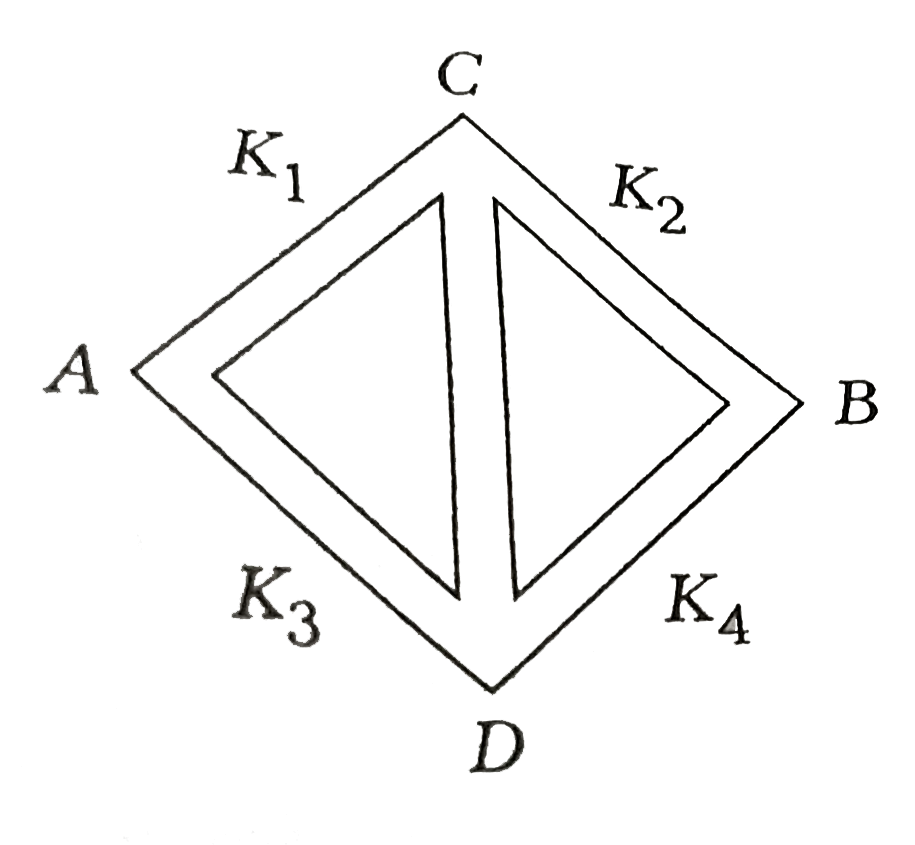
Five rods of same dimensions are arranged as shown in figyre. They have thermal conductivities `K_(1), K_(2), K_(3), K_(4) and K_(5)`. When points A and B are maintained at different temperatures, no heat flows through the central rod if

A

`k_1=k_4`and`k_2=k_3`

B

`k_1k_4=k_2k_3`

C

`k_1k_2=k_3k_4`

D

`(k_1)/(k_4)=(k_2)/(k_3)`

Text Solution

Verified by Experts

Promotional Banner

Similar Questions

Explore conceptually related problems

Five rods of same dimensions are arranged as shown in the figure. They have thermal conductivities K _(1) , K_(2) , K _(3) , K_( 4) and K_( 5) . When points A and B are maintained at different temperatures, no heat flows through the central rod if

Three rods of same dimensions are arranged as shown in Fig. They have thermal conductivities K_1 , K_2 and K_3 . The points P and Q are maintained at different temeperature for the heat to flow at the same rate along PRQ and PQ. Whi of the following options correct?

Rate of heat flow through two conducting rods of identical dimensions having thermal conductivities K_(1) and K_(2) and Q_(1) and Q_(2) when their ends are maintained at the same difference of temperature individually. When the two rods are joined in series with their ends maintained at the same temperature difference (as shown in the figure), the rate of heat flow will be

Three rods of same dimension are joined in series having thermal conductivity k_1 , k_2 and k_3 . The equivalent thermal conductivity is

Two rods A and B of different materials are welded together as shown in figure. Their thermal conductivities are K_(1) and K_(2) . The thermal conductivity of the composite rod will be

Two bar of identical dimensions are kept as shown in figure. If K_1 and K_2 are their coefficients of thermal conductivities, then equivalent K

A composite rod made of three rods of equal length and cross-section as shown in fig. The thermal conductivites of the materials of the rods are K//2 , 5K and K respectively. The end A and end B are at constant tempertures. All heat entering the face A goes out of the end B there being no loss of heat from the sides of the bar. The effective thermal conductivity of the bar is

A cylinder of radius R made of a material of thermal conductivity K_1 is surrounded by a cylindrical shell of inner radius R and outer radius 2R made of a material of thermal conductivity K_2 . The two ends of the combined system are maintained at two different temperatures. There is no loss of heat across the cylindrical surface and the system is in steady state. The effective thermal conductivity of the system is (a) K_1 + K_2 (b) K_1K_2//(K_1+K_2) (c ) (K_1 + 3K_2)//4 (d) (3K_1 + K_2)//4 .

A cylinder of radius r made of a material of thermal conductivity K_1 is surrounded by a cylindrical shell of inner radius r and outer radius 2r made of a material of thermal conductivity K_2 . The two ends of the combined system are maintained at two different temperatures. There is no loss of heat across the cylindrical surface and the system is in steady state. Show that the effective thermal conductivity of the system is (K_1 + 3K_2 )//4 .

Four identical rods AB, CD, CF and DE are joined as shown in figure. The length, cross-sectional area and thermal conductivity of each rod are l, A and K respectively. The ends A, E and F are maintained at temperature T_(1) , T_(2) and T_(3) respectively. Assuming no loss of heat to the atmosphere, find the temperature at B.

