Home
Class 12
PHYSICS
Two bodies A and B of same mass, area an...

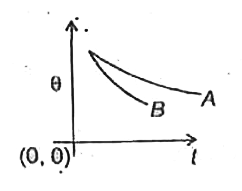
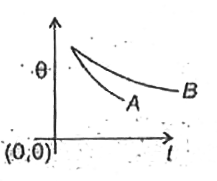
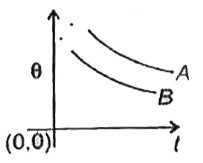
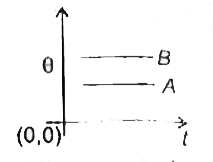
Two bodies A and B of same mass, area and surface finish with specific heats `S_(A)` and `S_(B)` `(S_(A)>S_(B))` are allowed to cool for given temperature range. Temperature varies with time as

A

B

C

D

Text Solution

Verified by Experts

Promotional Banner

Similar Questions

Explore conceptually related problems

Two blocks A and B of the same mass and surface finish are sliding on the same surface. Area of contact of A is twice that of the B. The frictional force between A and the surface is

Two bodies A and B of equal masses, area and emissivity cooling under Newton's law of cooling from same temperature are represented by the graph: If theta is the instantaneous temperature of the body and theta_(0) , is the temperature of surroundings, then relationship between their specific heats is

Two metallic spheres S_1 and S_2 are made of the same material and have got identical surface finish. The mass of S_1 is thrice that of S_2 . Both the spheres are heated to the same high temperature and placed in the same room having lower temperature but are thermally insulated from each other. the ratio of the initial rate of cooling of S_1 to that of S_2 is (a)1/3 (b)1/(sqrt3) (c) (sqrt3)/1 (d) (1/3)^(1/3)

Two balls of same material and same surface finish have their diameters in the ratio 1:2. They are heated to the same temperature and are left in a room to cool by radiation, then the initial rate of loss of heat

There are two thin spheres A and B of the same material and same thickness. They behave like black bodies, Radius of A is double that of B and Both have same temperature T. When A and B are kept in a room of temperature T_0 (lt T) , the ratio of their rates of cooling is (assume negligible heat exchange between A and B).

There are two thin spheres A and B of the same material and same thickness. They behave like black bodies, Radius of A is double that of B and Both have same temperature T. When A and B are kept in a room of temperature T_0 (lt T) , the ratio of their rates of cooling is (assume negligible heat exchange between A and B).

Two substances A and B of equal mass m are heated by uniform rate of 6 "cal"s^(-1) under similar conditions. A graph between temperature and time is shown in figure. Ratio of heat absorbed H_(A) //H_(B) by them during complete fusion :-

Two bodies of masses m_(1) and m_(2) and specific heat capacities S_(1) and S_(2) are connected by a rod of length l, cross-section area A, thermal conductivity K and negligible heat capacity. The whole system is thermally insulated. At time t=0 , the temperature of the first body is T_(1) and the temperature of the second body is T_(2)(T_(2)gtT_(1)) . Find the temperature difference between the two bodies at time t.

Condider two rods of same length and different specific heats (s_(1), s_(2)) , thermal conductivities (K_(1), K_(2)) and areas of cross-section (A_(1), A_(2)) and both having temperatures (T_(1), T_(2)) at their ends. If their rate of loss of heat due to conduction are equal, then

Two bodies A and B having equal surface areas are maintained at temperatures 10^(@)C . And 20^(@)C . The thermal radiation emitted in a given time by A and B are in the ratio
