Home
Class 12
PHYSICS
The three rods shown in figure have iden...

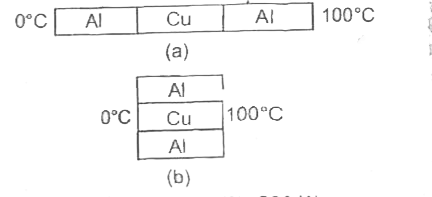
The three rods shown in figure have identical dimensions. Heat flows from the hot end at a rate of 40 W in the arrangement (a). Find the rates of heat flow when the rods are joined as in arrangement (b). (Assume `k_(Al) = 200 W/(m ^(@)C)` and `K_(Cu) = 400 W/(m ^(@)C)`

A

75 W

B

200 W

C

400 W

D

4 W

Text Solution

Verified by Experts

Promotional Banner

Similar Questions

Explore conceptually related problems

The two rods show in figure have identical geometrical dimension.. They are in contact with two heat baths at temperature 100^(@)C . And 0^(@)C . The temperature of the junction is 70^(@)C . Find the temperature of the junction if the rods are interchanged.

Three rods of the same dimension have thermal conductivity 3K , 2K and K. They are arranged as shown in the figure below Then , the temperature of the junction in steady - state is

An aluminium rod and copper rod of equal length 1 m and cross-sectional area 1 cm^(2) are welded as shown. K_(A1) = 200 W//m^(@)C, K_(Cu) = 400 W//m^(@)C . Find heat current

Two metal cubes A and B of same size are arranged as shown in Figure. The extreme ends of the combination are maintained at the indicated temperatures. The arrangement is thermally insulated. The coefficients of thermal conductivity of A and B are 300W//m ^@C and 200 W//m^@C, respectively. After steady state is reached the temperature t of the interface will be ......

A metal ball of mass 2kg is heated means of a 40W heater in a room at 25^(@)C . The temperature of the ball becomes steady at 60^(@)C . Find the rate of loss of heat to the surrounding when the ball is at 39^(@)C .

A metal ball of mass 2kg is heated means of a 40W heater in a room at 25^(@)C . The temperature of the ball beomes steady at 60^(@)C . Find the rate of loss of heat to the surrounding when the ball is at 60^(@)C .

Figure shows a steel rod joined to a brass rod. Each of the rods has length of 31 cm and area of cross-section 0.20 cm^(2) . The junction is maintained at a constant temperature 50^(@)C and the two ends are maintained at 100^(@)C . The amount of heat taken out from the cold junction in 10 minutes after the steady state is reached in n xx 10^(2)J . Find 'n' the thermal conductivities are K_(steel) = 46 W//m-^(@)C and K_(brass) = 109 W//m-^(@)C .

Figure shows an aluminium rod joined to a copper rod. Each of the rods has a length of 20cm and area of cross section 0.20cm^(2) . The junction is maintained at a constant temperature 40^(@)C and the two ends are maintained at 80^(@)C . Calculate the amount of heat taken out from the cold junction in one minute after the steady state is reached. The conductivities are K_(Al)=200Wm^(-1)C^(-1) . and K_(Cu)=400Wm^(-1)C^(-1) .

A rod of length 1 m is released from rest as shown in the figure below: If omega of rod is sqrtn at the moment it hits the ground, then find n.

Rate of heat flow through two conducting rods of identical dimensions having thermal conductivities K_(1) and K_(2) and Q_(1) and Q_(2) when their ends are maintained at the same difference of temperature individually. When the two rods are joined in series with their ends maintained at the same temperature difference (as shown in the figure), the rate of heat flow will be

