Home
Class 12
PHYSICS
Four charge Q, q, Q and q are kept at th...

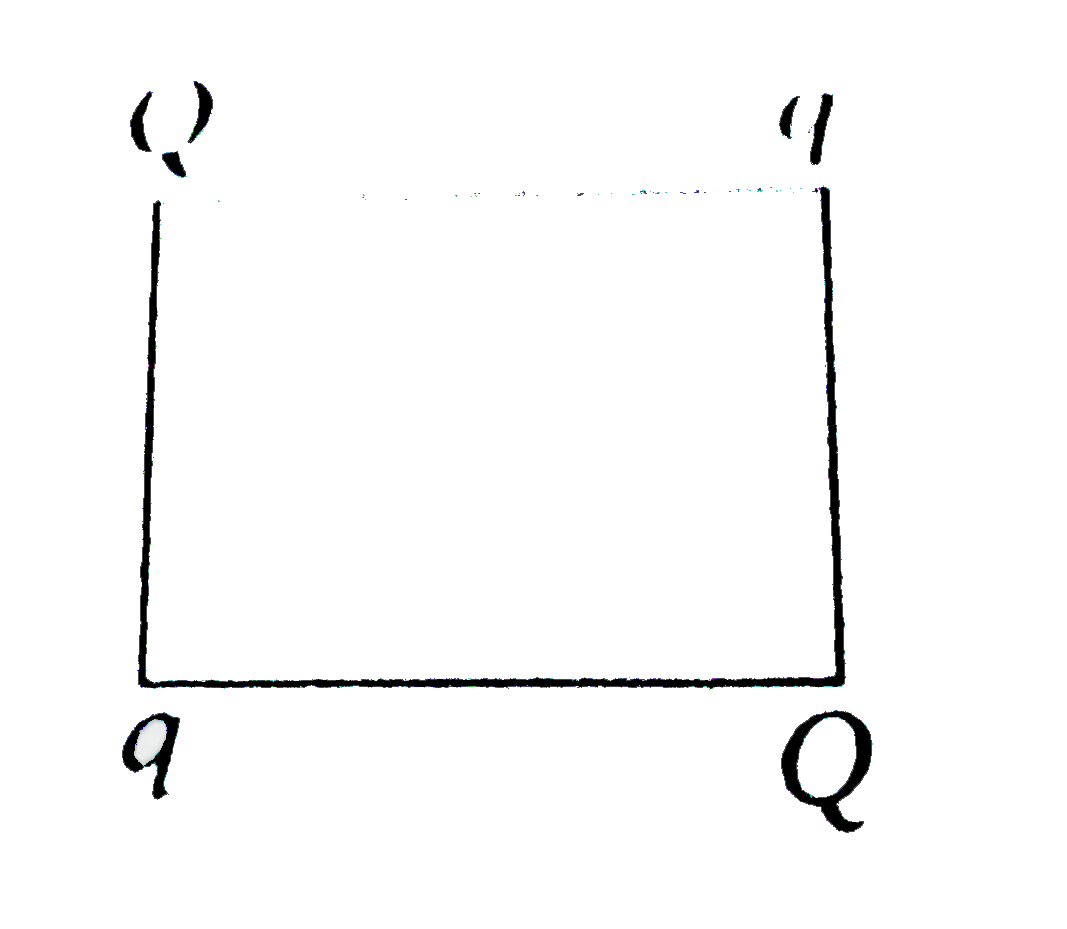
Four charge `Q, q, Q` and q are kept at the four corners of a square as shown below. What is the relation between Q and q, so that the net force on a charge q is zero ?

Text Solution

Verified by Experts

Here both the .q. will have same sign either positive or negative. Similarly both the Q will have same sign. Let us make the force on upper right corner q equal to zero.
Lower .q. will apply a repelling force `F_(1)` on upper q because both the charges have same sign. To balance this force both .Q. must apply attractive force `vec(F_(2))` and `vec(F_(3))` of equal magnitude, hence, Q and q will have opposite signs. Now the resultant of `vec(F_(2))` and `vec(F_(3))` will be `F sqrt(2)` (Parellelogram law of vector addition) if `|vec(F_(2))|=|vec(F_(3))|=F`. Also note that `F sqrt(2)` will be exactly equal and opposite to `F_(1)`.
So, `F_(1)=F sqrt(2)`
From, Coulomb.s law,
`F_(1)=(kq^(2))/((d sqrt(2))^(2))" and "F=(kQq)/(d^(2))`
`because F_(2)=sqrt(2) F`
`:." "(q^(2))/((d sqrt(2))^(2))=(sqrt(2)Qq)/(d^(2))`
`:." "Q=(q)/(2sqrt(2))`
But as we said Q and q have opposite sign so, `q=-2sqrt(2)Q`.
Promotional Banner

Similar Questions

Explore conceptually related problems

Four point charges Q, q, Q and q are placed at the corners of a square of side' a' as shown in the figure. Find the . (a) resultnat electric force on a charge Q and . (b) potential energy of this system.

Four point charges -Q, -q, 2q and 2Q are placed, one at each corner of the square. The relation between Q and q for which the potential at the centre of the square is zero is

Four point charges -Q, -q, 2q and 2Q are placed, one at each corner of the square. The relation between Q and q for which the potential at the centre of the square is zero is

Four charges of +q, +q, +q and +q are placed at the corners A, B, C and D of a square of side a. Find the resultant force on the charge at D

Three charges +q, -q and +q are kept at the corners of an equilateral triangle of side d. Find the resultant electric force on a charge +q placed at the centroid O of the triangle.

Four identical charges each .q. are placed at four corners of a square of side .a.. Find the charge to be placed at the centre of the square so that the system of charges is in equilibrium

Charges q, 2q,3q and 4q are placed at the corners A,B,C and D of a square as shown in the following figure. The directon of electric field at the centre of the square is along

Charges q, 2q,3q and 4q are placed at the corners A,B,C and D of a square as shown in the following figure. The directon of electric field at the centre of the square is along

Four charges equal to -Q are placed at the four corners of a square and a charge q is at its centre. If the system is in equilibrium the value of q is

Four charges of +q, +q +q and +q are placed at the corners A, B, C and D of s square. The resultant force on the charge at D

