Home
Class 12
PHYSICS
An electron falls through a distance of ...

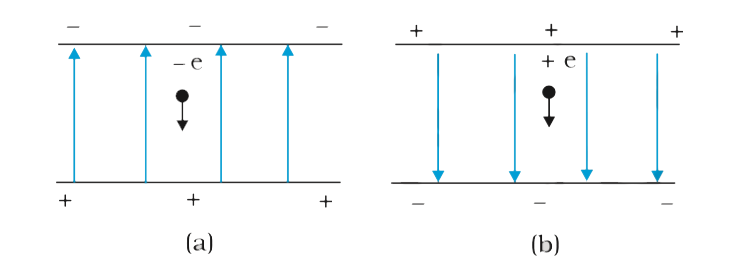
An electron falls through a distance of 1.5 cm in a uniform electric field of magnitude `2.0 xx 104 N C^(1)` [Fig. 1.13(a)]. The direction of the field is reversed keeping its magnitude unchanged and a proton falls through the same distance [Fig. 1.13(b)]. Compute the time of fall in each case. Contrast the situation with that of ‘free fall under gravity’.

Text Solution

Verified by Experts

`t_(e)=sqrt((2s)/(a_(e)))=sqrt((2sm_(e))/(eE))`
`=sqrt((2xx1.5xx10^(-2)xx9.1xx10^(-31))/(1.6xx10^(-19)xx2xx10^(4)))=2.9xx10^(-9)` s
`t_(p)=sqrt((2s)/(a_(p)))=sqrt((2sm_(p))/(eE))`
`=sqrt((2xx1.5xx10^(-2)xx1.67xx10^(-27))/(1.6xx10^(-19)xx2xx10^(4)))=1.3xx10^(-7)` s
Promotional Banner

Similar Questions

Explore conceptually related problems

An electron falls through a distance of 1.5 cm in a uniform electric field of magnitude 2.4xx10^(4) NC^(-1) [Fig.1.12 (a)] . The direction of the field is reversed keeping its magnitude unchagned and a proton falls through the same distance [Fig. 1.12 (b) ]. Complute the time of fall in each case. Contrast the situation (a) with that of free fall under gravity.

An electron falls through a small distance in a uniform electric field of magnitude 2xx10^(4)NC^(-1) . The direction of the field reversed keeping the magnitude unchanged and a proton falls through the same distance. The time of fall will be

An electron falls through a small distance in a uniform electric field of magnitude 2xx10^(4)NC^(-1) . The direction of the field reversed keeping the magnitude unchanged and a proton falls through the same distance. The time of fall will be

An electron (mass m_(e ) )falls through a distance d in a uniform electric field of magnitude E. , The direction of the field is reversed keeping its magnitudes unchanged, and a proton(mass m_(p) ) falls through the same distance. If the times taken by the electrons and the protons to fall the distance d is t_("electron") and t_("proton") respectively, then the ratio t_("electron")//t_("proton") .

An electron initially at rest falls a distance of 1.5 cm in a uniform electric field of magnitude 2 xx10^(4) N//C . The time taken by the electron to fall this distance is

An electron initially at rest falls a distance of 1.5 cm in a uniform electric field of magnitude 2 xx10^(4) N//C . The time taken by the electron to fall this distance is

An electron falls through a distance of 1.5 cm in a uniform electric field of magnitude 2.0xx10^(4)N//C(Fig.a) Calculate the time it takes to fall through this distance starting from rest. If the direction of the field is reversed (fig .b) keeping its magnitude unchanged , calculate the time taken by a proton to fall through this distance starting from rest.

An electron falls from rest through a vertical distance h in a uniform and vertically upward directed electric field E. the direction of electric field is now reversed, keeping its magnitude the same. A proton is allowed to fall from rest in it through the same vertical distance h.The time of fall of the electron, in comparison to the time of flal of the proton is

An electron entering field normally with a velocity 4 xx 10^7 ms^(-1) travels a distance of 0.10 m in an electric field of intensity 3200 Vm^(-1) . What is the deviation from its path?

A vertical electric field of magnitude 4.00xx 10^5 NC^(-1) . just prevents a water droplet of mass 1.000xx10^(-4) kg from. falling., find the charge on the droplet.
