Home
Class 12
PHYSICS
A glass prism of refractive index 1.5 is...

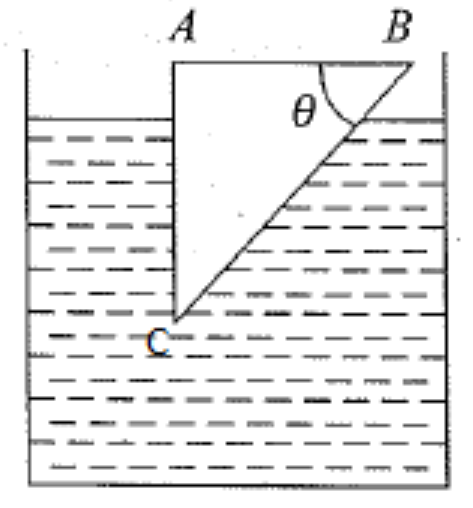
A glass prism of refractive index 1.5 is immersed in water of refractive index 4/3. A light ray incident normally on face AB is totally reflected at face AC if

A

`sinthetagt8//9`

B

`sinthetalt2//3`

C

`sintheta=sqrt3//2`

D

`2//3ltsinthetale8//9`

Text Solution

Verified by Experts

The correct Answer is:

A
Promotional Banner

Topper's Solved these Questions

  • RAY OPTICS AND OPTICAL INSTRUMENTS

    AAKASH INSTITUTE ENGLISH|Exercise ASSIGNMENT (SECTION - B)|35 Videos
  • RAY OPTICS AND OPTICAL INSTRUMENTS

    AAKASH INSTITUTE ENGLISH|Exercise ASSIGNMENT (SECTION - C)|80 Videos
  • RAY OPTICS AND OPTICAL INSTRUMENTS

    AAKASH INSTITUTE ENGLISH|Exercise EXERCISE|45 Videos
  • PHYSICAL WORLD

    AAKASH INSTITUTE ENGLISH|Exercise ASSIGNMENT (Section-B)|4 Videos
  • SEMICONDUCTOR ELECTRONICS (MATERIAL, DEVICES AND SIMPLE CIRUITS )

    AAKASH INSTITUTE ENGLISH|Exercise Assignment SECTION - D (Assertion & reason type Question)|10 Videos

Similar Questions

Explore conceptually related problems

A glass prism of refractive index 1.5 is immersed in water (refractive index 4//3 ) . A light beam normally on the face AB is totally reflected to reach on the face BC if

A glass prism is immeresed in water as shown in the figure. When a beam of light incident is incident normally on the face ab, it is internally reflected at the face ad. If the refractive index of glass is 1.5 and that of water is 4//3 , then

(a) Show using a proper diagram how unpolarised light can be linearly polarised by reflection from a transparent glass surface. (b) The figure shows a ray of light falling normally on. the face AB of an equilateral glass prism having refractive index 3/2, placed A in water ofrefractive index 4/3. Will this ray suffer total internal reflection on striking the face AC? Justify your answer.

A cubical block of glass of refractive index n_1 is in contact with the surface of water of refractive index n_2. A beam of light is incident on vertical face of the block. After refraction a total internal reflection at the base and refraction at the opposite face take place. The ray emerges at angle theta as shown. The value of theta is given by

A transparent cube of side d, made of a material of refractive index mu_(2) , is immersed in a liquid of refractive index mu_(1)(mu_(1)ltmu_(2)) . . A ray is incident on the face AV at an angle theta (shown in the figure). Total internal refraction takes place at point E on the face BC. Then must satisfy:

A transparent cube of side d, made of a material of refractive index mu_(2) , is immersed in a liquid of refractive index mu_(1)(mu_(1)ltmu_(2)) . . A ray is incident on the face AV at an angle theta (shown in the figure). Total internal refraction takes place at point E on the face BC. Then must satisfy:

A trianglular prims of glass is shown in the figure. A ray incident normally to one face is totally reflected. If theta=45^(@) the refractive index of glass is

A prism of glass (mu=1.5) is dipped in to water as shown in the figure. If the refractive index of water is 4/3, then the incident ray will be totally reflected if

A glass prism has a refractive angle of 90^(@) and a refractive index of 1.5. A ray is incident at an angle of 30^(@) . The ray emerges from an adjacent face at an angle of

A narrow beam of monochromatic light, PQ, is incident normally on one face of an equiangular glass prism of refractive index 1.45 . When the prism is immersed in a certain liquid, the ray makes a grazing emergence along the other face (figure). Find the refractive index of this liquid .

AAKASH INSTITUTE ENGLISH-RAY OPTICS AND OPTICAL INSTRUMENTS-ASSIGNMENT (SECTION - A)
  1. Two thin lenses of focal lengths 20 cm and -20 cm are placed in contac...

    Text Solution

    |

  2. If in a planoconvex lens, the radius of curvature of the convex surfac...

    Text Solution

    |

  3. A glass concave lens is placed in a liquid in which it behaves like a ...

    Text Solution

    |

  4. Diameter of plano-convex lens is 6 cm and thickness at the centre is 3...

    Text Solution

    |

  5. Two plano-convex lenses of equal focal lengths are arranged as shown ...

    Text Solution

    |

  6. When the object is at distance u1 and u2 from the optical centre of a ...

    Text Solution

    |

  7. A convex mirror of focal length f produced an image (1//n)^(th) of the...

    Text Solution

    |

  8. A thin convergent glass lens (mug=1.5) has a power of +5.0D. When this...

    Text Solution

    |

  9. In case of displacement method of lenses, the product of magnification...

    Text Solution

    |

  10. The focal length of a planoconvex glass lens is 20 cm (mu(g)=1.5). The...

    Text Solution

    |

  11. Two thin similar convex glass pieces are joined together front to fron...

    Text Solution

    |

  12. What is the cause of dispersion of white light through a glass prism ...

    Text Solution

    |

  13. The angle at which a ray of light be incident on one face of an equila...

    Text Solution

    |

  14. A prism of refractive index sqrt2 has refractive angle 60^@. In the or...

    Text Solution

    |

  15. A glass prism of refractive index 1.5 is immersed in water of refracti...

    Text Solution

    |

  16. A person can see clearly only upto a distance of 25 cm. He wants to re...

    Text Solution

    |

  17. An astronomical telescope has an objective of focal length 100 cm and ...

    Text Solution

    |

  18. When a telescope is adjusted for parallel light, the distance of the o...

    Text Solution

    |

  19. The focal lengths of the objective and eye lenses of a telescope are r...

    Text Solution

    |

  20. A convex lens of focal length 100 cm and a concave lens of focal lengt...

    Text Solution

    |
