Home
Class 12
PHYSICS
The pressure and volume of a gas are cha...

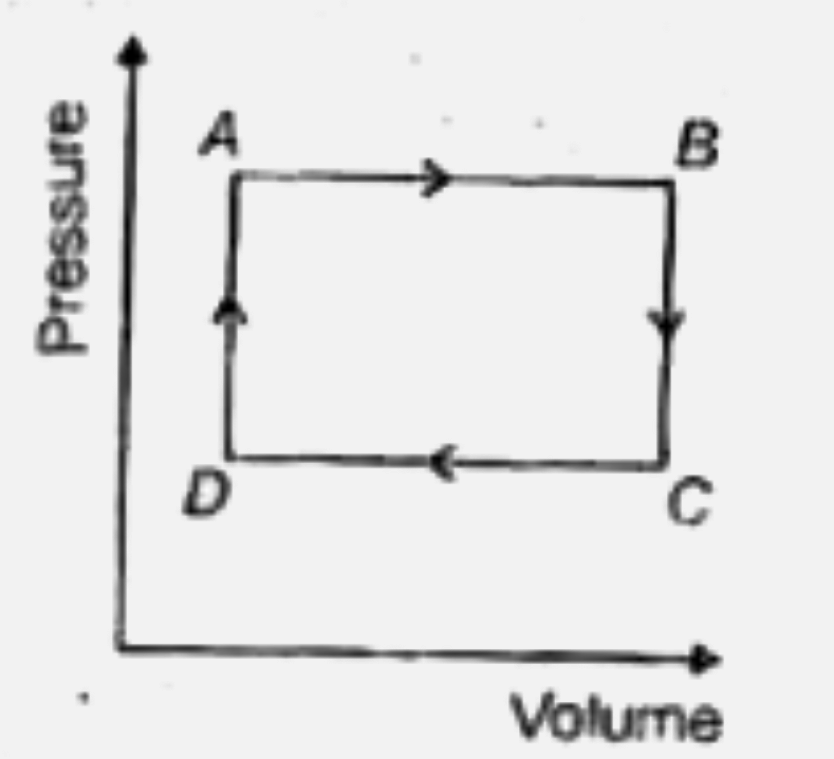
The pressure and volume of a gas are changed as shown in the p-V diagram in the figrue ahead. The thmperature of the gas

A

increases as if goes from A to B

B

Increases as it goes from B to C

C

Remains constant during these changes

D

Decreases as it goes from D to A

Text Solution

Verified by Experts

Once again plot the rectangular cycle aginst the beckground of various dotted isothermal lines.

Note here `T_8 gt T_7 gt T_6 gt T_5 gt … gt T_1`. So, in the process D to A the temperature increases. In A to B it further increases. In B to C it decreases and in C to D it decreases. So, the correct respone is (1).
Promotional Banner

Similar Questions

Explore conceptually related problems

The pressure P and volume V of an ideal gas both decreases in a process.

One mole of an ideal monotomic gas undergoes a linear process from A to B in which its pressure p and its volume V change as shown in figure. The maximum temperature of the gas during this process is

The pressure p and volume V of an ideal gas both increase in a process.

The work done by the gas in the process shown in given P-V diagram is

The pressure and volume of an ideal gas are related as p alpha 1/v^2 for process A rarrB as shown in figure . The pressure and volume at A are 3p_0 and v_0 respectively and pressure B is p_0 the work done in the process ArarrB is found to be [x-sqrt(3)]p_0v_0 find

A diatomic ideal gas undergoes a thermodynamic change according to the P-V diagram shown in the figure. The total heat given to the gas is nearly ( use ln2=0.7):

A diatomic ideal gas undergoes a thermodynamic change according to the P-V diagram shown in the figure. The total heat given to the gas is nearly ( use ln2=0.7):

An ideal gas in a thermally insulated vessel at internal pressure =P_(1) , volume =V_(1) and absolute temperature =T_(1) expands irreversibly against zero external pressure, as shown in the diagram. The final internal pressure, volume and absolute temperature of the gas are P_(2), V_(2) and T_(2) respectively. For this expansion.

An ideal gas in a thermally insulated vessel at internal pressure =P_(1) , volume =V_(1) and absolute temperature =T_(1) expands irreversibly against zero external pressure, as shown in the diagram. The final internal pressure, volume and absolute temperature of the gas are P_(2), V_(2) and T_(2) respectively. For this expansion.

An ideal gas in a thermally insulated vessel at internal pressure = P_(1) , volume = V_(1) and absolute temperature = T_(1) expands irreversibly against zero external pressure, as shown in the diagram. The final internal pressure, volume and absolute temperature of the gas are P_(2), V_(2) and T_(2) , respectively. For this expansion.

