Home
Class 12
PHYSICS
In the following plots match I,II, III,I...

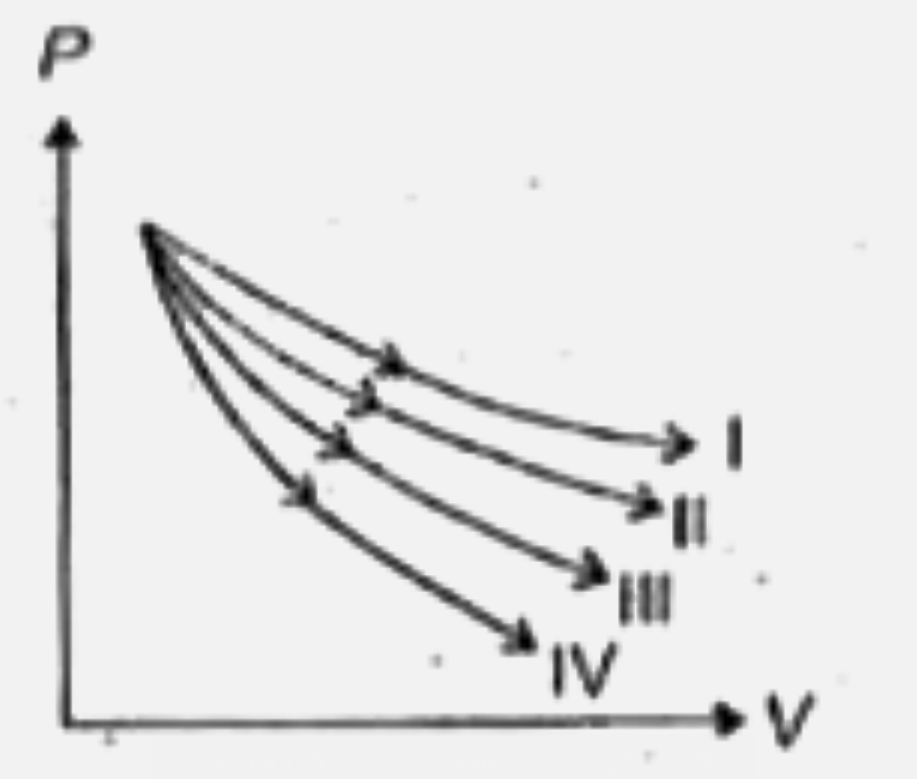
In the following plots match I,II, III,Iv with (a) isothermal process and Adiabatic process for (b) monatomic, (c ) diatomic and (d) triatomic gases respectively.

Text Solution

Verified by Experts

For isothermal process pV = const. `( :.n = 1)` (Note all the above graphs are basically pV^n = const. piotted)
For Adiabati process pV. = const. Now,
For monotomic gas `gamma = 5/3 = 1.66 ( :.n = 1.66)`
For diatomic gas `gamma = 7/5 = 1.4 ( :.n = 1.4)`
and for triatomic gas `gamma = 8 /6 = 1.33 ( :. n = 1.33)`
In expansion p-V graph we know that as the value of .n. increases the plot keeps coming down.
So, we can represent the graphs as follows :
Hence the final answer is that
Plot I. is isothermal process
Plot II is Triatomic adiabatic
Plot III is diatomic adiabatic &
Plot IV is monoatomic adiabatic.
Promotional Banner

Similar Questions

Explore conceptually related problems

What is γ ? Obtain the value of γ for (i) monatomic (ii) diatomic and (iii) triatomic gas.

P.V plots for two gases during adiabatic processes are shown in the figure Plots 1 and 2 should correspond respectively to

Write down the relation for an adiabatic process in terms of (i) P and V (ii) T and V and (iii) P and T.

The internal energy of a system remains constant when it undergoes (i) a cyclic process (ii) an isothermal process (iii) an adiabatic process (iv) any process in which the heat given out by the system equal to the work done on the system

p-V plots for two gases during adiabatic processes are shown in the figure. Plots 1 and 2 should correspond respectively to

P-V plots for two gases during adiabatic processes are shown in the figure. Plots 1 and 2 should corresponds respectively to

P-V plots for two gases during adiabatic processes are shown in Fig. 15.9.6. Plot 1 and 2 should correspond respectively to

Consider the following cyclic process. I. Isothermal , II. Adiabatic , (III) constant pressure process Sum of the work and heat in the above is:

The carnot cycle of a reversible heat engine consist of A. one isothermal and two adiabatic processes B. Two isobaric and one adiabatic processes C. Two isothermal and two adiabatic processes D. Two isobraic and two isothermal processes

The curves A and B in the figure shown P-V graphs for an isothermal and an adiabatic process for an idea gas. The isothermal process is represented by the curve A.

