Home
Class 12
PHYSICS
A thermodynamical process is shown in th...

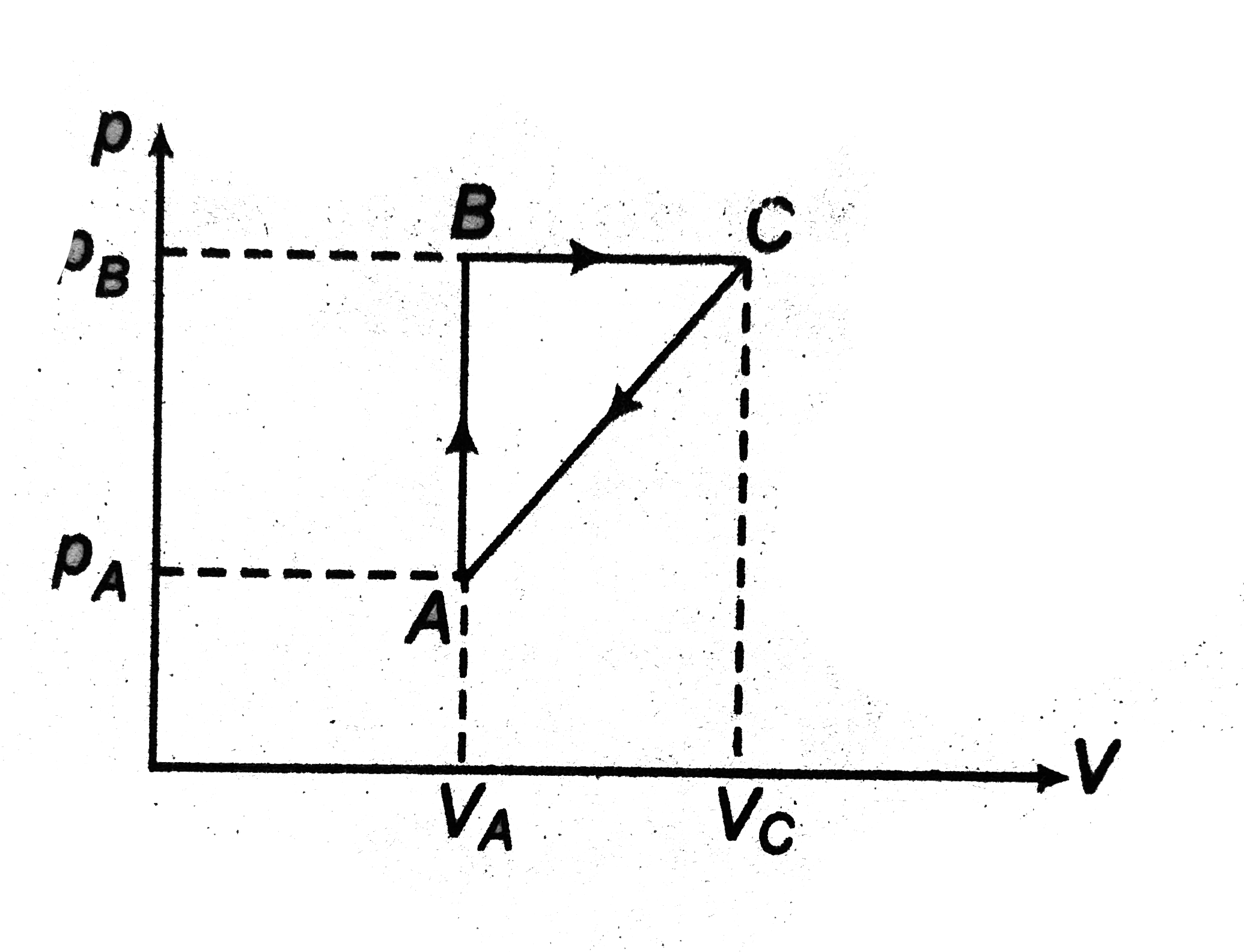
A thermodynamical process is shown in the figure with `p_A=3xxp_(atm)`, `V_A=2xx10^-4m^3`, `p_B=8xxp_(atm)`, `V_C=5xx10^-4m^3`. In the process AB and BC, 600J and 200J heat are added to the system. Find the change in internal energy of the system in the process CA. `[1 p_(atm)=10^5N//m^2]`

A

560 J

B

800 J

C

600 J

D

640 J

Text Solution

Verified by Experts

Since internal energy is a state function so the change in internal energy during the process AC will be same as that during the total process AB plue BC. Calculate the total wark `DeltaW` during AB plus BC and total heat `Delta`Q during these processes. Then calculate `DeltaU = DeltaQ -DeltaW`
During the processes AB the volume doesn.t change so work done is zero.
During BC the pressure is constant, so total work done
`P_B(V_C -V_B) =P_B (V_C -V_A) :.V_B=V_A`
`=B xx 10^(4) [N//m^2](5 xx 10^(-3)m^3 - 2 xx 10^(-3)m^3) = 240J`
`:. DeltaW` during process AB plus BC = 240 J
Now given `DeltaQ` during the same total process `= 600 + 200 = 800J`.
`:. DeltaU = DeltaQ - DeltaQ = 800 - 240 = 560 J`
Promotional Banner

Similar Questions

Explore conceptually related problems

A thermodynamic process is shown in the following figure. The process and volumes corresponding to some points in the figure are: P_(A) =3 xx 10^(3)Pa , V_(A) =2 xx 10^(-3) m^(-3) , P_(B) = 3 xx 10^(4) Pa, V_(D) = 2 xx 10^(-3) m^(3) In process AB, 600J of heat is added to the system and in the process BC, 200J of heat is added to the system. the change in internla energy of the system in the process AC would be

A thermodynamic process is shown in Fig. The pressures and volumes corresponding to some points in the figure are : P_(A) = 3 xx 10^(4) Pa, P_(B) = 8 xx 10^(4) Pa and V_(A) = 2 xx 10^(-3) m^(3) , V_(D) = 5 xx 10^(-3) m . In process AB, 600 J of heat is added to the system and in process BC, 200 J of heat is added to the system. The change in internal energy of the energy of the process AC would be.

The P - V diagram of a system undergoing thermodynamic transformation is shown in figure. The work done by the system in going from A rarr B rarr C is 30 J and 40 J heat is given to the system. The change in internal energy between A and C is

A gas expands against a constant pressure of 1 atm from a volume of 5L to 10L. During the process, system absorbs 400 J of heat from the surroundings. Calculate the change in the internal energy of the system.

500cm^(3) of a sample of an ideal gas is compressed by an average pressure of 0.1 atm of 250 cm^(3) . During this process, 10J of heat flows out to the surroundings. Calculate the change in internal enegry of the system.

500cm^(3) of a sample of an ideal gas is compressed by an average pressure of 0.1 atm of 250 cm^(3) . During this process, 10J of heat flows out to the surroundings. Calculate the change in internal enegry of the system.

One mole of an ideal gas undergoes change of state from (4 L, 3 atm) to (6 L, 5 atm). If the change in internal energy is 45 L-atm then the change of enthalpy for the process is

Three processes compose a thermodynamic cycle shown in the accompanying P-V , diagram of an ideal gas. Process 1 rarr 2 take place at constant temperature, during this process 60 J of heat enters the system. Process 2 rarr 3 takes place at constant volume. During this process 40 J of heat leaves the system. Process 3 rarr 1 is adiabatic. What is the change in internal energy of the during process 3 rarr 1 ?

An ideal monoatomic gas initially in state 1 with pressure P_(1)=20 atm and volume V_(1)1500cm^(3) it is then taken to state 2 with pressure P_(2)=1.5P_(1) and volume V_(2)=2V_(1) find the change in internal energy in this process in KJ. (take 1atm lit =100J )

One mole of an ideal gas undergoes a cyclic process ABCDA as shown in the P-V diagram, The net work done in the process is (1 atm=10^(6) dyne cm^(-2))

